imecadine.ge

Full ticket list

738 official tickets — category A, A1, with the correct answer and law explanation.

Ticket #468 — situation image

Is the driver prohibited from making a U-turn with the car in the direction of the arrow?

1 is not prohibited
2 is prohibited
Law explanation
According to Article 42(a) of the Law of Georgia "On Road Traffic", the following rule applies in tunnels marked with a road sign: the driver is prohibited from reversing or turning around.

Road sign used in this ticket

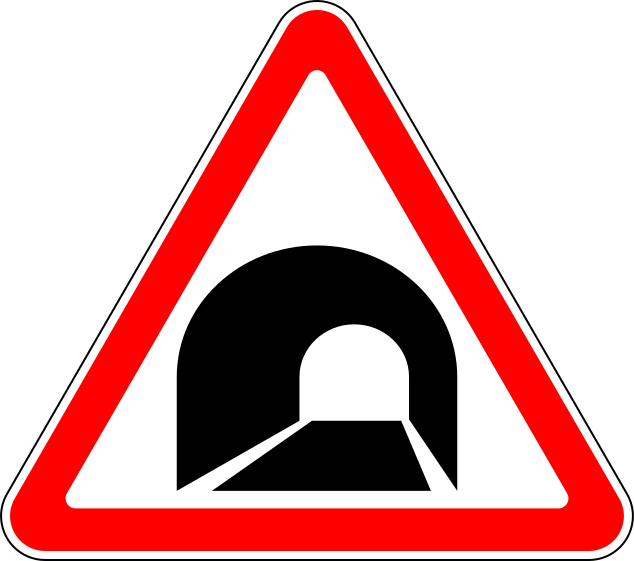
1.32. Tunnel

A tunnel without artificial lighting, or one whose entrance portal visibility is less than 150 m due to the terrain. Outside built-up areas the sign is placed 150−300 m before the start of the hazardous section, in built-up areas – 50–100 m before it.

Ticket #469 — situation image

Does the driver have the right to make a U-turn with the car in the direction of the arrow, if the tunnel is marked with road sign 1.32 ("Tunnel")?

1 is allowed if the tunnel is in a built-up area
2 does not have the right
3 has the right if the tunnel is outside a built-up area
Law explanation
According to Article 42(a) of the Law of Georgia "On Road Traffic", the following rule applies in tunnels marked with a road sign: the driver is prohibited from reversing or turning around.
Ticket #473 — situation image

In the given situation, does the driver violate the requirements established for a forced stop, if immediate removal of the broken-down car from the road is impossible?

1 Violates
2 Does not violate
Law explanation
According to Article 42(e) of the Law of Georgia "On Road Traffic", in tunnels marked with a road sign the following rule applies: in the event of a forced stop, the driver must ensure compliance with the requirements established by this Law in connection with forced stops in places where stopping is prohibited. According to Article 52(1)(b), paragraph 2(b) and paragraph 3 of the same Law: – hazard warning lights must be switched on when forced to stop in a place where stopping is prohibited; – after switching on the hazard warning lights, and also if such lights are not fitted or are out of order, the driver must immediately place a "warning triangle", and in conditions of insufficient visibility a flashing red lamp, when forced to stop in a place where stopping is prohibited; – the "warning triangle" and the flashing red lamp must be placed at a distance from the vehicle that, in the specific conditions, ensures timely warning of other drivers of the danger, but this distance must not be less than 15 metres in a built-up area and less than 30 metres outside a built-up area.
Ticket #477 — situation image

Towards the driver of which tram does the driver of the passenger car have an obligation to give way when moving in the direction of the arrow?

1 to the drivers of both trams
2 to none of the tram drivers
3 only to the driver of the first tram
4 only to the driver of the second tram
Law explanation
According to subparagraph “e” of paragraph 3 of Article 36 of the Law of Georgia “On Road Traffic”, at a controlled junction, a driver who has entered the junction on a permissive traffic light signal may proceed in the intended direction regardless of the prohibitive signals of the traffic light at the exit from the junction, provided that this does not obstruct other road users moving in the direction in which traffic has been opened. If, while he is moving through the junction, there are “stop” lines (and/or road signs 7.16) in front of the traffic lights on the road, the driver must follow the signal of each traffic light.
Ticket #482 — situation image

Does the driver of the passenger car have the right to continue moving in the direction of the arrow, if passengers are not boarding or alighting from the tram at the marked stop?

1 Has the right
2 does not have the right
Law explanation
According to Article 25(4) of the Law of Georgia "On Road Traffic", a driver who intends to pass a route vehicle standing at a properly marked stop on the side corresponding to the direction of travel must reduce speed and, if necessary, stop in order to allow passengers to get on or off public transport safely.

Road sign used in this ticket

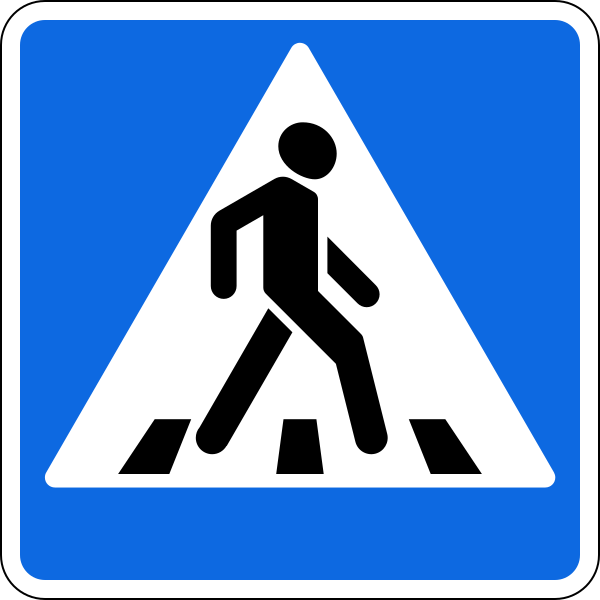
5.19.1. Pedestrian crossing

A place on the road designated as a pedestrian crossing. The sign is installed on the right side of the road. If marking 1.14 is absent at the crossing, the sign is installed at the near boundary of the crossing.

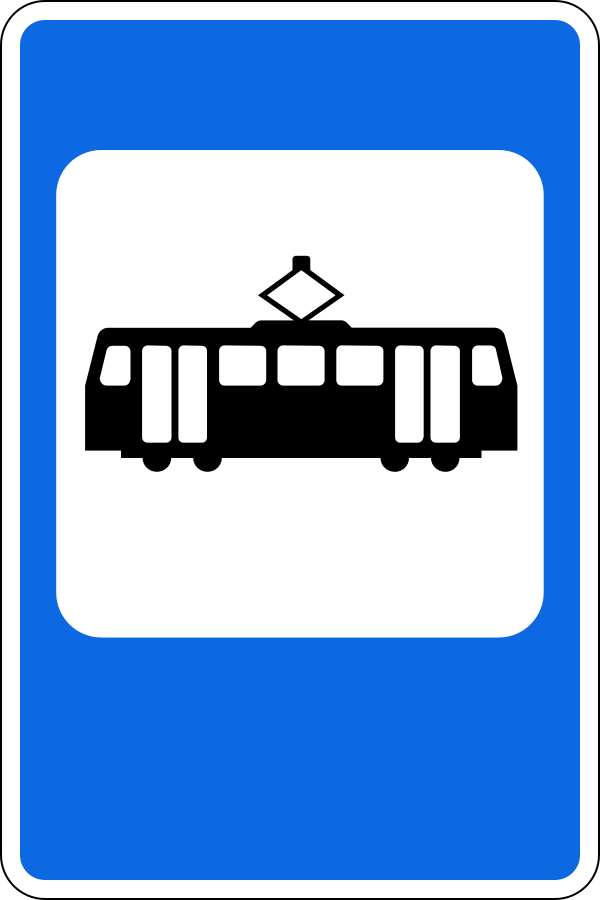
5.17. Tram stop

Indicates a tram stop and a taxi rank.

Ticket #483 — situation image

In the given situation, does the driver of the passenger car have the right to continue moving without stopping?

1 does not have the right
2 Has the right
Law explanation
According to Article 25(4) of the Law of Georgia "On Road Traffic", a driver who intends to pass a route vehicle standing at a properly marked stop on the side corresponding to the direction of travel must reduce speed and, if necessary, stop in order to allow passengers to get on or off public transport safely.

Road sign used in this ticket

5.19.2. Pedestrian crossing

A place on the road designated as a pedestrian crossing. The sign is installed on the left side of the road. If marking 1.14 is absent at the crossing, the sign is installed at the far boundary of the crossing.

5.19.1. Pedestrian crossing

A place on the road designated as a pedestrian crossing. The sign is installed on the right side of the road. If marking 1.14 is absent at the crossing, the sign is installed at the near boundary of the crossing.

5.17. Tram stop

Indicates a tram stop and a taxi rank.

Ticket #485 — situation image

The driver of the passenger car intends to turn right at the intersection; he will not violate the traffic rules if:

1 will let the bus pass and turn right from the second lane
2 will overtake the bus and turn right from the second lane
3 let the bus pass, move into the right lane and turn right from there
4 will overtake the bus, move into the right lane and turn right from there
Law explanation
According to subparagraph “a” of paragraph 7 of Article 32 of the Law of Georgia “On Road Traffic”, before turning right or left to exit onto another road or to enter an area adjacent to the road, without violating the requirements established by paragraph 2 of Article 20 of this Law and paragraphs 1 and 2 of this Article, if the driver of the vehicle intends to leave the road on the right side, the vehicle must move as close as possible to the right edge of the carriageway and then perform as short a manoeuvre as possible; according to paragraph 1.23 of Chapter 1 (Horizontal markings) of Annex 2 to the same Law, road marking 1.23 indicates a special lane intended for the movement of route vehicles. According to paragraph 3 of Article 41 of the same Law, on a road where there is a lane for route vehicles marked with road signs 5.11, 5.13.1, 5.13.2 and 5.14, the movement and stopping of other vehicles in this lane is prohibited. If this lane is separated from the rest of the carriageway by a broken marking line, other vehicles must move into this lane when turning. It is also permitted to enter this lane at such places when entering the road and when picking up or setting down passengers at the right edge of the carriageway, provided this does not obstruct the movement of route vehicles.
Ticket #486 — situation image

The driver of the passenger car has the right to move:

1 only in directions B and C
2 Only in direction A
3 only in directions A and B
4 Only in directions A and C
Law explanation
According to paragraph 5.13.2 of Chapter 5 (Special regulation signs) of Annex 1 to the Law of Georgia "On Road Traffic", 5.13.2 "Entering a road with a lane for route vehicles" indicates entry onto a road marked with sign 5.11 and is installed before every side entrance. The sign may not be installed at intersections of exits from adjacent areas with the road if entry to these areas is possible only from the road marked with sign 5.11. According to Article 32(7)(b) of the same Law, before turning right or left to enter another road or to enter an area adjacent to the road, without violating the requirements established by Article 20(2) of this Law and paragraphs 1 and 2 of this Article, if the driver of the vehicle intends to leave the road on the left-hand side, the vehicle must, as far as possible, approach the centre line of the carriageway (on a two-way road) or the left edge of the carriageway (on a one-way road), and if he intends to enter another two-way road, he must perform the turn in such a way that, when leaving the intersection of carriageways, the vehicle does not end up on the side for oncoming traffic.

Road sign used in this ticket
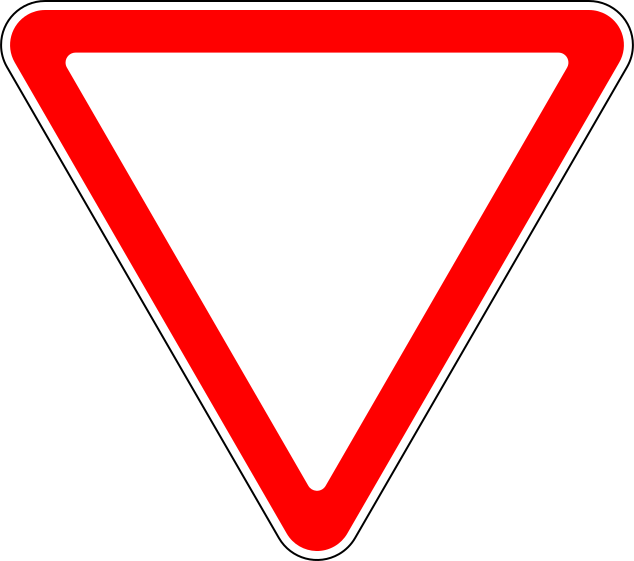
2.3. Give way

The driver on this road must give way to drivers moving on the road being crossed, and where plate 8.13 is present – to drivers on the main road. Outside built-up areas, sign 2.3 is placed in advance, 150−300 m before the intersection, with plate 8.1.1 if sign 2.3 is installed before the intersection, or with plate 8.1.2 if sign 2.4 is installed before the intersection. The sign applies to the intersection of carriageways before which the corresponding sign is installed.
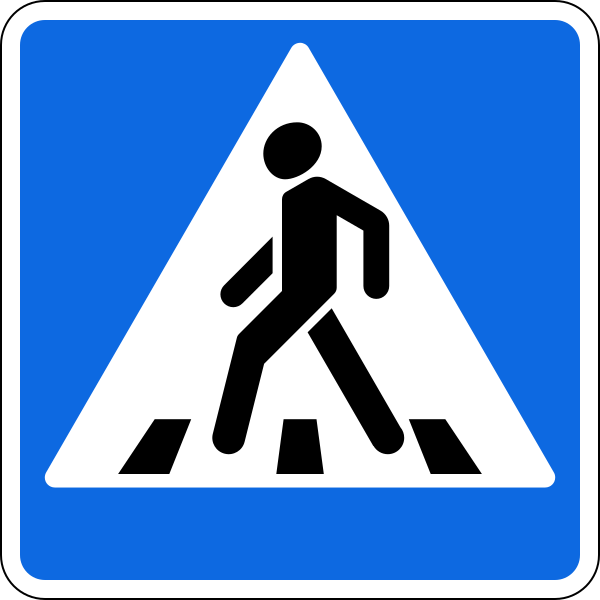
5.19.1. Pedestrian crossing

A place on the road designated as a pedestrian crossing. The sign is installed on the right side of the road. If marking 1.14 is absent at the crossing, the sign is installed at the near boundary of the crossing.
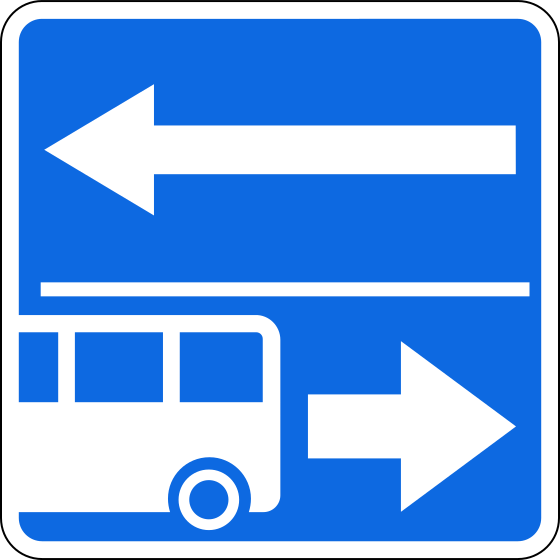
5.13.2. Entry to a road with a lane for route vehicles

Indicates entry to a road marked with sign 5.11. The sign is installed before every side entrance. The signs may be omitted at the junction of a road with an exit from an adjacent area if entry into that area is possible only from the road marked with sign 5.11.

Ticket #487 — situation image

Is the driver of the passenger car entitled to stop in a built-up area at the place indicated in the picture to let passengers board?

1 does not have the right
2 Has the right
Law explanation
According to paragraph 5.11 of Chapter 5 (Special regulation signs) of Annex 1 to the Law of Georgia “On Road Traffic”, 5.11 “Road with a lane for route vehicles” designates a road on which route vehicles move in a specially designated lane in the direction opposite to the general flow of vehicles. According to paragraph 3 of Article 41 of the same Law, on a road with a lane for route vehicles marked with road signs 5.11, 5.13.1, 5.13.2 and 5.14, movement and stopping of other vehicles in this lane is prohibited. If this lane is separated from the rest of the carriageway by a broken marking line, other vehicles must move into this lane when turning. It is also permitted to enter this lane at such places when entering the road and when picking up or setting down passengers at the right edge of the carriageway, if this does not obstruct the movement of route vehicles.

Road sign used in this ticket

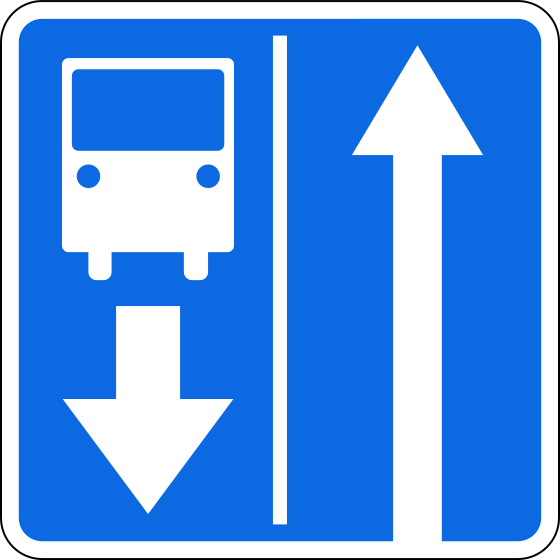
5.11. Road with a lane for route vehicles

A road on which route (public transport) vehicles travel in a specially designated lane in the direction opposite to the general flow of traffic. The sign applies to the traffic lane over which it is installed.

Ticket #488 — situation image

The driver of the passenger car has the right to move:

1 Only straight ahead and to the left
2 only straight ahead and to the right
3 Only straight ahead, to the left and in the reverse direction (U-turn)
4 only to the left and in the reverse direction (U-turn)
Law explanation
According to paragraph 5.13.2 of Chapter 5 (Special regulation signs) of Annex 1 to the Law of Georgia "On Road Traffic", 5.13.2 "Exit onto a road with a lane for route vehicles" indicates an exit onto a road marked with sign 5.11 and is installed before every side entrance. The sign may not be installed at the intersections of exits from adjacent areas with the road if entry into those areas is possible only from the road marked with sign 5.11. According to Article 41(3) of the same Law, on a road where there is a lane for route vehicles marked with road signs 5.11, 5.13.1, 5.13.2 and 5.14, the movement and stopping of other vehicles in this lane is prohibited. If this lane is separated from the rest of the carriageway by a broken marking line, other vehicles must move into this lane when turning. It is also permitted to enter this lane at such places when exiting onto the road and when picking up or setting down passengers at the right-hand edge of the carriageway, provided this does not obstruct the movement of route vehicles.

Road sign used in this ticket

2.3. Give way

The driver on this road must give way to drivers moving on the road being crossed, and where plate 8.13 is present – to drivers on the main road. Outside built-up areas, sign 2.3 is placed in advance, 150−300 m before the intersection, with plate 8.1.1 if sign 2.3 is installed before the intersection, or with plate 8.1.2 if sign 2.4 is installed before the intersection. The sign applies to the intersection of carriageways before which the corresponding sign is installed.

5.13.2. Entry to a road with a lane for route vehicles

Indicates entry to a road marked with sign 5.11. The sign is installed before every side entrance. The signs may be omitted at the junction of a road with an exit from an adjacent area if entry into that area is possible only from the road marked with sign 5.11.
Ticket #489 — situation image

The driver of which stationary car has priority when starting to move in the direction of the arrow, if the driver of a route bus in a built-up area is starting to move from a marked stop?

1 the passenger car driver
2 the driver of the bus
Law explanation
According to Article 41(1) of the Law of Georgia "On Road Traffic", subject to the requirements established by Article 33(4) of this Law, in a built-up area, in order to facilitate the movement of a route vehicle, drivers of other vehicles must slow down and, if necessary, stop so that the route vehicle can perform the manoeuvre needed to pull away from the stop. The driver of a route vehicle, after signalling the intention to move off with the direction indicator, must take the precautions necessary to avoid a road traffic accident and start moving only after making sure that other vehicles are giving way.

Road sign used in this ticket

5.17. Tram stop

Indicates a tram stop and a taxi rank.

In a built-up area, after a signal given by the direction indicator about resuming movement in order to pull away from a marked stop, drivers of route vehicles are obliged to:

1 use their priority and immediately start moving regardless of the situation on the road
2 take the precautions necessary to avoid a road traffic accident and start moving only after making sure that other vehicles are giving way
Law explanation
According to Article 41(1) of the Law of Georgia "On Road Traffic", subject to the requirements established by Article 33(4) of this Law, in a built-up area, in order to facilitate the movement of a route vehicle, drivers of other vehicles must slow down and, if necessary, stop so that the route vehicle can perform the manoeuvre needed to pull away from the stop. The driver of a route vehicle, after signalling the intention to move off with the direction indicator, must take the precautions necessary to avoid a road traffic accident and start moving only after making sure that other vehicles are giving way.
Ticket #492 — situation image

The driver of which car has priority when moving in the direction of the arrows?

1 the driver of the black car
2 the driver of the white car
Law explanation
According to paragraph 1.15 of Chapter 1 (Warning signs) of Annex 1 to the Law of Georgia "On Road Traffic", road sign 1.15 "Steep ascent" warns of an approaching section of road with a steep ascent. According to Article 35(2) of the same Law, on a mountain road and on a road with a steep gradient with similar characteristics, as well as on roads marked with road signs 1.14 and 1.15, where passing oncoming vehicles is impossible or difficult, the driver of a vehicle travelling downhill must stop and give way to the driver of a vehicle travelling uphill, except where a passing place is located along the carriageway in such a way that the driver of the vehicle travelling uphill, taking into account the speed and condition of the vehicle, could stop at the passing place ahead of him/her, thereby eliminating the need for one of the vehicles to reverse.

Does the driver have the right, in case of danger, to stop or park the vehicle in a tunnel marked with a road sign in which there are no places specially marked for stopping?

1 does not have the right
2 Has the right
Law explanation
According to Article 42(c) of the Law of Georgia "On Road Traffic", the following rules apply in tunnels marked with a road sign: the driver may stop or park the vehicle only in an emergency or in case of danger. In doing so, the driver must use a specially marked place, if possible.

In a tunnel designated by a road sign, in the event of a prolonged stop of a power-driven vehicle, is it permissible to stand with the engine running?

1 is not permitted
2 Is permitted
Law explanation
According to Article 42(d) of the Law of Georgia "On Road Traffic", the following rules apply in tunnels marked with a road sign: in the case of a prolonged stop, the driver must switch off the engine.
Ticket #497 — situation image

Which of the given identification signs is the "warning triangle"?

1 I
2 II
3 III
Law explanation
According to paragraph 5 of Article 52 of the Law of Georgia “On Road Traffic”, the “warning triangle” is an equilateral triangular plate with sides no less than 0.4 metres long and a red border no less than 0.05 metres wide. The central part of this triangle may be hollow or painted in a light colour. The red border must not transmit light or must have a strip with retro-reflective properties. The plate must be constructed so that it can be set up stably in a vertical position.

In order to assess the condition of a person injured in a road traffic accident, first of all it is necessary to:

1 only opening the airway and monitoring breathing
2 Only checking the pulse at the carotid artery
3 both opening the airways and checking breathing, and checking the carotid pulse and consciousness
4 Only checking consciousness
Law explanation
It is important to assess the condition of the injured person quickly and correctly. The first stage is checking consciousness (whether the injured person is conscious). The second stage is opening the airway; the third stage is checking breathing. The fourth stage is checking the pulse on the carotid artery.

Stopping of vehicles is prohibited from the structurally separated stopping places of route vehicles or taxis, and in their absence from the route vehicle or taxi stop sign, if this obstructs the movement of route vehicles:

1 closer than 25 metres
2 closer than 15 metres
3 closer than 30 metres
Law explanation
According to Article 37(6)(b.g) of the Law of Georgia "On Road Traffic", stopping of vehicles is prohibited in any place where it may create danger, including closer than 15 metres to the structurally separated stopping places of route vehicles or taxis, and in their absence, to the stop sign of route vehicles or taxis, if this obstructs the movement of these vehicles.

If a person injured in a road traffic accident has a second-degree skin burn (damage to the skin tissue and reddish colouring, formation of fluid-filled blisters at the burn site, severe pain), in order to provide first aid they must:

1 Do not open the blisters, do not remove the remnants of clothing from the burnt surface, apply a sterile dressing to the wound, do not bandage it, apply ice or a cold compress, give a painkiller (if the injured person is not allergic to it) and give the injured person water to drink
2 rinse the burned surface with cold water, treat it with iodine solution, apply a bactericidal or clean dressing and bandage it
3 Open the blisters, clean the burnt surface of clothing remnants, apply a bactericidal or clean dressing, and give the injured person water to drink
Law explanation
If a person injured in a road traffic accident has second-degree skin burns (damage to the skin tissue and reddish colouring, formation of fluid-filled blisters at the burn site, severe pain), then, to provide first aid, we must not open the blisters, must not remove remnants of clothing from the burnt surface, must place a sterile dressing on the wound, must not bandage it, must apply ice or a cold compress, give a painkiller (if the injured person is not allergic to it) and give the injured person water to drink.

Is it prohibited to stop vehicles under overpasses, bridges and flyovers where there are no places specially designated for stopping?

1 Is prohibited
2 Is not prohibited
3 Prohibited only for stopping of vehicles whose maximum permissible mass exceeds 3.5 tonnes
Law explanation
According to Article 37(6)(b.b) of the Law of Georgia "On Road Traffic", stopping vehicles is prohibited at any place where it may create danger, including under a flyover, bridge and overpass, as well as in a tunnel, except at places specially designated for this purpose.
Practical part

Exam routes — exactly the way the examiner drives them

60 real exam routes across 10 cities, 793 km in total. Every turn and stop on the map, with voice guidance.

  • All routes on the map
  • GPS mode on the real road
  • Practice mode with adjustable speed
  • On the web and in the app

One-off payment, no auto-renewal — by card on the Bank of Georgia secure page.

Chat with us