imecadine.ge

Full ticket list

738 official tickets — category A, A1, with the correct answer and law explanation.

Ticket #1019 — situation image

In which direction does the driver of the emergency service vehicle have the right to continue moving at this traffic light signal, if the vehicle does not have its blue flashing special light signal switched on?

1 only straight ahead and to the right
2 Only straight ahead to the left
3 only straight ahead
4 in all directions
Law explanation
According to paragraph 1 of Article 51 of the Law of Georgia “On Road Traffic”, the driver of an emergency or special service vehicle who has switched on the blue flashing special beacon on the vehicle and is performing an official task may, while ensuring road safety, deviate from the requirements established by Articles 25, 31−41 and 44 of this Law, as well as by Annexes No. 1 and No. 2 to this Law. According to paragraph 5 of Article 32 of the same Law, except when the turn is made to enter an intersection where roundabout traffic is organised, before turning right or left, and also before making a U-turn, the driver of a vehicle must in good time take up the appropriate extreme position on the carriageway intended for traffic in that direction. According to paragraph 4.1.4 of Chapter 4 (Mandatory signs) of Annex 1 to the same Law and subparagraphs “a” and “d” of the note to that paragraph, road sign 4.1.4 “Proceed straight or turn right” permits movement only in the directions shown by the arrows.

Road sign used in this ticket

2.3. Give way

The driver on this road must give way to drivers moving on the road being crossed, and where plate 8.13 is present – to drivers on the main road. Outside built-up areas, sign 2.3 is placed in advance, 150−300 m before the intersection, with plate 8.1.1 if sign 2.3 is installed before the intersection, or with plate 8.1.2 if sign 2.4 is installed before the intersection. The sign applies to the intersection of carriageways before which the corresponding sign is installed.

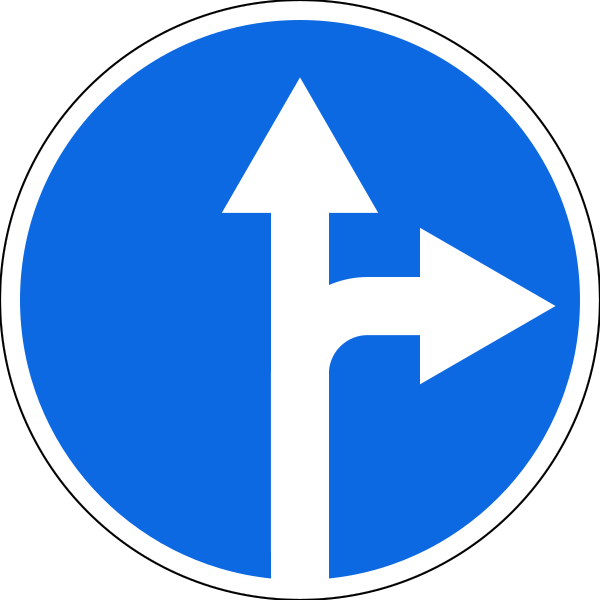
4.1.4. Straight ahead or right

Requires the driver to proceed only straight ahead or to the right. The sign applies to the intersection of carriageways before which it is installed; the sign does not apply to route (public transport) vehicles.

In case of damage to the skin and muscle tissue of a person injured in a road traffic accident, in order to provide first aid, they must:

1 iodine solution should be poured onto the wound
2 the muscle tissue should be cleared of foreign bodies and a bactericidal dressing applied
3 Treat the area around the wound with iodine solution and apply a bactericidal dressing (if not available, apply a clean dressing)
Law explanation
In the case of damage to the skin and muscle tissue of a person injured in a road traffic accident, the area around the wound must be treated with iodine solution and a bactericidal dressing applied (if not available, a clean dressing should be applied).
Ticket #1025 — situation image

In what order must the vehicles pass through the intersection when moving in the direction of the arrows, if the emergency vehicle does not have its flashing blue special beacon switched on?

1 the passenger car must pass first, then the motorcycle, and finally the emergency service vehicle
2 the emergency service vehicle must pass first, then the passenger car, and finally the motorcycle
3 The motorcycle must pass first, then the passenger car, and finally the emergency service vehicle
Law explanation
According to Article 51(1) of the Law of Georgia "On Road Traffic", the driver of an emergency or special service vehicle who has switched on the flashing blue special light on the vehicle and is performing an official task may, while ensuring road traffic safety, deviate from the requirements established by Articles 25, 31–41 and 44 of this Law, as well as by Annexes No. 1 and No. 2 to this Law. In addition to the flashing blue special light, a flashing red light may also be switched on. To obtain priority over other road users, the driver of this vehicle must switch on the flashing blue special light and the audible signal. According to Article 36(4)(a), (b) and (c) of the same Law, at an uncontrolled intersection: a) at the intersection of roads of unequal importance, the driver of a vehicle travelling on the secondary road must give way to a vehicle approaching on the main road, regardless of its further direction of travel; b) if the main road changes direction at an intersection, drivers travelling on this road must follow among themselves the rules for passing intersections of roads of equal importance. Drivers travelling on the secondary roads must follow the same rules among themselves; c) at the intersection of roads of equal importance, the driver of a trackless vehicle must give way to a vehicle approaching from the right. Drivers of rail vehicles must follow the same rule among themselves. At such an intersection a rail vehicle has priority over a trackless vehicle, regardless of its direction of travel.

Road sign used in this ticket
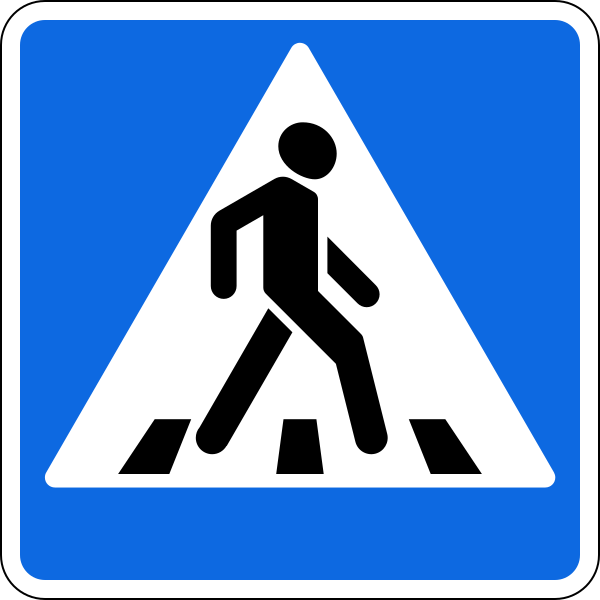
5.19.2. Pedestrian crossing

A place on the road designated as a pedestrian crossing. The sign is installed on the left side of the road. If marking 1.14 is absent at the crossing, the sign is installed at the far boundary of the crossing.
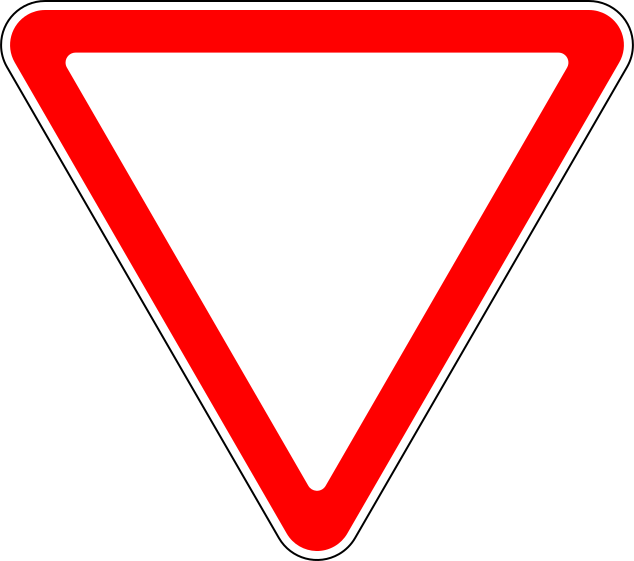
2.3. Give way

The driver on this road must give way to drivers moving on the road being crossed, and where plate 8.13 is present – to drivers on the main road. Outside built-up areas, sign 2.3 is placed in advance, 150−300 m before the intersection, with plate 8.1.1 if sign 2.3 is installed before the intersection, or with plate 8.1.2 if sign 2.4 is installed before the intersection. The sign applies to the intersection of carriageways before which the corresponding sign is installed.

8.13. Direction of the main road

Indicates the direction of the main road at an intersection. The plate is used with signs 2.1, 2.3 and 2.4 when the main road changes direction at the intersection.
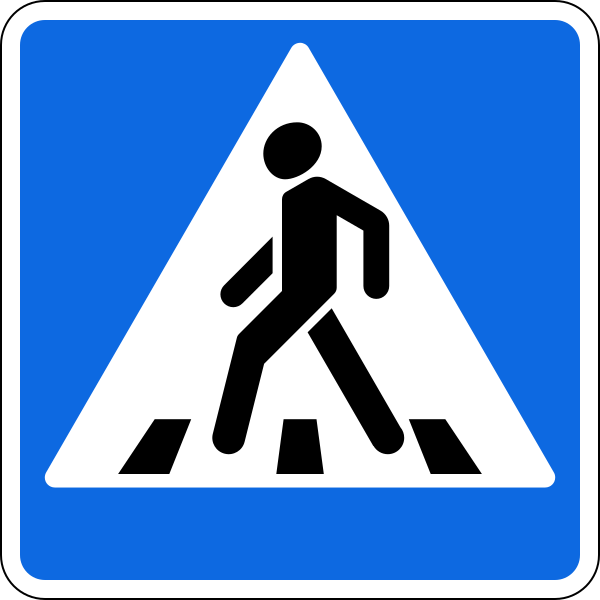
5.19.1. Pedestrian crossing

A place on the road designated as a pedestrian crossing. The sign is installed on the right side of the road. If marking 1.14 is absent at the crossing, the sign is installed at the near boundary of the crossing.

Ticket #1026 — situation image

In what order must the vehicles pass through the intersection when moving in the direction of the arrows, if the emergency service vehicle has its flashing blue special beacon and siren switched on?

1 the passenger car must pass first, then the motorcycle, and finally the emergency service vehicle
2 The motorcycle must pass first, then the emergency service vehicle, and finally the passenger car
3 the emergency service vehicle must pass first, then the passenger car, and finally the motorcycle
Law explanation
According to Article 51(2) of the Law of Georgia "On Road Traffic", when an emergency or special service vehicle is approaching with a flashing blue special light switched on and giving a signal with an audible signal and/or a loudspeaker, as well as the vehicles escorted by it that have their dipped headlights switched on, road users must clear the way on the carriageway and, if necessary, stop. According to Article 36(4)(c) of the same Law, at an uncontrolled intersection, at the intersection of roads of equal importance, the driver of a trackless vehicle must give way to a vehicle approaching from the right. Drivers of rail vehicles must follow the same rule among themselves. At such an intersection a rail vehicle has priority over a trackless vehicle, regardless of its direction of travel.

Road sign used in this ticket

5.19.2. Pedestrian crossing

A place on the road designated as a pedestrian crossing. The sign is installed on the left side of the road. If marking 1.14 is absent at the crossing, the sign is installed at the far boundary of the crossing.

5.19.1. Pedestrian crossing

A place on the road designated as a pedestrian crossing. The sign is installed on the right side of the road. If marking 1.14 is absent at the crossing, the sign is installed at the near boundary of the crossing.
What kind of bandage is used in case of an ankle joint injury of a person injured in a road traffic accident?

1 Figure-of-eight
2 Ear-shaped
3 sling-type
Law explanation
If a person injured in a road traffic accident has an injured ankle joint, a figure-of-eight bandage is applied.

The driver of a vehicle must use the hazard warning lights:

1 to warn other road users of an impending danger
2 to gain an advantage over other road users
Law explanation
According to Article 52(1) of the Law of Georgia "On Road Traffic", hazard warning lights are used to warn other road users of a potential danger.

The driver of a vehicle is obliged to switch on the hazard warning lights (if fitted):

1 if the vehicle involved in the accident or broken down cannot be removed from the carriageway immediately
2 when exiting from an adjacent area onto a motor road
3 when reversing
Law explanation
According to subparagraph “a” of paragraph 1 of Article 52 of the Law of Georgia “On Road Traffic”, hazard warning lights are used to warn other road users of a possible danger. Hazard warning lights must be switched on: a) if a vehicle involved in a road traffic accident or a broken-down vehicle cannot immediately be removed or towed away and this obstructs other road users.

The driver of a vehicle is obliged to switch on the hazard warning lights (if fitted):

1 during a forced stop at a place where stopping is prohibited
2 When passing a pedestrian crossing at high speed
3 When making a U-turn beyond the intersection
Law explanation
According to Article 52(1)(b) of the Law of Georgia "On Road Traffic", hazard warning lights are used to warn other road users of possible danger. Hazard warning lights must be switched on: b) when forced to stop at a place where stopping is prohibited.

In the event of a forced stop at places where stopping is prohibited, the driver must immediately put out the warning triangle (or a similar effective device):

1 Both after switching on the hazard warning lights, and if such lights are not fitted or are out of order
2 only after switching on the hazard warning lights
3 only if there are no hazard warning lights or they are out of order
Law explanation
According to Article 52(2)(b) of the Law of Georgia "On Road Traffic", after switching on the hazard warning lights, and also if such lights are absent or out of order, the driver must immediately place a "Warning triangle", and in conditions of insufficient visibility, a flashing red lamp: b) when forced to stop at a place where stopping is prohibited, and where, given the visibility conditions, other drivers will not be able to notice the vehicle in time.

In a built-up area, during a forced stop in places where stopping is prohibited, the driver must place the warning triangle (or a similar effective device) from the vehicle at a distance of not less than:

1 At a distance of 10 metres
2 At a distance of 5 metres
3 at a distance of 15 metres
Law explanation
According to Article 52(2)(b) and paragraphs 3 and 4 of the Law of Georgia "On Road Traffic": 2. After switching on the hazard warning lights, and also if there are no such lights or they are out of order, the driver must immediately place a "warning triangle", and in conditions of insufficient visibility a flashing red lamp: b) when making a forced stop in a place where stopping is prohibited, and where, taking visibility conditions into account, other drivers would not be able to notice the vehicle in time. 3. The "warning triangle" and the flashing red lamp must be placed at a distance from the vehicle that ensures timely warning of other drivers of the danger in the specific conditions, but this distance must not be less than 15 metres in a built-up area and not less than 30 metres outside a built-up area. 4. If there is no warning triangle or flashing red lamp, the driver must ensure timely warning of approaching drivers by other similar effective means.

Outside built-up areas, in the event of a forced stop in places where stopping is prohibited, the driver must place the warning triangle (or a similar effective device) from the vehicle at a distance of not less than:

1 At a distance of 20 metres
2 at a distance of 15 metres
3 at a distance of 30 metres
Law explanation
According to subparagraph “b” of paragraph 2 and paragraphs 3 and 4 of Article 52 of the Law of Georgia “On Road Traffic”: 2. After switching on the hazard warning lights, and also if such lights are absent or out of order, the driver must immediately place a “warning triangle”, and in conditions of insufficient visibility a flashing red lamp: b) when forced to stop at a place where stopping is prohibited, and where, given the visibility conditions, other drivers will not be able to notice the vehicle in time. 3. The “warning triangle” and the flashing red lamp must be placed at a distance from the vehicle that, in the specific conditions, ensures that other drivers are warned of the danger in good time, but this distance must not be less than 15 metres in a built-up area and less than 30 metres in a non-built-up area.

In the event of a forced stop at a place where stopping is prohibited, if there is no warning triangle and no flashing red lamp:

1 The driver must ensure timely warning of approaching drivers by other similar effective means
2 timely warning of approaching drivers is not necessary
Law explanation
According to Article 52(4) of the Law of Georgia "On Road Traffic", if there is no warning triangle or flashing red lamp, the driver must ensure timely warning of approaching drivers by other similar effective means.
Ticket #1043 — situation image

When stopping at which place shown in the picture will the driver of a bus carrying a group of children violate the traffic rules if they do not switch on the hazard warning lights?

1 only at place A
2 both at place A and at place B
3 Only at place B
Law explanation
According to Article 26(4) of the Law of Georgia "On Road Traffic", a bus carrying a group of children must display the identification sign "Transporting children". When the bus stops, the driver must switch on the hazard warning lights. Adults accompanying the children must ensure that the children board and leave the bus, as well as cross the carriageway, safely.
Ticket #1045 — situation image

Is the driver of the passenger car obliged to switch on the hazard warning lights and place the warning triangle in case of a forced stop at the place shown in the picture?

1 is obliged only to place an emergency stop sign behind the car, at a distance of 15 metres
2 is obliged to switch on only the hazard warning lights
3 is not obliged
Law explanation
According to Article 52(1)(b) of the Law of Georgia "On Road Traffic", hazard warning lights are used to warn other road users of a potential danger. Hazard warning lights must be switched on: b) when forced to stop in a place where stopping is prohibited. According to Article 37(6)(a.c) of the same Law, it is prohibited to stop a vehicle on the carriageway: a.c) at the intersection of carriageways, and also closer than 5 metres from the edges of intersecting carriageways, except when stopping takes place at three-way intersections (junctions) opposite side exits where there is a solid marking line or a dividing strip.

If a person injured in a road traffic accident has a fracture of the collarbone, they must be transported:

1 In a sitting position
2 Lying on the stomach
3 Lying on the back
4 lying on the side
Law explanation
In the case of a collarbone fracture, a person injured in a road traffic accident must be transported in a sitting position.

At which of the listed places is it not prohibited to make a U-turn with a vehicle:

1 At a level crossing
2 on a bridge, overpass, flyover and under them
3 At an intersection
4 In a tunnel
Law explanation
According to Article 32(15)(b), (c) and (d) of the Law of Georgia "On Road Traffic", turning a vehicle around is prohibited: b) in a tunnel; c) on a bridge, overpass, flyover and under them; d) on a level crossing.

If a person injured in a road traffic accident has lost consciousness due to a skull and brain injury, they must:

1 lay them on their back
2 lay them on their side
3 seat them
Law explanation
If a person injured in a road traffic accident loses consciousness due to a skull and brain injury, the injured person should be laid on their side.

The areas of skin of a person injured in a road traffic accident that are damaged by sulphuric acid must be:

1 should be rinsed with plenty of water
2 Clean it with alcohol
3 Treat it with iodine solution
Law explanation
The areas of skin of a person injured in a road traffic accident that have been damaged by sulphuric acid must be rinsed with plenty of water.

Does the emotional state of the driver affect traffic safety?

1 has no effect
2 Yes, it does
Law explanation
The driver's emotional state affects traffic safety.

How does driver fatigue affect his attention and reaction when participating in road traffic?

1 attention decreases, reaction time increases
2 Neither attention nor reaction time changes
3 attention deteriorates, reaction time decreases
Law explanation
Driver fatigue reduces the driver's attention and increases reaction time.
Practical part

Exam routes — exactly the way the examiner drives them

60 real exam routes across 10 cities, 793 km in total. Every turn and stop on the map, with voice guidance.

  • All routes on the map
  • GPS mode on the real road
  • Practice mode with adjustable speed
  • On the web and in the app

One-off payment, no auto-renewal — by card on the Bank of Georgia secure page.

Chat with us