imecadine.ge

Full ticket list

738 official tickets — category A, A1, with the correct answer and law explanation.

When a person injured in a road traffic accident has a wound, iodine solution, as a disinfectant, is applied:

1 To treat the entire surface of the wound
2 to treat the edges of the wound and the surrounding skin
Law explanation
In the case of a wound sustained by a person injured in a road traffic accident, iodine solution, as a disinfectant, is used to treat the edges of the wound and the skin surrounding it.
Ticket #1252 — situation image

Did the driver of the passenger car violate the traffic rules when moving in the direction of the arrow?

1 will violate
2 will not violate
Law explanation
According to subparagraph “a.c” of paragraph 9 of Article 34 of the Law of Georgia “On Road Traffic”, taking into account the requirements established by paragraph 3 of this Article, overtaking is prohibited at a junction other than a roundabout or immediately before such a junction, except when the overtaking is carried out at a controlled junction without moving into the lane for oncoming traffic.

Road sign used in this ticket

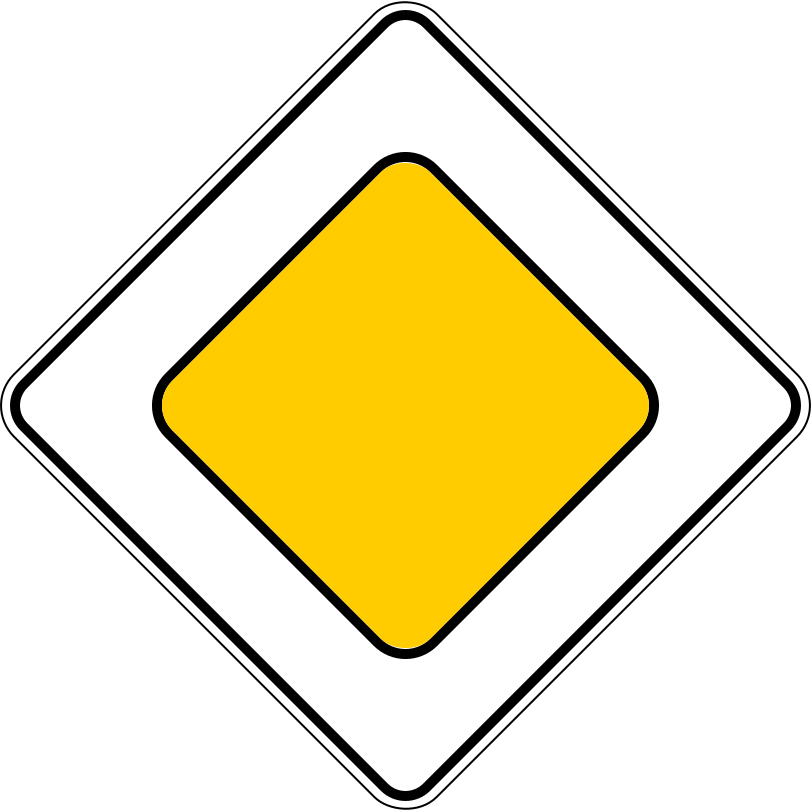
2.1. Priority road

A road on which drivers have priority when passing through unregulated intersections. The sign is installed at the beginning of the road and repeated immediately before every intersection. Sign 2.1 with plate 8.13 is installed in built-up areas before an intersection at which the main road changes direction; outside built-up areas − in advance, 150−300 m before the intersection, and before the intersection.

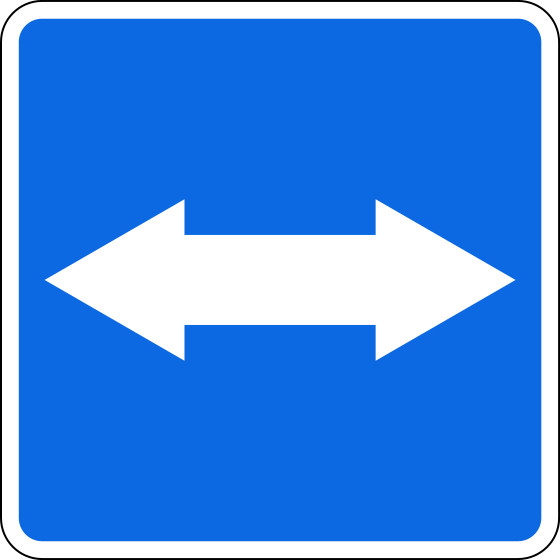
8.13. Direction of the main road

Indicates the direction of the main road at an intersection. The plate is used with signs 2.1, 2.3 and 2.4 when the main road changes direction at the intersection.

Ticket #1253 — situation image

Does the driver of the passenger car have the right to stop at the place indicated by the arrow to let a passenger alight?

1 does not have the right
2 Has the right
Law explanation
According to paragraph 1.4 of Chapter 1 (Horizontal markings) of Annex 2 of the Law of Georgia “On Road Traffic”, road marking 1.4, a solid yellow line, marks a place where stopping is prohibited; it is used on its own or together with sign 3.27; it is drawn along the edge of the carriageway or on top of the kerb.
Ticket #1254 — situation image

Inscriptions applied on the carriageway indicate:

1 the distance to the nearest built-up area
2 the traffic lanes intended for route vehicles with the corresponding number
3 the road (route) number
Law explanation
According to paragraph 1.22 of Chapter 1 (Horizontal markings) of Annex 2 to the Law of Georgia "On Road Traffic", road marking 1.22 denotes the number of the road (route).

Road sign used in this ticket

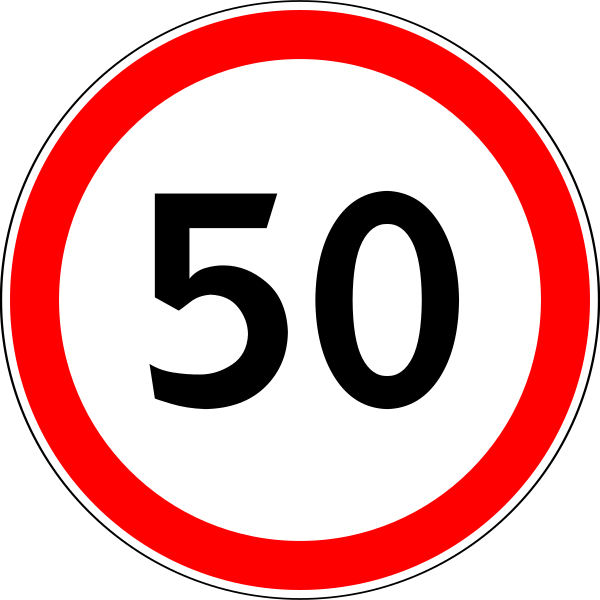
3.24. Maximum speed limit

Prohibits driving at a speed (km/h) exceeding that shown on the sign. The sign applies from the place where it is installed to the nearest intersection behind it, and in a built-up area with no intersection – to the end of the built-up area. The sign's effect is also not interrupted at exits from adjacent areas or at intersections (junctions) with field, forest and other minor roads before which no corresponding sign is installed. Sign 3.24 installed before a built-up area marked with signs 5.23.1 and 5.23.2 applies up to signs 5.23.1 and 5.23.2, respectively, that mark the built-up area.

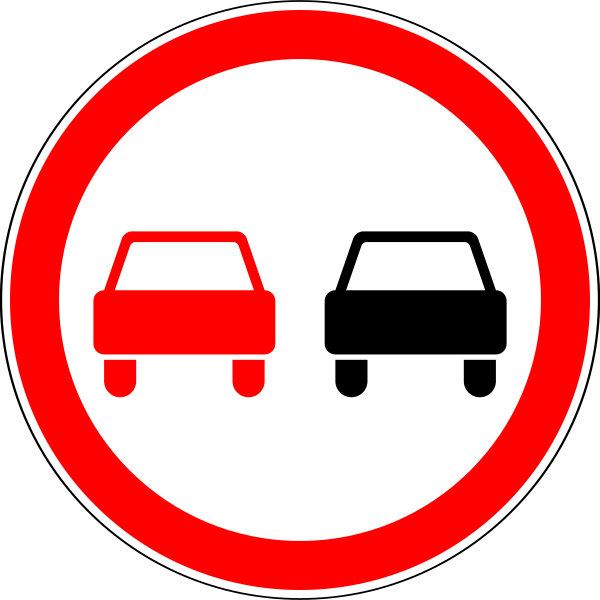
3.20. No overtaking

Prohibits overtaking all types of motor vehicles (except vehicles moving at less than 30 km/h). Overtaking motorcycles without a sidecar, mopeds and bicycles is permitted without crossing into the oncoming lane. The sign applies from the place where it is installed to the nearest intersection behind it, and in a built-up area with no intersection – to the end of the built-up area. The sign's effect is also not interrupted at exits from adjacent areas or at intersections (junctions) with field, forest and other minor roads before which no corresponding sign is installed.

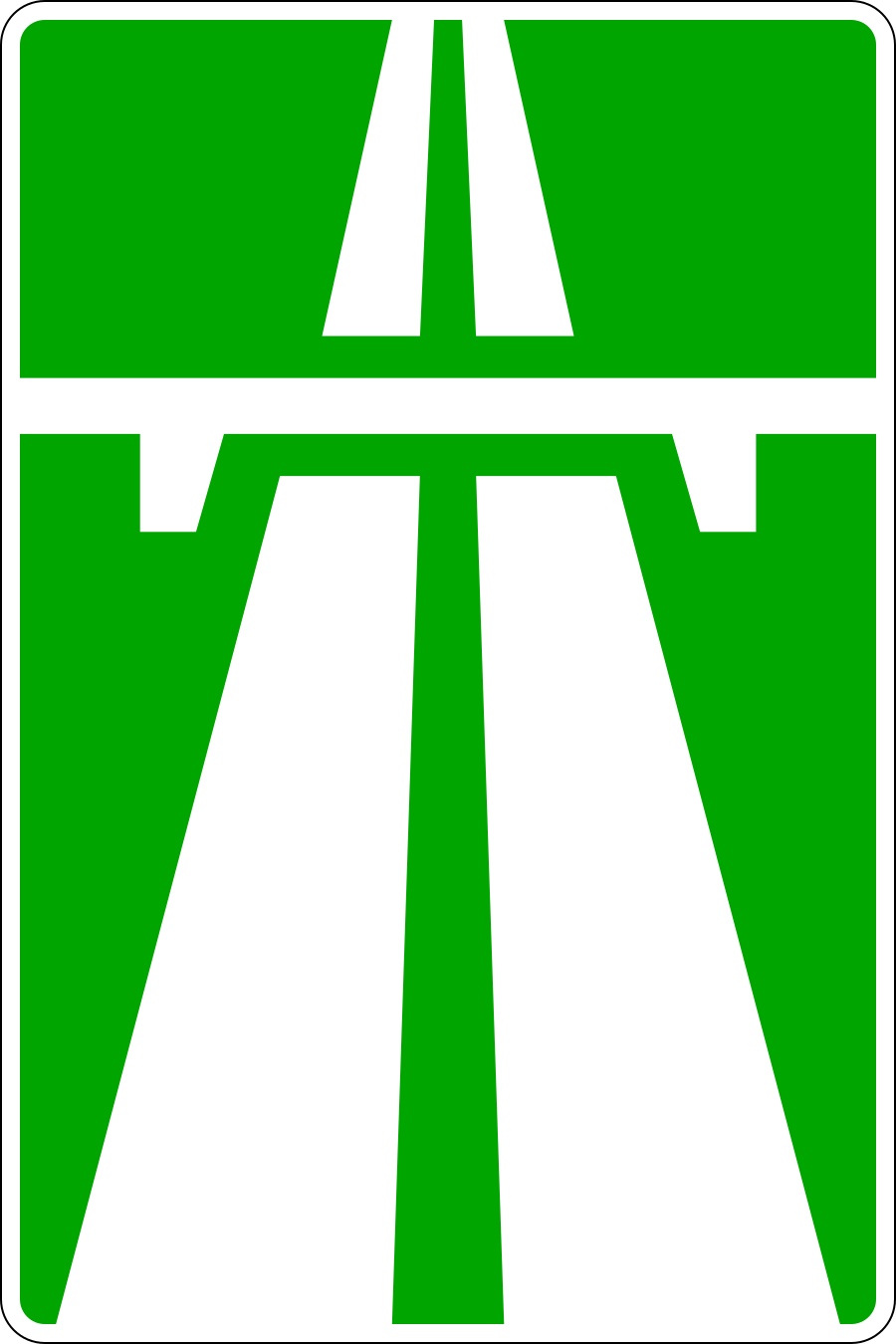
5.1. Motorway

A motorway on which the requirements of the rules governing traffic on motorways apply. The sign is installed at the beginning of the motorway or near it with plate 8.1.1.

5.25. Beginning of built-up area

Indicates the beginning of a built-up area in which the traffic rules established for built-up areas do not apply. The sign is installed at every entrance to the built-up area.

Ticket #1255 — situation image

Yellow marking applied on the carriageway designates:

1 a stop for route vehicles and a taxi rank
2 a parking place for long rest
Law explanation
According to paragraph 1.17 of Chapter 1 (Horizontal markings) of Annex 2 to the Law of Georgia "On Road Traffic", road marking 1.17 (a yellow line) indicates stopping places for route vehicles and taxi ranks.
Ticket #1256 — situation image

A transverse marking applied to the carriageway indicates the place where:

1 a cycle path crosses the carriageway
2 a footpath crosses the carriageway
Law explanation
According to paragraph 1.15 of Chapter 1 (Horizontal markings) of Annex 2 to the Law of Georgia "On Road Traffic", road marking 1.15 marks the place where a cycle path crosses the carriageway.
Ticket #1257 — situation image

A double broken line applied on the carriageway designates:

1 the place where the driver must stop if necessary
2 cycle paths at the intersection
3 the boundaries of lanes with reversible traffic
Law explanation
According to paragraph 1.9 of Chapter 1 (Horizontal markings) of Annex 2 to the Law of Georgia "On Road Traffic", road marking 1.9 denotes the boundary of a lane with reversible traffic; it separates traffic flows moving in opposite directions (when the reversible traffic lights are switched off) on a road where traffic is regulated reversibly.

Road sign used in this ticket

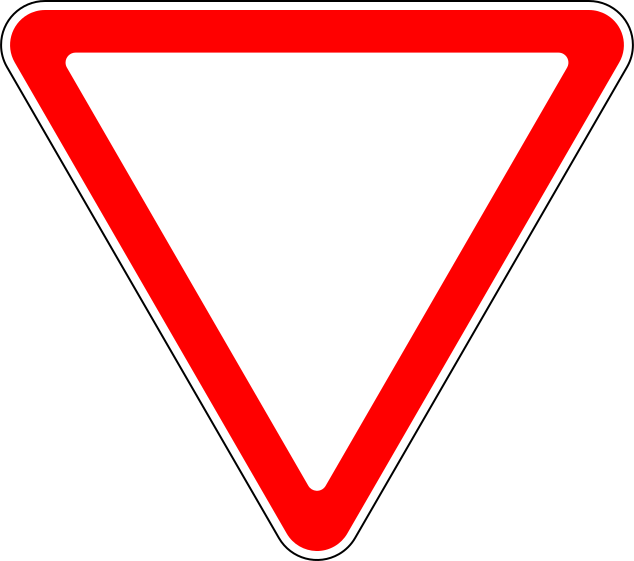
2.3. Give way

The driver on this road must give way to drivers moving on the road being crossed, and where plate 8.13 is present – to drivers on the main road. Outside built-up areas, sign 2.3 is placed in advance, 150−300 m before the intersection, with plate 8.1.1 if sign 2.3 is installed before the intersection, or with plate 8.1.2 if sign 2.4 is installed before the intersection. The sign applies to the intersection of carriageways before which the corresponding sign is installed.

5.10. Entry to a road with reversible traffic

Indicates entry to a section of road marked with sign 5.8. The sign is installed before every side exit. The sign may be omitted at the junction of a road with an exit from an adjacent area if entry into that area is possible only from the road marked with sign 5.8.

Ticket #1259 — situation image

The marking "BUS" applied on the carriageway designates a special lane intended for:

1 for route vehicles
2 for bicycles and mopeds
3 for slow-moving vehicles
Law explanation
According to paragraph 1.23 of Chapter 1 (Horizontal markings) of Annex 2 to the Law of Georgia "On Road Traffic", road marking 1.23 marks a special lane intended for the movement of route vehicles.

Road sign used in this ticket

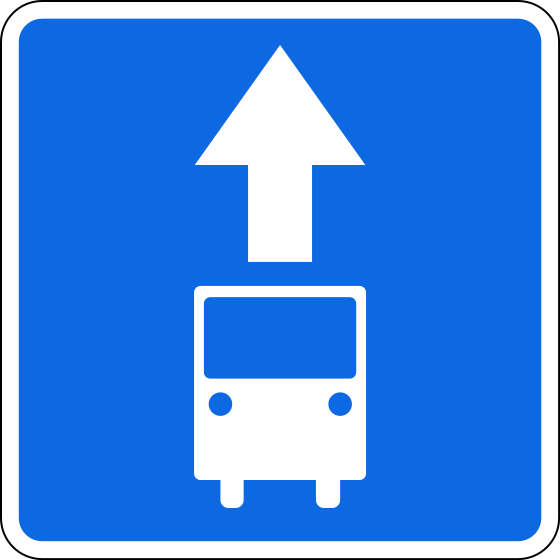
5.14. Lane for route vehicles

A road on which route (public transport) vehicles travel in a specially designated lane in the same direction as the general flow of traffic. The sign applies to the traffic lane over which it is installed. A sign installed on the right side of the road applies to the rightmost lane of the carriageway.

Ticket #1260 — situation image

An arrow-shaped marking applied in the middle of a traffic lane on the carriageway warns:

1 about approaching a narrowing of the carriageway, a section where the number of traffic lanes in the given direction decreases
2 about approaching a dangerous section of road with bends
Law explanation
According to paragraph 1.19 of Chapter 1 (Horizontal markings) of Annex 2 to the Law of Georgia “On Road Traffic”, road marking 1.19 warns of approaching a narrowing of the carriageway, a section where the number of lanes in a given direction decreases, or a marking 1.1 or 1.11 dividing traffic flows moving in opposite directions. In the first case, marking 1.19 may be used together with signs 1.21.1–1.21.3.

Road sign used in this ticket

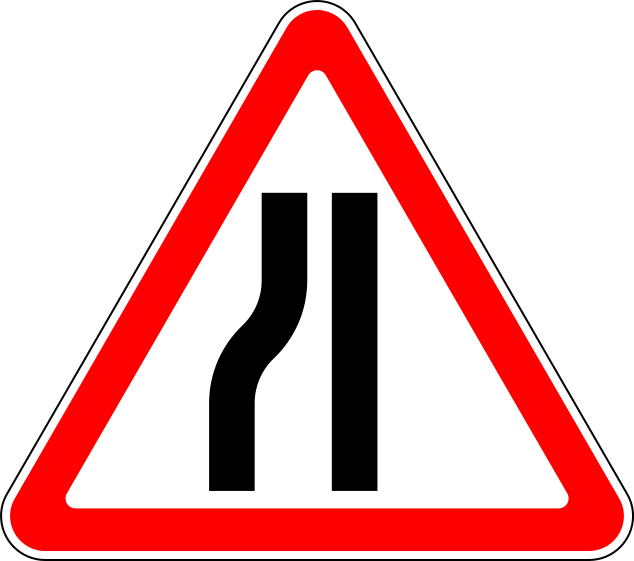
1.21.3. Road narrows

A section of road where the width of the carriageway narrows 1.21.3 − on the left. Outside built-up areas the sign is placed 150−300 m before the start of the hazardous section, in built-up areas – 50–100 m before it.

Ticket #1261 — situation image

The vertical marking drawn on a bridge indicates:

1 the lower edge of tunnels, bridges, overpasses and elements of other structures located at a height of less than 5 m above the carriageway, under which the carriageway passes wholly or partially
2 the number of traffic lanes on the carriageway
Law explanation
According to paragraph 2.2 of Chapter 2 (Vertical markings) of Annex 2 to the Law of Georgia “On Road Traffic”, road marking 2.2 marks the lower edge of an element of a tunnel, bridge, overpass or other structure located at a height of less than 5 metres above the carriageway, under which the carriageway passes wholly or partly.
Ticket #1262 — situation image

In the given situation, is the driver prohibited from stopping the car at the place indicated by the arrow?

1 is not prohibited
2 is prohibited
Law explanation
According to paragraph 3.27 of Chapter 3 (Prohibitory signs) of Annex 1 to the Law of Georgia "On Road Traffic", road sign 3.27 "No stopping" prohibits both stopping and parking of vehicles. According to subparagraph (e) of the note to the same Chapter, the effect of signs 3.26–3.30 extends after the relevant sign, from the place where the sign is installed to the nearest intersection, and in a built-up area where there is no intersection, to the end of the built-up area. The effect of the signs also extends past exits from adjacent areas and intersections (junctions) with field, forest and other minor roads before which the relevant sign is not installed. According to Article 5(13) of the same Law, an intersection is a crossing, junction or fork of roads at the same level, including the areas formed by such crossing, junction or fork. The crossing of roads with exits from adjacent areas is not considered an intersection.

Road sign used in this ticket
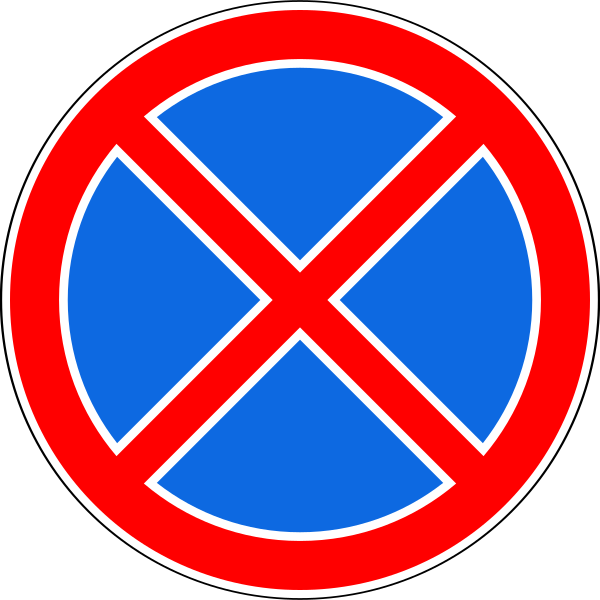
3.27. No stopping

Prohibits both stopping and parking of vehicles. The sign does not apply to route (public transport) vehicles. The sign applies from the place where it is installed to the nearest intersection behind it, and in a built-up area with no intersection – to the end of the built-up area. The sign's effect is also not interrupted at exits from adjacent areas or at intersections (junctions) with field, forest and other minor roads before which no corresponding sign is installed. The sign applies only to the side of the road on which it is installed.

Ticket #1263 — situation image

The driver of the passenger car has the right to stop:

1 only at place A
2 Only at place B
3 At neither place A nor place B
Law explanation
According to paragraph 1.4 of Chapter 1 (Horizontal markings) of Annex 2 of the Law of Georgia “On Road Traffic”, road marking 1.4, a solid yellow line, marks a place where stopping is prohibited; it is used on its own or together with sign 3.27; it is drawn along the edge of the carriageway or on top of the kerb. According to paragraph 3.27 of Chapter 3 (Prohibitory signs) of Annex 1 of the same Law and subparagraph “i” of the note to the same Chapter, road sign 3.27 “No stopping” - prohibits both stopping and parking of vehicles. Sign 3.27 may be used together with marking 1.4, and sign 3.28 – together with marking 1.10. In that case the zone of effect of the signs is determined by the length of the marking line.

Road sign used in this ticket

3.27. No stopping

Prohibits both stopping and parking of vehicles. The sign does not apply to route (public transport) vehicles. The sign applies from the place where it is installed to the nearest intersection behind it, and in a built-up area with no intersection – to the end of the built-up area. The sign's effect is also not interrupted at exits from adjacent areas or at intersections (junctions) with field, forest and other minor roads before which no corresponding sign is installed. The sign applies only to the side of the road on which it is installed.
If a person injured in a road traffic accident has a wound to the eye, they must:

1 lay them on the side of the healthy eye and place a clean dressing on the injured eye
2 lay them on their back and raise the head forward. Apply a clean dressing to the injured eye
3 seat them in a semi-sitting position, tilt the head back and place a clean dressing on the injured eye
Law explanation
In the case of an eye wound sustained by a person injured in a road traffic accident, the injured person must be laid on his/her back with the head raised forward. A clean dressing must be placed over the injured eye.

In case of an injury to an arm bone below the elbow of a person injured in a road traffic accident, the tourniquet to stop arterial bleeding should be applied:

1 above the wound, up to the elbow
2 above the elbow, near the shoulder
Law explanation
In the case of an injury to the arm bone below the elbow of a person injured in a road traffic accident, a tourniquet to stop arterial bleeding must be applied above the elbow, near the shoulder.

When calling an ambulance for persons injured in a road traffic accident, we must inform the dispatcher of:

1 only the nearest landmark to the scene of the road traffic accident, the number of injured persons, their sex and age
2 the exact location of the road traffic accident (street, house number and nearest landmark), the number of injured persons, their sex, approximate age, the presence of vital signs, and also about severe bleeding
Law explanation
When calling an ambulance for persons injured in a road traffic accident, we must tell the dispatcher the exact location of the road traffic accident (street, house number and nearest landmark), the number of injured persons, their sex, approximate age, the presence of vital signs, and also any severe bleeding.

If a person injured in a road traffic accident has injuries to the hairy part of the head, in order to provide first aid, they must:

1 Apply an improvised bandage to the neck, apply a pressure bandage with a sterile dressing to the wound, lay the injured person on their side with the legs bent at the knees, and place ice or a cold compress on the head
2 an improvised bandage should be applied to the neck, a sterile cotton pad placed on the wound, and the injured person laid on their back
Law explanation
If a person injured in a road traffic accident has injuries to the hairy part of the head, then, in order to provide first aid, an improvised collar should be placed on their neck, a pressure bandage made with a sterile bandage should be applied to the wound, the injured person should be laid on their side with the legs bent at the knees, and ice or a cold compress should be applied to the head.
Ticket #1269 — situation image

The driver of the passenger car has the right to stop:

1 only at place A
2 both at place A and at place B
3 Only at place B
Law explanation
According to Article 37(6)(a.a) and (a.c) of the Law of Georgia "On Road Traffic", stopping a vehicle on the carriageway is prohibited: a.a) on pedestrian and cyclist crossings and closer than 5 metres before them; a.c) at the intersection of carriageways, and also closer than 5 metres from the edges of the intersecting carriageways, except when stopping at three-way intersections (junctions) opposite side exits where there is a solid marking line or a dividing strip.

Road sign used in this ticket

2.1. Priority road

A road on which drivers have priority when passing through unregulated intersections. The sign is installed at the beginning of the road and repeated immediately before every intersection. Sign 2.1 with plate 8.13 is installed in built-up areas before an intersection at which the main road changes direction; outside built-up areas − in advance, 150−300 m before the intersection, and before the intersection.

Ticket #1270 — situation image

The driver of which vehicle has an obligation to give way when moving in the direction of the arrow?

1 the passenger car driver
2 the cyclist
Law explanation
According to paragraph 6 of Article 43 of the Law of Georgia “On Road Traffic”, at an unregulated crossing of a cycle path with a road outside an intersection, riders of bicycles and mopeds must give way to drivers of vehicles travelling on that road.
Ticket #1278 — situation image

In the given situation, is the driver of the passenger car obliged, when moving in the direction of the arrow, to stop at the prohibiting light signal of the traffic light?

1 is obliged
2 is not obliged
Law explanation
According to Article 36(3)(e) of the Law of Georgia "On Road Traffic", at a controlled intersection, a driver who has entered the intersection on a permissive traffic light signal may move in the intended direction regardless of the prohibitive signals of the traffic light at the exit from the intersection, provided that this does not obstruct the movement of other road users in the direction in which traffic is open. If, while he/she is moving through the intersection, there are "Stop" lines (and/or road signs 7.16) in front of the traffic lights on the road, the driver must follow the signal of each traffic light.

Road sign used in this ticket

2.1. Priority road

A road on which drivers have priority when passing through unregulated intersections. The sign is installed at the beginning of the road and repeated immediately before every intersection. Sign 2.1 with plate 8.13 is installed in built-up areas before an intersection at which the main road changes direction; outside built-up areas − in advance, 150−300 m before the intersection, and before the intersection.

Ticket #1279 — situation image

In the given situation, is the driver of the passenger car obliged, when moving in the direction of the arrow, to stop at the prohibiting light signal of the traffic light?

1 is obliged
2 is not obliged
Law explanation
According to Article 36(3)(e) of the Law of Georgia "On Road Traffic", at a controlled intersection, a driver who has entered the intersection on a permissive traffic light signal may move in the intended direction regardless of the prohibitive signals of the traffic light at the exit from the intersection, provided that this does not obstruct the movement of other road users in the direction in which traffic is open. If, while he/she is moving through the intersection, there are "Stop" lines (and/or road signs 7.16) in front of the traffic lights on the road, the driver must follow the signal of each traffic light.
Practical part

Exam routes — exactly the way the examiner drives them

60 real exam routes across 10 cities, 793 km in total. Every turn and stop on the map, with voice guidance.

  • All routes on the map
  • GPS mode on the real road
  • Practice mode with adjustable speed
  • On the web and in the app

One-off payment, no auto-renewal — by card on the Bank of Georgia secure page.

Chat with us