imecadine.ge

Use of special signals

17 official tickets in this topic, with the correct answer and law explanation.

Blue and red flashing lights, siren — who to give way to and how.

Red and yellow traffic light signals switched on together:

1 prohibits movement and informs about the imminent switching on of the green signal
2 permits movement and gives information about the presence of a hazard on the section of road
Law explanation
According to subparagraph "b" of paragraph 2 of Article 29 of the Law of Georgia "On Road Traffic", red and yellow light signals lit together prohibit movement and indicate that the green light signal is about to come on.

At a level crossing, it is not prohibited:

1 going around a vehicle standing in front of the crossing by moving into the lane for oncoming traffic
2 Opening a barrier or half-barrier without authorisation
3 Passing over it without stopping
4 The movement of slow-moving machines whose speed does not exceed 8 km/h and of tractor sledges/drags without the permission of the railway track section manager
Law explanation
According to Article 39(2)(a), (b) and (d) of the Law of Georgia "On Road Traffic", at a level crossing it is prohibited: a) to go around a vehicle standing in front of the crossing by moving into the opposite traffic lane; b) to open a barrier or half-barrier without authorisation; d) to move a slow-moving vehicle whose speed does not exceed 8 km/h, or a tractor sledge-drag, without the permission of the head of the railway track section.

The driver of an emergency service vehicle, regardless of the requirements of road signs and markings, has priority over other road users if he has switched on:

1 blue and red flashing special signal lights
2 A blue flashing special signal
3 blue flashing special lights and audible signals
Law explanation
According to paragraph 1 of Article 51 of the Law of Georgia “On Road Traffic”, the driver of an emergency or special service vehicle who has switched on the flashing blue special light on the vehicle and is performing an official task may, while ensuring road traffic safety, deviate from the requirements established by Articles 25, 31−41 and 44 of this Law, as well as by Annexes No. 1 and No. 2 to this Law. In addition to the flashing blue special light, a flashing red light may also be switched on. To obtain priority over other road users, the driver of this vehicle must switch on the flashing blue special light and the sound signal. Priority may be used only when the driver has made sure that he is being given way.

Is a road user obliged to give way to a vehicle moving with dipped-beam headlights switched on that is being escorted by an emergency service vehicle with its blue flashing special lights and sound signals switched on?

1 is obliged
2 is not obliged
Law explanation
According to paragraph 2 of Article 51 of the Law of Georgia “On Road Traffic”, when an emergency or special service vehicle approaches with a flashing blue special signal and an audible signal switched on and/or giving signals through a loudspeaker, road users must clear space on the carriageway for it, as well as for the vehicle escorted by it with dipped-beam headlamps switched on, and, if necessary, stop.

When an emergency or special service vehicle is approaching with its flashing blue special light and audible signal switched on and/or giving a signal with a loudspeaker, road users must:

1 clear space on the carriageway and, if necessary, stop
2 move into the leftmost lane for traffic in the same direction
3 stop immediately where they are
Law explanation
According to paragraph 2 of Article 51 of the Law of Georgia “On Road Traffic”, when an emergency or special service vehicle approaches with a flashing blue special signal and an audible signal switched on and/or giving signals through a loudspeaker, road users must clear space on the carriageway for it, as well as for the vehicle escorted by it with dipped-beam headlamps switched on, and, if necessary, stop.

When approaching a stationary special service vehicle with its blue flashing special light switched on, the driver must:

1 continue on their way without changing speed
2 increase speed in order to pass the said place in time
3 slow down so as to be able to stop the vehicle immediately if necessary
Law explanation
According to Article 51(3) of the Law of Georgia "On Road Traffic", when approaching a stationary vehicle with its flashing blue special light switched on, the driver must reduce speed so that, if necessary, he can stop his vehicle immediately.

A driver who has the orange flashing special light signal switched on on a special service vehicle may, while performing official duties, deviate from the requirements of road signs and markings if:

1 temporary road signs are fixed to the vehicle
2 has the dipped headlights switched on
3 ensures road traffic safety
Law explanation
According to Article 51(4) of the Law of Georgia "On Road Traffic", a driver who has a flashing orange or yellow special light switched on on the vehicle and who is carrying out construction, repair or cleaning work on the road, or transporting valuables or securities in a cash-in-transit vehicle, or carrying dangerous goods, or travelling in an oversized (large-dimension) or overweight (heavy) vehicle, may deviate from the requirements of road signs and markings, as well as from the requirements established by Article 31(5)–(10), (15) and (16) and Article 38(1) of this Law, provided that road traffic safety is ensured. A flashing orange or yellow special light does not give priority over other road users and is used to attract attention in order to avert possible danger.

The yellow flashing special light switched on on a special service vehicle is used:

1 To attract attention, in order to avert impending danger
2 To gain an advantage over other road users
Law explanation
According to Article 51(4) of the Law of Georgia "On Road Traffic", a driver who has a flashing orange or yellow special light switched on on the vehicle and who is carrying out construction, repair or cleaning work on the road, or transporting valuables or securities in a cash-in-transit vehicle, or carrying dangerous goods, or travelling in an oversized (large-dimension) or overweight (heavy) vehicle, may deviate from the requirements of road signs and markings, as well as from the requirements established by Article 31(5)–(10), (15) and (16) and Article 38(1) of this Law, provided that road traffic safety is ensured. A flashing orange or yellow special light does not give priority over other road users and is used to attract attention in order to avert possible danger.

The installation of special flashing lights and sound signals on vehicles, as well as giving motor vehicles a special colour scheme, is carried out:

1 in accordance with the procedure established by the Minister of Internal Affairs of Georgia
2 in accordance with the procedure determined by the Minister of Justice of Georgia
3 In accordance with the procedure established by the Minister of Finance of Georgia
Law explanation
According to paragraph 8 of Article 51 of the Law of Georgia "On Road Traffic", the installation of special flashing lights and audible signals, as well as a special loudspeaker device, on a vehicle and the application of special colouring to a vehicle are carried out in accordance with the procedure established by the Minister of Internal Affairs of Georgia.
Ticket #1013 — situation image

A truck with dipped-beam headlights switched on is being escorted by an emergency service vehicle with its blue flashing special lights and sound signals switched on. Towards which car does the bus driver have an obligation to give way when moving in the direction of the arrow at this traffic light signal?

1 to the driver of neither car
2 to both the emergency service vehicle and the truck drivers
3 only to the driver of the emergency vehicle
Law explanation
According to paragraph 2 of Article 51 of the Law of Georgia “On Road Traffic”, when an emergency or special service vehicle approaches with a flashing blue special signal and an audible signal switched on and/or giving signals through a loudspeaker, road users must clear space on the carriageway for it, as well as for the vehicle escorted by it with dipped-beam headlamps switched on, and, if necessary, stop.
Ticket #1014 — situation image

In which direction does the driver of the emergency service vehicle have the right to continue moving on this traffic light signal, if the vehicle has its flashing blue special light switched on?

1 only to the left and in the reverse direction (U-turn)
2 in all directions
3 only straight ahead and to the right
4 only to the right
Law explanation
According to Article 51(1) of the Law of Georgia "On Road Traffic", the driver of an emergency or special service vehicle who has a special flashing blue light switched on and is performing an official task may, while ensuring the conditions of road traffic safety, deviate from the requirements established by Articles 25, 31–41 and 44 of this Law, as well as by Annexes №1 and №2 to this Law.

Road sign used in this ticket

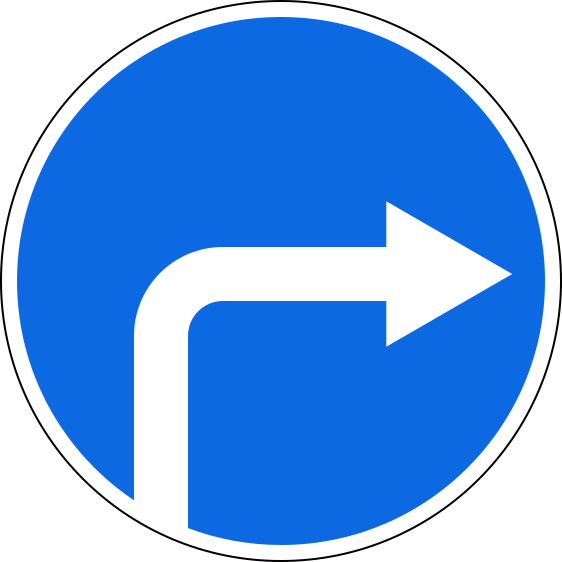
4.1.2. Turn right

Requires the driver to proceed only to the right. The sign applies to the intersection of carriageways before which it is installed; the sign does not apply to route (public transport) vehicles.

Ticket #1015 — situation image

Is the driver of the red car obliged to give way to the driver of the emergency service vehicle, if the vehicle does not have its blue flashing special lights and sound signals switched on?

1 is not obliged
2 is obliged
Law explanation
According to paragraph 2 of Article 51 of the Law of Georgia “On Road Traffic”, when an emergency or special service vehicle approaches with a flashing blue special signal and an audible signal switched on and/or giving signals through a loudspeaker, road users must clear space on the carriageway for it, as well as for the vehicle escorted by it with dipped-beam headlamps switched on, and, if necessary, stop.
Ticket #1016 — situation image

An emergency service vehicle has its flashing blue special light and audible signal switched on. The driver of the red car will not violate the traffic rules if:

1 will not give way to the yellow car and will move into the lane on the right
2 will let the yellow car pass and move into the lane on the right
3 will continue moving in the occupied lane
Law explanation
According to Article 51(2) of the Law of Georgia "On Road Traffic", when an emergency or special service vehicle is approaching with a flashing blue special light and an audible signal switched on and/or giving a signal with a loudspeaker, road users must clear the way on the carriageway for it, as well as for the vehicles escorted by it that have their dipped headlights switched on, and, if necessary, stop. According to Article 32(4) of the same Law, when changing lanes without changing direction of travel, the driver must give way to a vehicle moving in the same direction in the lane being entered.
Ticket #1017 — situation image

An emergency service vehicle has stopped with its blue flashing special light signal switched on. The driver of the passenger car must move at no more than:

1 At a speed of 70 km/h
2 at a speed that will allow the car to be stopped immediately if necessary
3 At a speed of 90 km/h
Law explanation
According to Article 51(3) of the Law of Georgia "On Road Traffic", when approaching a stationary vehicle with its flashing blue special light switched on, the driver must reduce speed so that, if necessary, he can stop his vehicle immediately.
Ticket #1018 — situation image

In what order should the vehicles pass through the intersection when moving in the direction of the arrows, if the emergency vehicle has its blue flashing special light and sound signals switched on?

1 The emergency service vehicle must pass first, then the grey passenger car, and finally the motorcycle
2 the motorcycle must pass first, then the emergency service vehicle, and finally the grey passenger car
3 the grey passenger car must pass first, then the motorcycle, and finally the emergency service vehicle
Law explanation
According to Article 51(2) of the Law of Georgia "On Road Traffic", when an emergency or special service vehicle is approaching with a special flashing blue light and an audible signal switched on and/or giving a signal with a loudspeaker, road users must clear the way on the carriageway for it, as well as for the vehicle escorted by it that has its dipped headlights switched on, and, if necessary, stop. According to Article 36(3)(a) of the same Law, at a controlled intersection, when turning left or turning around on a green traffic light signal, the driver of a trackless vehicle must give way to a vehicle travelling straight ahead or turning right from the opposite direction.

Road sign used in this ticket

2.1. Priority road

A road on which drivers have priority when passing through unregulated intersections. The sign is installed at the beginning of the road and repeated immediately before every intersection. Sign 2.1 with plate 8.13 is installed in built-up areas before an intersection at which the main road changes direction; outside built-up areas − in advance, 150−300 m before the intersection, and before the intersection.

Ticket #1019 — situation image

In which direction does the driver of the emergency service vehicle have the right to continue moving at this traffic light signal, if the vehicle does not have its blue flashing special light signal switched on?

1 only straight ahead and to the right
2 Only straight ahead to the left
3 only straight ahead
4 in all directions
Law explanation
According to paragraph 1 of Article 51 of the Law of Georgia “On Road Traffic”, the driver of an emergency or special service vehicle who has switched on the blue flashing special beacon on the vehicle and is performing an official task may, while ensuring road safety, deviate from the requirements established by Articles 25, 31−41 and 44 of this Law, as well as by Annexes No. 1 and No. 2 to this Law. According to paragraph 5 of Article 32 of the same Law, except when the turn is made to enter an intersection where roundabout traffic is organised, before turning right or left, and also before making a U-turn, the driver of a vehicle must in good time take up the appropriate extreme position on the carriageway intended for traffic in that direction. According to paragraph 4.1.4 of Chapter 4 (Mandatory signs) of Annex 1 to the same Law and subparagraphs “a” and “d” of the note to that paragraph, road sign 4.1.4 “Proceed straight or turn right” permits movement only in the directions shown by the arrows.

Road sign used in this ticket

2.3. Give way

The driver on this road must give way to drivers moving on the road being crossed, and where plate 8.13 is present – to drivers on the main road. Outside built-up areas, sign 2.3 is placed in advance, 150−300 m before the intersection, with plate 8.1.1 if sign 2.3 is installed before the intersection, or with plate 8.1.2 if sign 2.4 is installed before the intersection. The sign applies to the intersection of carriageways before which the corresponding sign is installed.
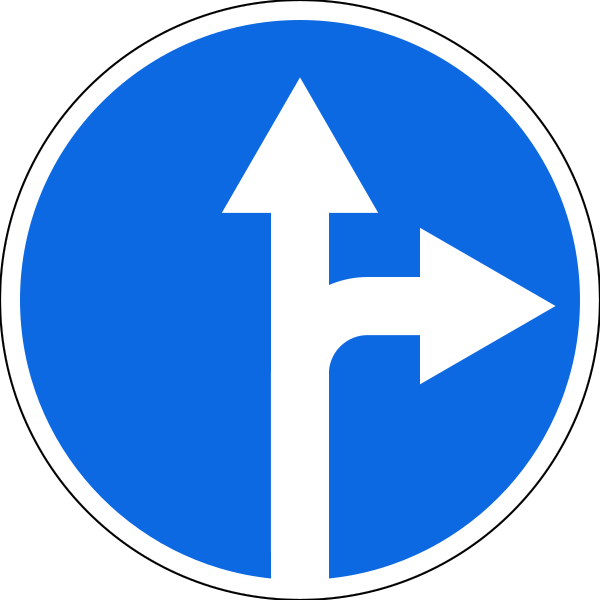
4.1.4. Straight ahead or right

Requires the driver to proceed only straight ahead or to the right. The sign applies to the intersection of carriageways before which it is installed; the sign does not apply to route (public transport) vehicles.

Ticket #1026 — situation image

In what order must the vehicles pass through the intersection when moving in the direction of the arrows, if the emergency service vehicle has its flashing blue special beacon and siren switched on?

1 the passenger car must pass first, then the motorcycle, and finally the emergency service vehicle
2 The motorcycle must pass first, then the emergency service vehicle, and finally the passenger car
3 the emergency service vehicle must pass first, then the passenger car, and finally the motorcycle
Law explanation
According to Article 51(2) of the Law of Georgia "On Road Traffic", when an emergency or special service vehicle is approaching with a flashing blue special light switched on and giving a signal with an audible signal and/or a loudspeaker, as well as the vehicles escorted by it that have their dipped headlights switched on, road users must clear the way on the carriageway and, if necessary, stop. According to Article 36(4)(c) of the same Law, at an uncontrolled intersection, at the intersection of roads of equal importance, the driver of a trackless vehicle must give way to a vehicle approaching from the right. Drivers of rail vehicles must follow the same rule among themselves. At such an intersection a rail vehicle has priority over a trackless vehicle, regardless of its direction of travel.

Road sign used in this ticket

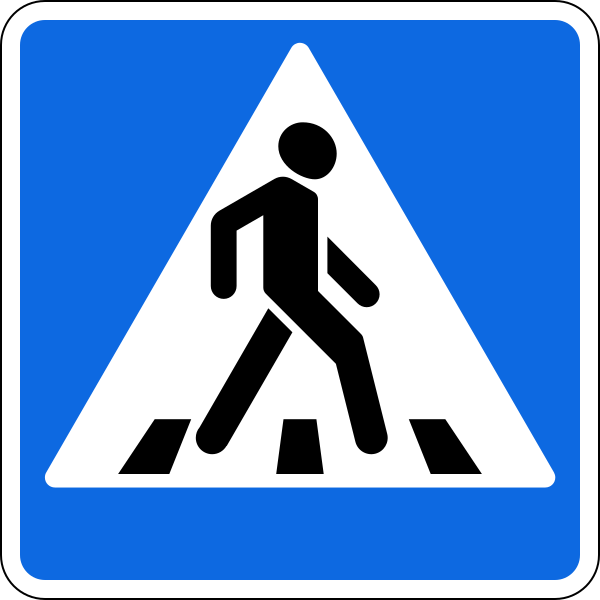
5.19.2. Pedestrian crossing

A place on the road designated as a pedestrian crossing. The sign is installed on the left side of the road. If marking 1.14 is absent at the crossing, the sign is installed at the far boundary of the crossing.

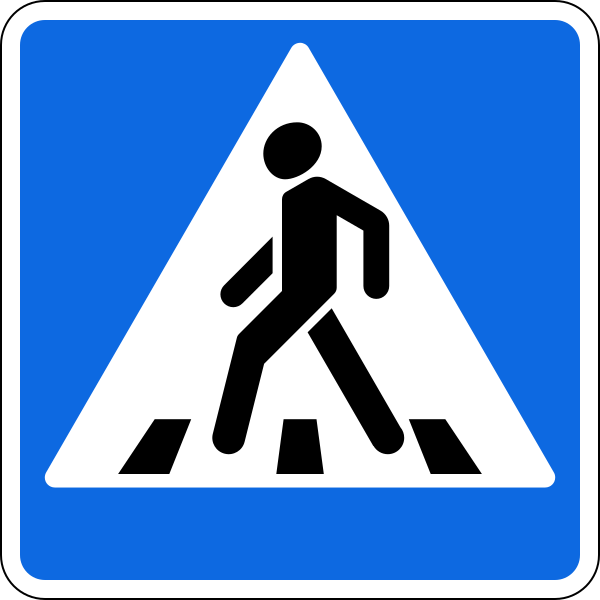
5.19.1. Pedestrian crossing

A place on the road designated as a pedestrian crossing. The sign is installed on the right side of the road. If marking 1.14 is absent at the crossing, the sign is installed at the near boundary of the crossing.

Practical part

Exam routes — exactly the way the examiner drives them

60 real exam routes across 10 cities, 793 km in total. Every turn and stop on the map, with voice guidance.

  • All routes on the map
  • GPS mode on the real road
  • Practice mode with adjustable speed
  • On the web and in the app

One-off payment, no auto-renewal — by card on the Bank of Georgia secure page.

Chat with us