imecadine.ge

Moving off, manoeuvring, positioning

56 official tickets in this topic, with the correct answer and law explanation.

Changing lanes, turning, reversing and correct positioning.

Ticket #376 — situation image

In the given situation, a U-turn of the car is permitted:

1 only in direction B
2 Only in direction A
3 both in direction A and in direction B
4 Not permitted in either direction
Law explanation
According to subparagraphs “a” and “f” of paragraph 15 of Article 32 of the Law of Georgia “On Road Traffic”, making a U-turn with a vehicle is prohibited: a) on a pedestrian crossing; f) at a place where there is a stop. According to paragraph 5.16 of Chapter 5 (Special regulation signs) of Annex 1 to the same Law, road sign 5.16 “Bus and (or) trolleybus stop” indicates the stopping place for the corresponding type of route vehicle. According to paragraphs 5.19.1 and 5.19.2 of the same Chapter, road signs 5.19.1 and 5.19.2 “Pedestrian crossing” indicate the place on the road allocated for a pedestrian crossing. Sign 5.19.1 is installed on the right side of the road and 5.19.2 on the left side of the road. Where there is no marking 1.14 at the crossing, sign 5.19.1 is installed at the near boundary of the crossing and sign 5.19.2 at the far boundary of the crossing.
Road sign used in this ticket

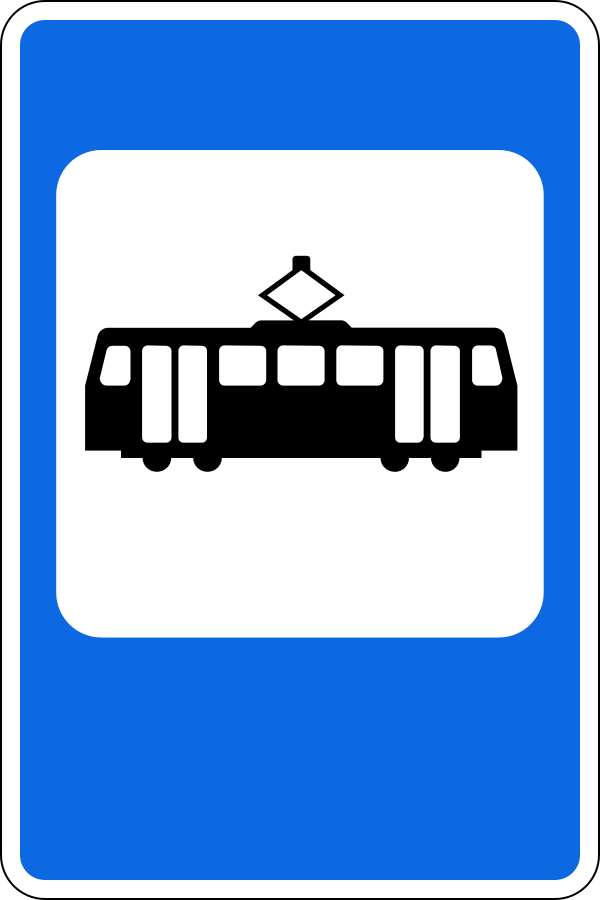
5.17. Tram stop

Indicates a tram stop and a taxi rank.

Ticket #383 — situation image

The driver of the passenger car has the right to move:

1 only to the left and to the right
2 only straight ahead and to the right
3 Only to the left
4 Only straight ahead, to the left and in the reverse direction (U-turn)
Law explanation
According to paragraph 7 of Article 32 of the Law of Georgia “On Road Traffic”, before turning right or left to exit onto another road or to enter an area adjacent to the road, without violating the requirements established by paragraph 2 of Article 20 of this Law and paragraphs 1 and 2 of this Article, if the driver of the vehicle intends to leave the road: a) on the right side, the vehicle must move as close as possible to the right edge of the carriageway and then perform as short a manoeuvre as possible; b) on the left side, the vehicle must, as far as possible, approach the centre line of the carriageway (on a two-way road) or the left edge of the carriageway (on a one-way road), and if it intends to exit onto another two-way road, it must perform the turn so that, on leaving the crossing of carriageways, the vehicle does not end up on the side of oncoming traffic. According to paragraph 1.1 of Chapter 1 (Horizontal markings) of Annex 2 to the same Law, horizontal marking 1.1 separates traffic flows moving in opposite directions and, on dangerous sections of the road, indicates the boundaries of lanes or the boundaries of the carriageway which it is prohibited to enter; crossing line 1.1 is prohibited. It is permitted to cross a line 1.1 that indicates the edge of the carriageway and is located on the driver's right side in order to stop the vehicle on the roadside.
Ticket #384 — situation image

The driver of the passenger car has the right to move:

1 Only straight ahead, to the left and in the reverse direction (U-turn)
2 only straight ahead and to the right
3 only to the left and to the right
4 only to the right
Law explanation
According to paragraph 7 of Article 32 of the Law of Georgia “On Road Traffic”, before turning right or left to exit onto another road or to enter an area adjacent to the road, without violating the requirements established by paragraph 2 of Article 20 of this Law and paragraphs 1 and 2 of this Article, if the driver of the vehicle intends to leave the road: a) on the right side, the vehicle must move as close as possible to the right edge of the carriageway and then perform as short a manoeuvre as possible; b) on the left side, the vehicle must, as far as possible, approach the centre line of the carriageway (on a two-way road) or the left edge of the carriageway (on a one-way road), and if it intends to exit onto another two-way road, it must perform the turn so that, on leaving the crossing of carriageways, the vehicle does not end up on the side of oncoming traffic. According to paragraph 1.1 of Chapter 1 (Horizontal markings) of Annex 2 to the same Law, horizontal marking 1.1 separates traffic flows moving in opposite directions and, on dangerous sections of the road, indicates the boundaries of lanes or the boundaries of the carriageway which it is prohibited to enter; crossing line 1.1 is prohibited. It is permitted to cross a line 1.1 that indicates the edge of the carriageway and is located on the driver's right side in order to stop the vehicle on the roadside.
Ticket #385 — situation image

The driver of the car has passed the right turn. Are they prohibited from reversing in the direction of the arrow to enter the turn?

1 is prohibited
2 is not prohibited
Law explanation
According to Article 32(16) of the Law of Georgia "On Road Traffic", a driver who intends to turn around or reverse must make sure that he/she can perform this manoeuvre without endangering or obstructing other road users. If necessary, the assistance of another person is advisable. Reversing is prohibited at an intersection, on a motorway and in the places defined by paragraph 15 of this Article.

When tram tracks are located in the middle of the carriageway of a two-way road, at the same level with it, the following is considered to divide the opposite directions of traffic:

1 The left track of the tram travelling in the opposite direction
2 The imaginary centre line between the tram tracks running in opposite directions
3 the right-hand track of a tram moving in the same direction
Law explanation
According to Article 31(3) of the Law of Georgia "On Road Traffic", on a two-way road where tram tracks are located in the middle of the carriageway at the same level as it, the imaginary centre line between the tram tracks running in opposite directions is regarded as the divider between the sides of opposing traffic.
Ticket #388 — situation image

The driver of the passenger car has the right to move:

1 only in direction B
2 Only in direction A
3 both in direction A and in direction B
Law explanation
According to subparagraph “b” of paragraph 7 of Article 32 of the Law of Georgia “On Road Traffic”, before turning right or left to exit onto another road or to enter an area adjacent to the road, without violating the requirements established by paragraph 2 of Article 20 of this Law and paragraphs 1 and 2 of this Article, if the driver of the vehicle intends to leave the road on the left side, the vehicle must, as far as possible, approach the centre line of the carriageway (on a two-way road) or the left edge of the carriageway (on a one-way road), and if it intends to exit onto another two-way road, it must perform the turn so that, on leaving the crossing of carriageways, the vehicle does not end up on the side of oncoming traffic.

Road sign used in this ticket

2.3. Give way

The driver on this road must give way to drivers moving on the road being crossed, and where plate 8.13 is present – to drivers on the main road. Outside built-up areas, sign 2.3 is placed in advance, 150−300 m before the intersection, with plate 8.1.1 if sign 2.3 is installed before the intersection, or with plate 8.1.2 if sign 2.4 is installed before the intersection. The sign applies to the intersection of carriageways before which the corresponding sign is installed.

Is it prohibited for a trackless vehicle to drive onto the track of a tram moving in the opposite direction?

1 It is not prohibited if all lanes for traffic in the same direction are occupied
2 Is prohibited
Law explanation
According to Article 31(15) of the Law of Georgia "On Road Traffic", subject to the requirements established by Article 32(6) of this Law, driving is permitted on tram tracks of the same direction located on the left at the same level as the carriageway if all lanes intended for traffic in the same direction are occupied, as well as when bypassing an obstacle or overtaking, or when turning left or turning around. In doing so, tram traffic must not be obstructed. Entering tram tracks of the opposite direction is prohibited.

In which of the places listed below is making a U-turn with a vehicle prohibited?

1 only on a road where visibility in at least one direction is less than 100 metres
2 only on a motorway
3 only at a place where there is a stopping point
4 at any of the places listed in this ticket
Law explanation
According to subparagraphs "e" and "f" of paragraph 15 of Article 32 of the Law of Georgia "On Road Traffic", making a U-turn with a vehicle is prohibited: e) on a road where visibility in at least one direction is less than 100 metres; f) at a place where there is a stop. According to subparagraph "c.b" of paragraph 1 of Article 38 of the same Law, on motorways and at motorway entrances and exits the driver is prohibited from making a U-turn or reversing, as well as from driving onto the central dividing strip or the transverse connections between the two carriageways of the road.

If the paths of vehicles intersect and the order of passage is not determined, the driver must give way to the vehicle approaching:

1 from the left
2 from the right
Law explanation
According to paragraph 12 of Article 32 of the Law of Georgia “On Road Traffic”, if the paths of vehicles cross and the order of passing is not determined, the driver must give way to the vehicle approaching from the right.

In which of the places listed below is reversing a vehicle prohibited?

1 only on a motorway
2 only at an intersection
3 at any of the places listed in this ticket
4 Only in a tunnel
Law explanation
According to Article 32(15)(b) and Article 32(16) of the Law of Georgia "On Road Traffic": 15. "b" turning a vehicle around in a tunnel is prohibited; 16. A driver who intends to turn around or reverse must make sure that he/she can perform this manoeuvre without creating danger or obstruction for other road users. If necessary, it is advisable to get help from another person. Reversing is prohibited at intersections, on motorways and in the places specified in paragraph 15 of this Article.
Ticket #402 — situation image

Is the driver of the passenger car obliged to switch on the right-turn indicator when moving in the direction of the arrow, if no vehicle is moving behind him?

1 is not obliged
2 is obliged
Law explanation
According to Article 32(2) of the Law of Georgia "On Road Traffic", before starting a manoeuvre the driver must switch on the direction indicator for the corresponding direction, and if there is none or it is out of order, signal by hand.

Road sign used in this ticket

2.1. Priority road

A road on which drivers have priority when passing through unregulated intersections. The sign is installed at the beginning of the road and repeated immediately before every intersection. Sign 2.1 with plate 8.13 is installed in built-up areas before an intersection at which the main road changes direction; outside built-up areas − in advance, 150−300 m before the intersection, and before the intersection.

8.13. Direction of the main road

Indicates the direction of the main road at an intersection. The plate is used with signs 2.1, 2.3 and 2.4 when the main road changes direction at the intersection.

Ticket #404 — situation image

Which picture shows the hand signal for turning left given by the driver of a motorcycle?

1 I
2 III
3 II
Law explanation
According to Article 32(2) of the Law of Georgia "On Road Traffic", before starting a manoeuvre the driver must switch on the direction indicator for the corresponding direction, and if there is none or it is out of order, signal by hand. The signal for turning left or turning around is the left arm extended horizontally to the side, or the right arm extended to the side and bent upward at the elbow at a right angle. The signal for turning right is the right arm extended horizontally to the side, or the left arm extended to the side and bent upward at the elbow at a right angle. The braking signal is the left or right arm raised vertically upward.
Ticket #405 — situation image

Which picture shows the right-turn hand signal given by the driver of a motorcycle?

1 III
2 I
3 II
Law explanation
According to Article 32(2) of the Law of Georgia "On Road Traffic", before starting a manoeuvre the driver must switch on the direction indicator for the corresponding direction, and if there is none or it is out of order, signal by hand. The signal for turning left or turning around is the left arm extended horizontally to the side, or the right arm extended to the side and bent upward at the elbow at a right angle. The signal for turning right is the right arm extended horizontally to the side, or the left arm extended to the side and bent upward at the elbow at a right angle. The braking signal is the left or right arm raised vertically upward.
Ticket #406 — situation image

Which picture shows the braking hand signal given by the driver of a motorcycle?

1 I
2 II
3 III
Law explanation
According to Article 32(2) of the Law of Georgia "On Road Traffic", before starting a manoeuvre the driver must switch on the direction indicator for the corresponding direction, and if there is none or it is out of order, signal by hand. The signal for turning left or turning around is the left arm extended horizontally to the side, or the right arm extended to the side and bent upward at the elbow at a right angle. The signal for turning right is the right arm extended horizontally to the side, or the left arm extended to the side and bent upward at the elbow at a right angle. The braking signal is the left or right arm raised vertically upward.
Ticket #407 — situation image

Which picture shows the braking hand signal given by the driver of a car?

1 I
2 III
3 II
Law explanation
According to Article 32(2) of the Law of Georgia "On Road Traffic", before starting a manoeuvre the driver must switch on the direction indicator for the corresponding direction, and if there is none or it is out of order, signal by hand. The signal for turning left or turning around is the left arm extended horizontally to the side, or the right arm extended to the side and bent upward at the elbow at a right angle. The signal for turning right is the right arm extended horizontally to the side, or the left arm extended to the side and bent upward at the elbow at a right angle. The braking signal is the left or right arm raised vertically upward.
Ticket #408 — situation image

Which picture shows the hand signal given by a car driver for turning right?

1 II
2 I
3 III
Law explanation
According to Article 32(2) of the Law of Georgia "On Road Traffic", before starting a manoeuvre the driver must switch on the direction indicator for the corresponding direction, and if there is none or it is out of order, signal by hand. The signal for turning left or turning around is the left arm extended horizontally to the side, or the right arm extended to the side and bent upward at the elbow at a right angle. The signal for turning right is the right arm extended horizontally to the side, or the left arm extended to the side and bent upward at the elbow at a right angle. The braking signal is the left or right arm raised vertically upward.
Ticket #409 — situation image

Which picture shows the hand signal given by a car driver for turning left or making a U-turn?

1 II
2 III
3 I
Law explanation
According to Article 32(2) of the Law of Georgia "On Road Traffic", before starting a manoeuvre the driver must switch on the direction indicator for the corresponding direction, and if there is none or it is out of order, signal by hand. The signal for turning left or turning around is the left arm extended horizontally to the side, or the right arm extended to the side and bent upward at the elbow at a right angle. The signal for turning right is the right arm extended horizontally to the side, or the left arm extended to the side and bent upward at the elbow at a right angle. The braking signal is the left or right arm raised vertically upward.

Of those listed below, in which place does the law provide the driver with the possibility of using the lane that is more convenient for them?

1 In a built-up area, on a road with at least two lanes for traffic in the same direction, marked with longitudinal markings
2 outside and inside built-up areas, on a section of the carriageway on which driving at a speed of more than 80 km/h is permitted
3 On any road in a built-up area, if the driver is driving a slow-moving vehicle
Law explanation
According to Article 34(13) of the Law of Georgia "On Road Traffic", taking into account the requirements established by Article 31 of this Law (except paragraph 5), in a built-up area, on a road with at least two lanes for traffic in the same direction marked by longitudinal markings, the driver may use the lane that is most convenient for him/her (except in cases provided for by this Law). He/she must move into another lane only in accordance with the rules governing the manoeuvres of turning right or left, overtaking, stopping or parking.
Ticket #435 — situation image

In the given situation, is the driver of the white car prohibited from moving in the direction of the arrow?

1 is not prohibited
2 is prohibited
Law explanation
According to Article 39(2)(a) of the Law of Georgia "On Road Traffic", at a level crossing it is prohibited to go around a vehicle standing in front of the crossing by moving into the lane for oncoming traffic. According to paragraph 1.1 of Chapter 1 (Horizontal markings) of Annex 2 to the same Law, road marking 1.1 separates traffic flows travelling in opposite directions and, on dangerous sections of road, marks the boundary of a traffic lane or the boundary of the carriageway which it is prohibited to enter; it marks the boundary of vehicle parking places and the edge of the carriageway of a road which, in terms of traffic conditions, is not a motorway. Crossing line 1.1 is prohibited. It is permitted to cross line 1.1 marking the edge of the carriageway and located on the driver's right side in order to stop the vehicle at the edge of the road.

Road sign used in this ticket

1.3.2. Multi-track railway

Warns of approaching an unguarded (without barrier) level crossing of a railway with two or more tracks. Installed immediately before the level crossing.

If the traffic lane intended for turning right at an intersection is separated from the rest of the carriageway by a raised safety island and there is no traffic light on the right in front of the intersection, the driver may turn right at the following signal of the traffic light at the intersection:

1 by giving way to all vehicles moving from other directions, regardless of the light signals
2 after the light signal permitting movement is switched on
Law explanation
According to subparagraph “g” of paragraph 3 of Article 36 of the Law of Georgia “On Road Traffic”, if at a junction the lane intended for turning right is separated from the rest of the carriageway by a raised traffic island and there is no traffic light on the right before the junction, the right turn is made independently of the signals of the traffic light at the junction, giving way to all vehicles travelling from other directions.
Practical part

Exam routes — exactly the way the examiner drives them

60 real exam routes across 10 cities, 793 km in total. Every turn and stop on the map, with voice guidance.

  • All routes on the map
  • GPS mode on the real road
  • Practice mode with adjustable speed
  • On the web and in the app

One-off payment, no auto-renewal — by card on the Bank of Georgia secure page.

Chat with us