imecadine.ge

Full ticket list

822 official tickets — category D1, with the correct answer and law explanation.

Before passing through which of the places listed below are the drivers of a bus and a truck obliged to make sure it is safe to pass?

1 only in tunnels or other similar places
2 only under a high-voltage transmission line
3 only under bridges and overpasses
4 at any of the places listed in this ticket
Law explanation
According to paragraph 10 of Article 21 of the Law of Georgia “On Road Traffic”, before passing under a bridge, an overpass or a high-voltage power line, and also in a tunnel or other similar place, the driver of a bus or a lorry must make sure that the vehicle can pass safely.

Does the driver have the right, in case of danger, to stop or park the vehicle in a tunnel marked with a road sign in which there are no places specially marked for stopping?

1 does not have the right
2 Has the right
Law explanation
According to Article 42(c) of the Law of Georgia "On Road Traffic", the following rules apply in tunnels marked with a road sign: the driver may stop or park the vehicle only in an emergency or in case of danger. In doing so, the driver must use a specially marked place, if possible.

In a tunnel designated by a road sign, in the event of a prolonged stop of a power-driven vehicle, is it permissible to stand with the engine running?

1 is not permitted
2 Is permitted
Law explanation
According to Article 42(d) of the Law of Georgia "On Road Traffic", the following rules apply in tunnels marked with a road sign: in the case of a prolonged stop, the driver must switch off the engine.
Ticket #497 — situation image

Which of the given identification signs is the "warning triangle"?

1 I
2 II
3 III
Law explanation
According to paragraph 5 of Article 52 of the Law of Georgia “On Road Traffic”, the “warning triangle” is an equilateral triangular plate with sides no less than 0.4 metres long and a red border no less than 0.05 metres wide. The central part of this triangle may be hollow or painted in a light colour. The red border must not transmit light or must have a strip with retro-reflective properties. The plate must be constructed so that it can be set up stably in a vertical position.

In order to assess the condition of a person injured in a road traffic accident, first of all it is necessary to:

1 only opening the airway and monitoring breathing
2 Only checking the pulse at the carotid artery
3 both opening the airways and checking breathing, and checking the carotid pulse and consciousness
4 Only checking consciousness
Law explanation
It is important to assess the condition of the injured person quickly and correctly. The first stage is checking consciousness (whether the injured person is conscious). The second stage is opening the airway; the third stage is checking breathing. The fourth stage is checking the pulse on the carotid artery.

Stopping of vehicles is prohibited from the structurally separated stopping places of route vehicles or taxis, and in their absence from the route vehicle or taxi stop sign, if this obstructs the movement of route vehicles:

1 closer than 25 metres
2 closer than 15 metres
3 closer than 30 metres
Law explanation
According to Article 37(6)(b.g) of the Law of Georgia "On Road Traffic", stopping of vehicles is prohibited in any place where it may create danger, including closer than 15 metres to the structurally separated stopping places of route vehicles or taxis, and in their absence, to the stop sign of route vehicles or taxis, if this obstructs the movement of these vehicles.

If a person injured in a road traffic accident has a second-degree skin burn (damage to the skin tissue and reddish colouring, formation of fluid-filled blisters at the burn site, severe pain), in order to provide first aid they must:

1 Do not open the blisters, do not remove the remnants of clothing from the burnt surface, apply a sterile dressing to the wound, do not bandage it, apply ice or a cold compress, give a painkiller (if the injured person is not allergic to it) and give the injured person water to drink
2 rinse the burned surface with cold water, treat it with iodine solution, apply a bactericidal or clean dressing and bandage it
3 Open the blisters, clean the burnt surface of clothing remnants, apply a bactericidal or clean dressing, and give the injured person water to drink
Law explanation
If a person injured in a road traffic accident has second-degree skin burns (damage to the skin tissue and reddish colouring, formation of fluid-filled blisters at the burn site, severe pain), then, to provide first aid, we must not open the blisters, must not remove remnants of clothing from the burnt surface, must place a sterile dressing on the wound, must not bandage it, must apply ice or a cold compress, give a painkiller (if the injured person is not allergic to it) and give the injured person water to drink.

Is it prohibited to stop vehicles under overpasses, bridges and flyovers where there are no places specially designated for stopping?

1 Is prohibited
2 Is not prohibited
3 Prohibited only for stopping of vehicles whose maximum permissible mass exceeds 3.5 tonnes
Law explanation
According to Article 37(6)(b.b) of the Law of Georgia "On Road Traffic", stopping vehicles is prohibited at any place where it may create danger, including under a flyover, bridge and overpass, as well as in a tunnel, except at places specially designated for this purpose.

If a person injured in a road traffic accident shows no breathing and no pulse in the carotid artery, in order to provide first aid, they must be given:

1 Only indirect (external) heart massage
2 both artificial respiration and indirect heart massage
3 Only artificial respiration
Law explanation
If the victim shows no breathing and no pulse in the carotid artery, artificial respiration and chest compressions (external cardiac massage) must be performed (two rescue breaths and 30 chest compressions, which should total 100 compressions per minute).
Ticket #510 — situation image

The driver of which vehicle will violate the traffic rules when moving in the direction of the arrow?

1 only motorcycle drivers
2 the driver of none of the vehicles
3 Only the driver of the passenger car
Law explanation
According to Article 31(14) of the Law of Georgia "On Road Traffic", mopeds and/or motorcycles without a sidecar may travel in the same direction two abreast in a lane. According to paragraph 1.5 of Chapter 1 (Horizontal markings) of Annex 2 to the same Law, road marking 1.5 separates traffic flows travelling in opposite directions on a road with two or three lanes; it marks lane boundaries where there are two or more lanes intended for traffic in one direction. Line 1.5 may be crossed from either side.

Road sign used in this ticket

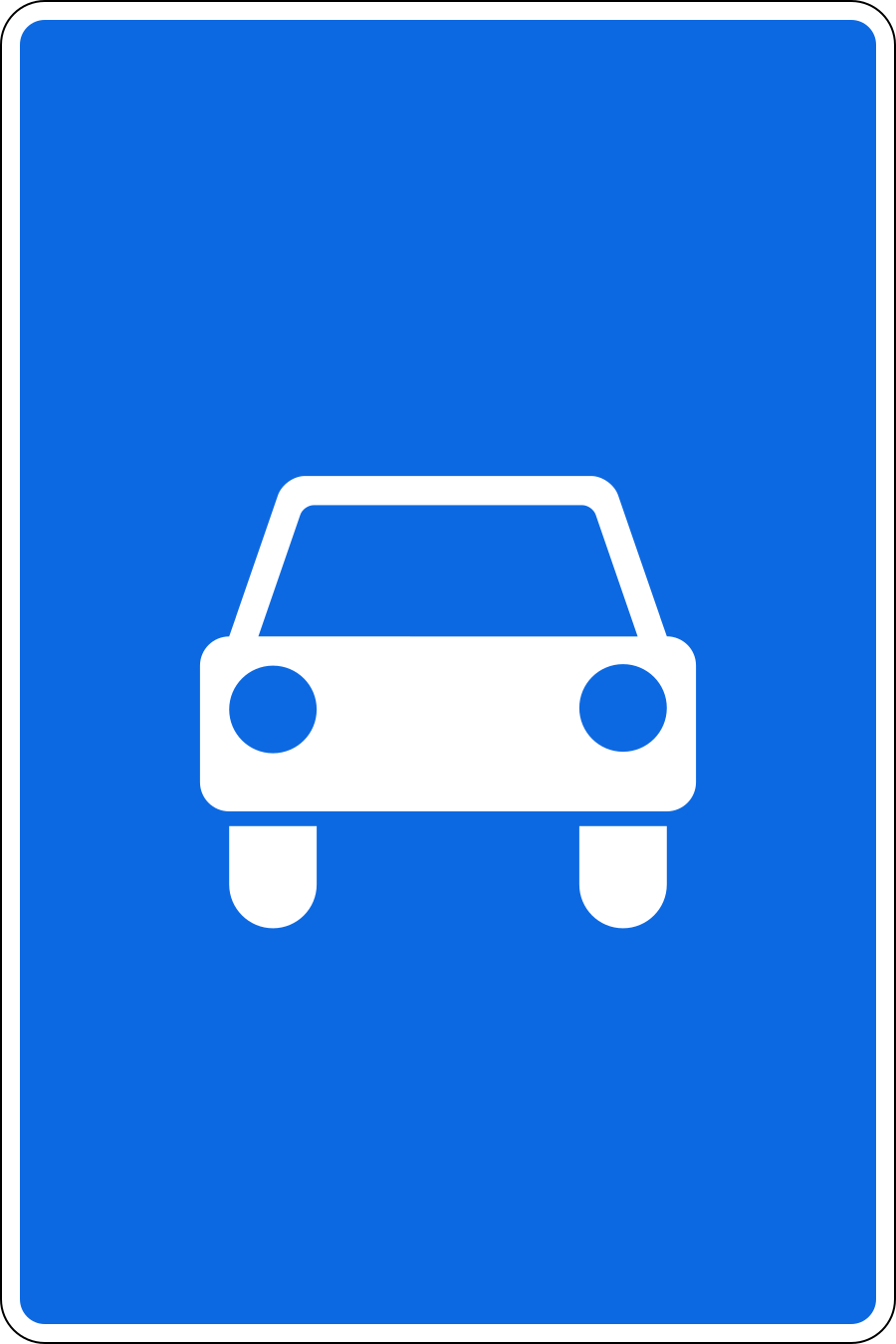
5.3. Road for motor vehicles

A road intended only for the movement of cars and motorcycles.

Ticket #513 — situation image

Do pedestrians walking in a residential zone have the right to obstruct the movement of the white car without good reason?

1 they do not have the right
2 they are allowed, since in a residential zone a pedestrian has priority over other road users
Law explanation
According to subparagraph “d” of paragraph 1 of Article 44 of the Law of Georgia “On Road Traffic”, in residential zones marked with the appropriate sign, a pedestrian must not obstruct the movement of vehicles without good reason. According to paragraph 5.21 of Chapter 5 (Special regulation signs) of Annex 1 to the same Law, road sign 5.21 “Residential zone” indicates an area (zone) where the rules established for traffic in a residential zone apply. The sign is installed at all entrances to such a residential zone.

Road sign used in this ticket

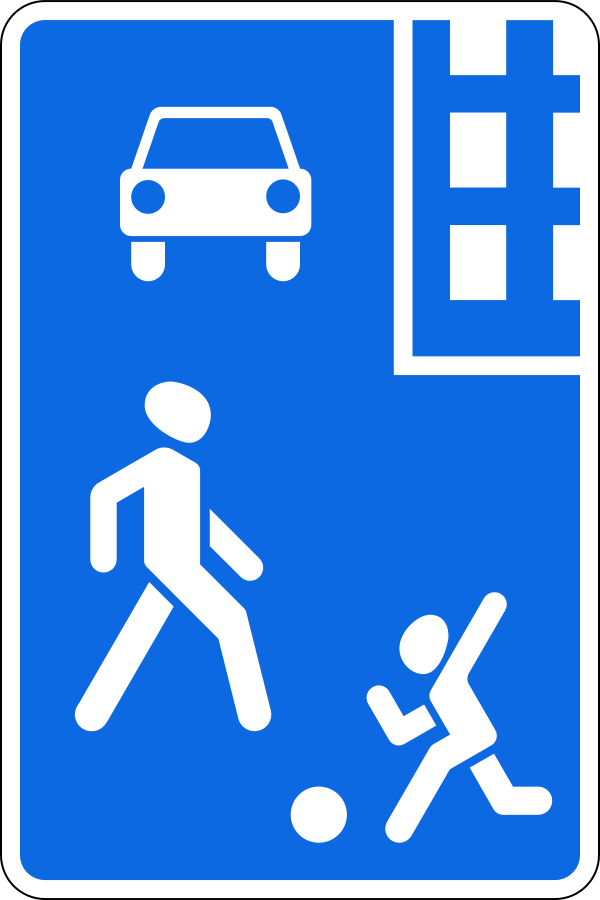
5.21. Residential zone

An area (zone) in which the traffic rules established for residential zones apply. The sign is installed at every entrance to the residential zone.

Ticket #514 — situation image

In the given situation, the driver of which vehicle is violating the rules of driving on a motorway?

1 Only the driver of the moped
2 Only the driver of the bus
3 only drivers of trucks and mopeds
4 only the truck driver
Law explanation
According to subparagraphs “a” and “c.c” of paragraph 1 of Article 38 of the Law of Georgia “On Road Traffic”, on a motorway and at motorway entrances and exits: a) the movement of pedestrians, animals, bicycles, mopeds and all vehicles other than motor cars and their trailers is prohibited; c.c) the driver is prohibited from driving beyond the second lane a goods vehicle (with or without trailers) whose maximum permissible mass exceeds 3.5 tonnes, or vehicles with trailers whose total length exceeds 7 metres. According to paragraph 71 of Article 5 of the same Law, a lorry is a motor vehicle intended for the carriage of goods whose maximum permissible mass exceeds 3,500 kg.
Ticket #515 — situation image

In a residential zone, the driver of a passenger car has the right to move at no more than:

1 at a speed of 20 km/h
2 at a speed of 40 km/h
3 At a speed of 60 km/h
Law explanation
According to Article 33(6) of the Law of Georgia "On Road Traffic", unless otherwise provided by this Law, in a built-up area vehicles are permitted to travel at a speed not exceeding 60 km/h, and in a residential zone at a speed not exceeding 20 km/h. According to Article 44(1)(b) of the same Law, in residential zones marked with the relevant sign, the driver must travel at a speed not exceeding 20 km/h. According to paragraph 5.21 of Chapter 5 (Special regulation signs) of Annex 1 to the same Law, road sign 5.21 "Residential zone" indicates a territory (zone) where the rules established for traffic in a residential zone apply. The sign is placed at all entrances to such a residential zone.

Road sign used in this ticket

5.21. Residential zone

An area (zone) in which the traffic rules established for residential zones apply. The sign is installed at every entrance to the residential zone.

Ticket #518 — situation image

The driver of which car has an obligation to give way when moving in the direction of the arrow?

1 the driver of the bus
2 the passenger car driver
Law explanation
According to Article 44(1)(e) of the Law of Georgia "On Road Traffic", in residential zones marked with the relevant sign, a road user leaving a residential zone must give way at the intersection to other road users. According to paragraph 5.22 of Chapter 5 (Special regulation signs) of Annex 1 to the same Law, road sign 5.22 "End of residential zone" indicates the end of the residential zone marked with the 5.21 "Residential zone" sign. The sign is placed at all exits from the residential zone.

Road sign used in this ticket

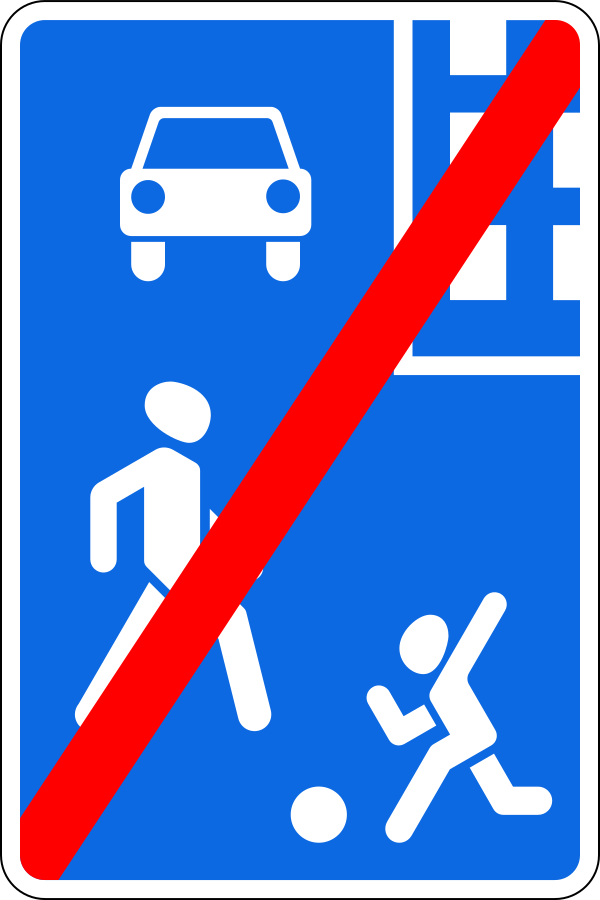
5.22. End of residential zone

Indicates the end of the residential zone marked with sign 5.21. The sign is installed at every exit from the residential zone.

Ticket #519 — situation image

Towards which road user does the driver of the passenger car have an obligation to give way when moving in the direction of the arrow?

1 to the pedestrians as well as to the drivers of the bicycle and the moped
2 only in relation to the moped driver
3 only to the pedestrians
4 only to the cyclist
Law explanation
According to paragraph 5.22 of Chapter 5 (Special regulation signs) of Annex 1 to the Law of Georgia "On Road Traffic", road sign 5.22 "End of residential zone" marks the end of a residential zone marked with sign 5.21 "Residential zone". The sign is installed at all exits from the residential zone. According to Article 44(1)(e) of the same Law, in residential zones marked with the corresponding sign, when leaving the residential zone a road user must give way to other road users at the intersection.

Road sign used in this ticket

5.22. End of residential zone

Indicates the end of the residential zone marked with sign 5.21. The sign is installed at every exit from the residential zone.

When groups of cyclists and mopeds are moving on the carriageway, in order to facilitate overtaking, the distance between the groups must be:

1 40-60 metres
2 60-80 metres
3 80-100 metres
Law explanation
According to paragraph 4 of Article 43 of the Law of Georgia “On Road Traffic”, riders of bicycles and mopeds are permitted to travel in a column. When columns of bicycles and mopeds travel on the carriageway, they must be divided into groups of no more than 10 units each. To facilitate overtaking, the distance between groups must be 80−100 metres.

Is it prohibited to overtake a moped by car at a regulated intersection without moving into the lane for oncoming traffic

1 Is prohibited
2 Is not prohibited
Law explanation
According to paragraph 6 of Article 43 of the Law of Georgia “On Road Traffic”, at an unregulated crossing of a cycle path with a road outside an intersection, riders of bicycles and mopeds must give way to drivers of vehicles travelling on that road.

Which of the actions listed below is not prohibited in places declared pedestrian zones and in residential zones?

1 Driving a car whose design speed exceeds 120 km/h
2 Training run
3 Through traffic of motor vehicles
4 standing of a vehicle with the engine running
Law explanation
According to Article 44(3) of the Law of Georgia "On Road Traffic", in a place designated as a pedestrian zone and in a residential zone, through traffic, driving instruction and parking with the engine running are prohibited; in addition, pedestrians have priority over other road users.

The door of a stationary vehicle on the side of the carriageway, cycle path or cycle lane must not be opened:

1 for more than 15 minutes
2 For more than 20 minutes
3 for more than 5 minutes
4 for longer than the time needed for passengers to board and alight
Law explanation
According to Article 20(6) of the Law of Georgia "On Road Traffic", it is prohibited to open the door of a vehicle before it has come to a complete stop. Opening the door must not create an obstacle or danger for other road users. On the side of the carriageway, cycle path or cycle lane, the door of a vehicle must not be left open longer than the time needed for passengers to get in or out. Passengers may get in or out on the carriageway side or from the rear of the vehicle only if this does not create danger for other road users.

Is it permitted for passengers to board and alight from the side of the carriageway or from the rear of the vehicle?

1 is not allowed
2 is permitted only if this does not create a danger for other road users
Law explanation
According to Article 20(6) of the Law of Georgia "On Road Traffic", it is prohibited to open the door of a vehicle before it has come to a complete stop. Opening the door must not create an obstacle or danger for other road users. On the side of the carriageway, cycle path or cycle lane, the door of a vehicle must not be left open longer than the time needed for passengers to get in or out. Passengers may get in or out on the carriageway side or from the rear of the vehicle only if this does not create danger for other road users.
Practical part

Exam routes — exactly the way the examiner drives them

60 real exam routes across 10 cities, 793 km in total. Every turn and stop on the map, with voice guidance.

  • All routes on the map
  • GPS mode on the real road
  • Practice mode with adjustable speed
  • On the web and in the app

One-off payment, no auto-renewal — by card on the Bank of Georgia secure page.

Chat with us