imecadine.ge

Full ticket list

822 official tickets — category D1, with the correct answer and law explanation.

Ticket #376 — situation image

In the given situation, a U-turn of the car is permitted:

1 only in direction B
2 Only in direction A
3 both in direction A and in direction B
4 Not permitted in either direction
Law explanation
According to subparagraphs “a” and “f” of paragraph 15 of Article 32 of the Law of Georgia “On Road Traffic”, making a U-turn with a vehicle is prohibited: a) on a pedestrian crossing; f) at a place where there is a stop. According to paragraph 5.16 of Chapter 5 (Special regulation signs) of Annex 1 to the same Law, road sign 5.16 “Bus and (or) trolleybus stop” indicates the stopping place for the corresponding type of route vehicle. According to paragraphs 5.19.1 and 5.19.2 of the same Chapter, road signs 5.19.1 and 5.19.2 “Pedestrian crossing” indicate the place on the road allocated for a pedestrian crossing. Sign 5.19.1 is installed on the right side of the road and 5.19.2 on the left side of the road. Where there is no marking 1.14 at the crossing, sign 5.19.1 is installed at the near boundary of the crossing and sign 5.19.2 at the far boundary of the crossing.
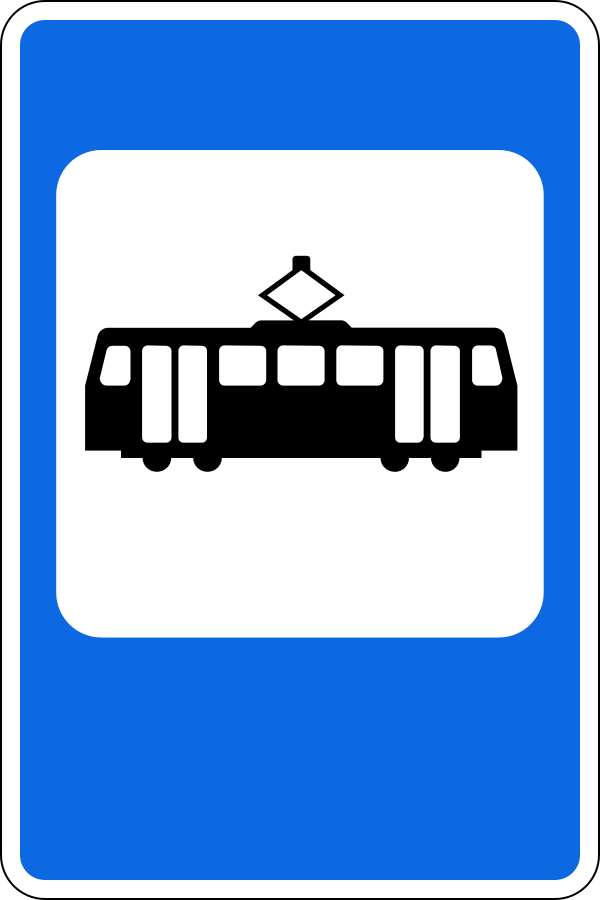
Road sign used in this ticket

5.17. Tram stop

Indicates a tram stop and a taxi rank.

Ticket #377 — situation image

The driver of which car is prohibited from moving in the direction of the arrow?

1 the driver of neither car
2 the drivers of both cars
3 only the driver of the passenger car
4 only the truck driver
Law explanation
According to Article 29(8) of the Law of Georgia "On Road Traffic", at level crossings, at the approach to opening bridges, at ship or ferry landings, at exits of fire engines onto the road and at places where the road is crossed at low altitude by the flight path of aircraft, two alternately flashing or one flashing red or yellow light signals, arranged on one post at the same height and facing the same direction, are used; the red light signal prohibits crossing the "Stop" line, or in its absence, passing beyond the traffic light, and the yellow light signal means that drivers may continue moving but must exercise particular caution. If the coloured light signals are switched off, movement is permitted only when no train (locomotive, draisine) approaching the crossing is visible within the range of visibility. According to Article 32(15)(d) of the same Law, turning a vehicle around on a level crossing is prohibited.
Ticket #378 — situation image

The driver of the red car has passed the right turn. Are they prohibited from reversing in the direction of the arrow to enter the turn?

1 is prohibited
2 is not prohibited
Law explanation
According to Article 38(1)(c.b) of the Law of Georgia "On Road Traffic", on motorways and on motorway entries and exits the driver is prohibited from turning around or reversing, as well as from driving onto the central dividing strip and the transverse connections between the two carriageways of the road. According to paragraph 5.1 of Chapter 5 (Special regulation signs) of Annex 1 to the same Law, road sign 5.1 "Motorway" denotes a motorway on which the requirements of the rules governing traffic on motorways apply.

Road sign used in this ticket

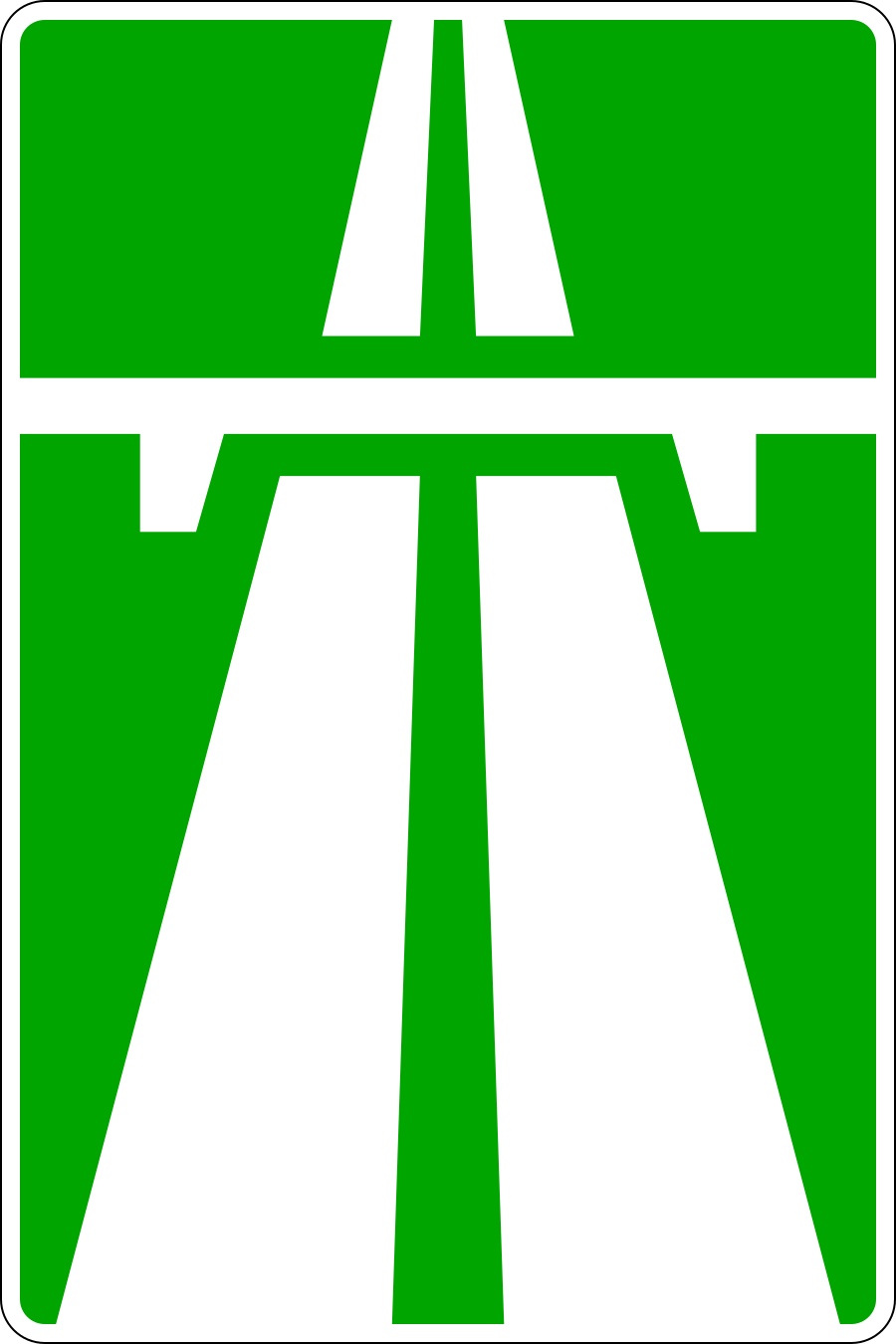
5.1. Motorway

A motorway on which the requirements of the rules governing traffic on motorways apply. The sign is installed at the beginning of the motorway or near it with plate 8.1.1.

Ticket #379 — situation image

The driver of the passenger car has passed the place where the carriageways cross. Is he prohibited from reversing in the direction of the arrow?

1 is prohibited
2 is not prohibited
Law explanation
According to Article 38(1)(c.b) of the Law of Georgia "On Road Traffic", on motorways and on motorway entries and exits the driver is prohibited from turning around or reversing, as well as from driving onto the central dividing strip and the transverse connections between the two carriageways of the road. According to paragraph 5.1 of Chapter 5 (Special regulation signs) of Annex 1 to the same Law, road sign 5.1 "Motorway" denotes a motorway on which the requirements of the rules governing traffic on motorways apply.

Road sign used in this ticket

5.1. Motorway

A motorway on which the requirements of the rules governing traffic on motorways apply. The sign is installed at the beginning of the motorway or near it with plate 8.1.1.

In addition to the maximum speed limit established by law, the driver is prohibited from exceeding:

1 both the maximum design speed established for the vehicle, and the maximum speed indicated on the "Speed limit" identification sign fixed to the vehicle and established by a road sign
2 only the speed indicated on the "Speed limit" identification sign attached to the vehicle
3 only the maximum design speed established for the vehicle
4 only the maximum speed established by a road sign
Law explanation
According to subparagraphs “a”, “b” and “c” of paragraph 9 of Article 33 of the Law of Georgia “On Road Traffic”, in addition to the maximum speed limits defined by paragraphs 6-8 of this Article, the driver is prohibited from: a) exceeding the maximum design speed established for the vehicle; b) exceeding the speed indicated on the “Speed limit” identification sign attached to the vehicle; c) exceeding the maximum speed established by a road sign.
Ticket #383 — situation image

The driver of the passenger car has the right to move:

1 only to the left and to the right
2 only straight ahead and to the right
3 Only to the left
4 Only straight ahead, to the left and in the reverse direction (U-turn)
Law explanation
According to paragraph 7 of Article 32 of the Law of Georgia “On Road Traffic”, before turning right or left to exit onto another road or to enter an area adjacent to the road, without violating the requirements established by paragraph 2 of Article 20 of this Law and paragraphs 1 and 2 of this Article, if the driver of the vehicle intends to leave the road: a) on the right side, the vehicle must move as close as possible to the right edge of the carriageway and then perform as short a manoeuvre as possible; b) on the left side, the vehicle must, as far as possible, approach the centre line of the carriageway (on a two-way road) or the left edge of the carriageway (on a one-way road), and if it intends to exit onto another two-way road, it must perform the turn so that, on leaving the crossing of carriageways, the vehicle does not end up on the side of oncoming traffic. According to paragraph 1.1 of Chapter 1 (Horizontal markings) of Annex 2 to the same Law, horizontal marking 1.1 separates traffic flows moving in opposite directions and, on dangerous sections of the road, indicates the boundaries of lanes or the boundaries of the carriageway which it is prohibited to enter; crossing line 1.1 is prohibited. It is permitted to cross a line 1.1 that indicates the edge of the carriageway and is located on the driver's right side in order to stop the vehicle on the roadside.
Ticket #384 — situation image

The driver of the passenger car has the right to move:

1 Only straight ahead, to the left and in the reverse direction (U-turn)
2 only straight ahead and to the right
3 only to the left and to the right
4 only to the right
Law explanation
According to paragraph 7 of Article 32 of the Law of Georgia “On Road Traffic”, before turning right or left to exit onto another road or to enter an area adjacent to the road, without violating the requirements established by paragraph 2 of Article 20 of this Law and paragraphs 1 and 2 of this Article, if the driver of the vehicle intends to leave the road: a) on the right side, the vehicle must move as close as possible to the right edge of the carriageway and then perform as short a manoeuvre as possible; b) on the left side, the vehicle must, as far as possible, approach the centre line of the carriageway (on a two-way road) or the left edge of the carriageway (on a one-way road), and if it intends to exit onto another two-way road, it must perform the turn so that, on leaving the crossing of carriageways, the vehicle does not end up on the side of oncoming traffic. According to paragraph 1.1 of Chapter 1 (Horizontal markings) of Annex 2 to the same Law, horizontal marking 1.1 separates traffic flows moving in opposite directions and, on dangerous sections of the road, indicates the boundaries of lanes or the boundaries of the carriageway which it is prohibited to enter; crossing line 1.1 is prohibited. It is permitted to cross a line 1.1 that indicates the edge of the carriageway and is located on the driver's right side in order to stop the vehicle on the roadside.
Ticket #385 — situation image

The driver of the car has passed the right turn. Are they prohibited from reversing in the direction of the arrow to enter the turn?

1 is prohibited
2 is not prohibited
Law explanation
According to Article 32(16) of the Law of Georgia "On Road Traffic", a driver who intends to turn around or reverse must make sure that he/she can perform this manoeuvre without endangering or obstructing other road users. If necessary, the assistance of another person is advisable. Reversing is prohibited at an intersection, on a motorway and in the places defined by paragraph 15 of this Article.

When tram tracks are located in the middle of the carriageway of a two-way road, at the same level with it, the following is considered to divide the opposite directions of traffic:

1 The left track of the tram travelling in the opposite direction
2 The imaginary centre line between the tram tracks running in opposite directions
3 the right-hand track of a tram moving in the same direction
Law explanation
According to Article 31(3) of the Law of Georgia "On Road Traffic", on a two-way road where tram tracks are located in the middle of the carriageway at the same level as it, the imaginary centre line between the tram tracks running in opposite directions is regarded as the divider between the sides of opposing traffic.
Ticket #388 — situation image

The driver of the passenger car has the right to move:

1 only in direction B
2 Only in direction A
3 both in direction A and in direction B
Law explanation
According to subparagraph “b” of paragraph 7 of Article 32 of the Law of Georgia “On Road Traffic”, before turning right or left to exit onto another road or to enter an area adjacent to the road, without violating the requirements established by paragraph 2 of Article 20 of this Law and paragraphs 1 and 2 of this Article, if the driver of the vehicle intends to leave the road on the left side, the vehicle must, as far as possible, approach the centre line of the carriageway (on a two-way road) or the left edge of the carriageway (on a one-way road), and if it intends to exit onto another two-way road, it must perform the turn so that, on leaving the crossing of carriageways, the vehicle does not end up on the side of oncoming traffic.

Road sign used in this ticket

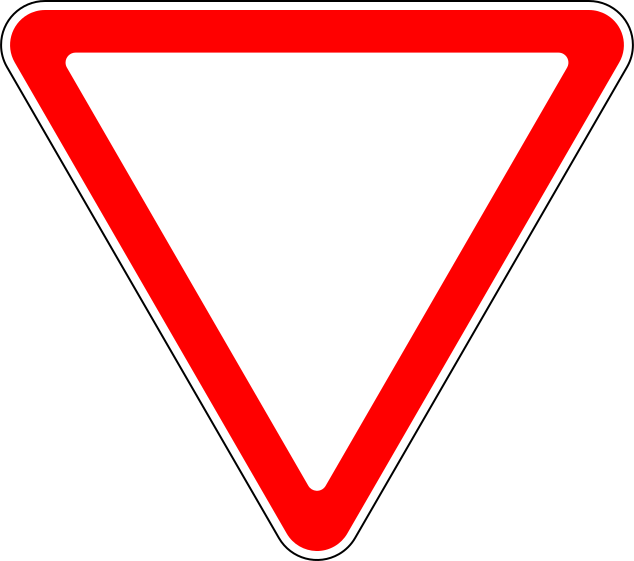
2.3. Give way

The driver on this road must give way to drivers moving on the road being crossed, and where plate 8.13 is present – to drivers on the main road. Outside built-up areas, sign 2.3 is placed in advance, 150−300 m before the intersection, with plate 8.1.1 if sign 2.3 is installed before the intersection, or with plate 8.1.2 if sign 2.4 is installed before the intersection. The sign applies to the intersection of carriageways before which the corresponding sign is installed.

Ticket #389 — situation image

The driver of the passenger car has the right to move:

1 Only in direction A
2 Only in direction C
3 in neither direction
4 only in direction B
Law explanation
According to Article 31(17) of the Law of Georgia "On Road Traffic", when turning in order to enter a carriageway with reversible traffic, the driver of a vehicle must move so that, on leaving the intersection of carriageways, he/she occupies the extreme right-hand lane. Changing to another lane is permitted only after the driver makes sure that traffic in the same direction is permitted in that lane. According to paragraph 5.10 of Chapter 5 (Special regulation signs) of Annex 1 to the same Law, road sign 5.10 "Exit onto a road with reversible traffic" indicates exit onto a road section marked with sign 5.8 "Reversible traffic". The sign is placed before every side exit. The sign may not be placed at the intersection of an exit from an adjacent area with the road if entry to that area is possible only from the road marked with sign 5.8 "Reversible traffic".

Road sign used in this ticket

2.3. Give way

The driver on this road must give way to drivers moving on the road being crossed, and where plate 8.13 is present – to drivers on the main road. Outside built-up areas, sign 2.3 is placed in advance, 150−300 m before the intersection, with plate 8.1.1 if sign 2.3 is installed before the intersection, or with plate 8.1.2 if sign 2.4 is installed before the intersection. The sign applies to the intersection of carriageways before which the corresponding sign is installed.

5.10. Entry to a road with reversible traffic

Indicates entry to a section of road marked with sign 5.8. The sign is installed before every side exit. The sign may be omitted at the junction of a road with an exit from an adjacent area if entry into that area is possible only from the road marked with sign 5.8.

Ticket #390 — situation image

How many carriageways does the given road have?

1 three
2 four
3 one
4 two
Law explanation
According to paragraph 15 of Article 5 of the Law of Georgia "On Road Traffic", the carriageway of a road (carriageway) is an element of the road intended for the movement of trackless vehicles (except the pavement, kerb-side strip, cycle path and footpath). According to paragraph 12 of the same Article, a road is the entire surface of a road or street open to traffic. A road may have either one carriageway or several carriageways clearly separated by a dividing strip or located at different levels. This term may include tram tracks, the pavement, the kerb-side strip, the dividing strip and the cycle path.
Ticket #391 — situation image

How many carriageways does the given road have?

1 one
2 two
3 three
Law explanation
According to paragraph 15 of Article 5 of the Law of Georgia "On Road Traffic", the carriageway of a road (carriageway) is an element of the road intended for the movement of trackless vehicles (except the pavement, kerb-side strip, cycle path and footpath). According to paragraph 12 of the same Article, a road is the entire surface of a road or street open to traffic. A road may have either one carriageway or several carriageways clearly separated by a dividing strip or located at different levels. This term may include tram tracks, the pavement, the kerb-side strip, the dividing strip and the cycle path.

Is it prohibited for a trackless vehicle to drive onto the track of a tram moving in the opposite direction?

1 It is not prohibited if all lanes for traffic in the same direction are occupied
2 Is prohibited
Law explanation
According to Article 31(15) of the Law of Georgia "On Road Traffic", subject to the requirements established by Article 32(6) of this Law, driving is permitted on tram tracks of the same direction located on the left at the same level as the carriageway if all lanes intended for traffic in the same direction are occupied, as well as when bypassing an obstacle or overtaking, or when turning left or turning around. In doing so, tram traffic must not be obstructed. Entering tram tracks of the opposite direction is prohibited.

In which of the places listed below is making a U-turn with a vehicle prohibited?

1 only on a road where visibility in at least one direction is less than 100 metres
2 only on a motorway
3 only at a place where there is a stopping point
4 at any of the places listed in this ticket
Law explanation
According to subparagraphs "e" and "f" of paragraph 15 of Article 32 of the Law of Georgia "On Road Traffic", making a U-turn with a vehicle is prohibited: e) on a road where visibility in at least one direction is less than 100 metres; f) at a place where there is a stop. According to subparagraph "c.b" of paragraph 1 of Article 38 of the same Law, on motorways and at motorway entrances and exits the driver is prohibited from making a U-turn or reversing, as well as from driving onto the central dividing strip or the transverse connections between the two carriageways of the road.

If the paths of vehicles intersect and the order of passage is not determined, the driver must give way to the vehicle approaching:

1 from the left
2 from the right
Law explanation
According to paragraph 12 of Article 32 of the Law of Georgia “On Road Traffic”, if the paths of vehicles cross and the order of passing is not determined, the driver must give way to the vehicle approaching from the right.

In which of the places listed below is reversing a vehicle prohibited?

1 only on a motorway
2 only at an intersection
3 at any of the places listed in this ticket
4 Only in a tunnel
Law explanation
According to Article 32(15)(b) and Article 32(16) of the Law of Georgia "On Road Traffic": 15. "b" turning a vehicle around in a tunnel is prohibited; 16. A driver who intends to turn around or reverse must make sure that he/she can perform this manoeuvre without creating danger or obstruction for other road users. If necessary, it is advisable to get help from another person. Reversing is prohibited at intersections, on motorways and in the places specified in paragraph 15 of this Article.

If a safety island, bollard or device is located on the axis of the carriageway of a two-way road, the driver must pass it:

1 from the right or the left side
2 only from the left side
3 only from the right side
Law explanation
According to Article 32(17)(b) of the Law of Georgia "On Road Traffic", subject to the requirements established by this Article, the driver may pass on the right or left of a traffic island, bollard or other device placed on the carriageway on which he is travelling, except where the traffic island, bollard or other device is located on the centre line of the carriageway of a two-way road. In this case the driver must pass the traffic island, bollard or other device only on the right-hand side.
Ticket #402 — situation image

Is the driver of the passenger car obliged to switch on the right-turn indicator when moving in the direction of the arrow, if no vehicle is moving behind him?

1 is not obliged
2 is obliged
Law explanation
According to Article 32(2) of the Law of Georgia "On Road Traffic", before starting a manoeuvre the driver must switch on the direction indicator for the corresponding direction, and if there is none or it is out of order, signal by hand.

Road sign used in this ticket

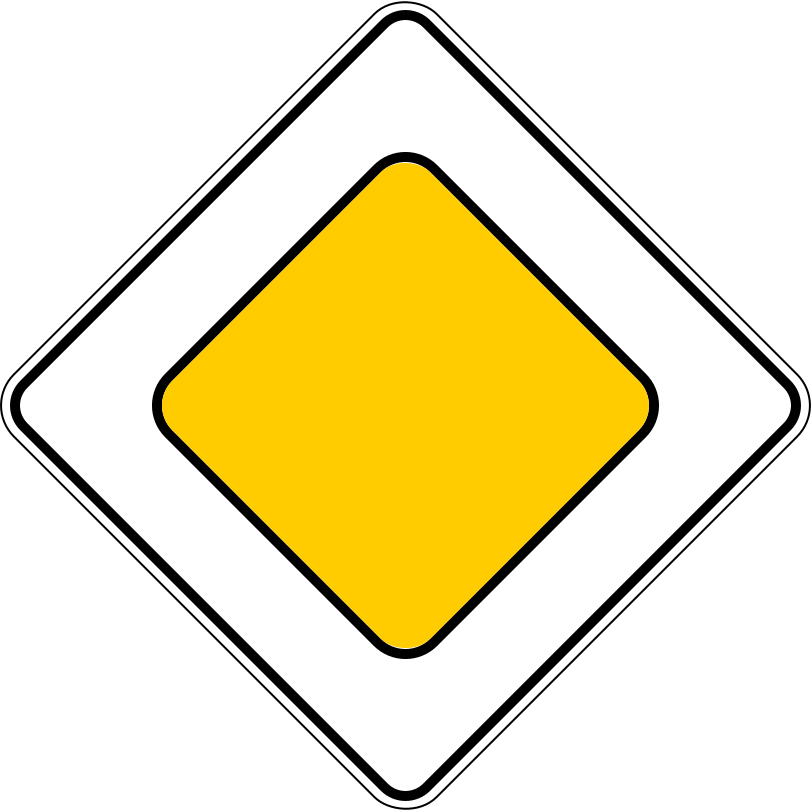
2.1. Priority road

A road on which drivers have priority when passing through unregulated intersections. The sign is installed at the beginning of the road and repeated immediately before every intersection. Sign 2.1 with plate 8.13 is installed in built-up areas before an intersection at which the main road changes direction; outside built-up areas − in advance, 150−300 m before the intersection, and before the intersection.

8.13. Direction of the main road

Indicates the direction of the main road at an intersection. The plate is used with signs 2.1, 2.3 and 2.4 when the main road changes direction at the intersection.

Ticket #403 — situation image

Is the driver of the passenger car obliged to switch on the left direction indicator when travelling in the direction of the arrow?

1 is not obliged
2 is obliged
Law explanation
According to Article 32(2) of the Law of Georgia "On Road Traffic", before starting a manoeuvre the driver must switch on the direction indicator for the corresponding direction, and if there is none or it is out of order, signal by hand.

Road sign used in this ticket

2.2. End of priority road

The end of the section of road at which it loses its main road status. If the main road ends before an intersection with a road that has priority at that intersection, sign 2.2 is installed outside built-up areas in advance together with sign 2.4, and in built-up areas − 25 m from the intersection and/or together with sign 2.3 or 2.4. The sign may also be installed at another distance indicated on plate 8.1.1.

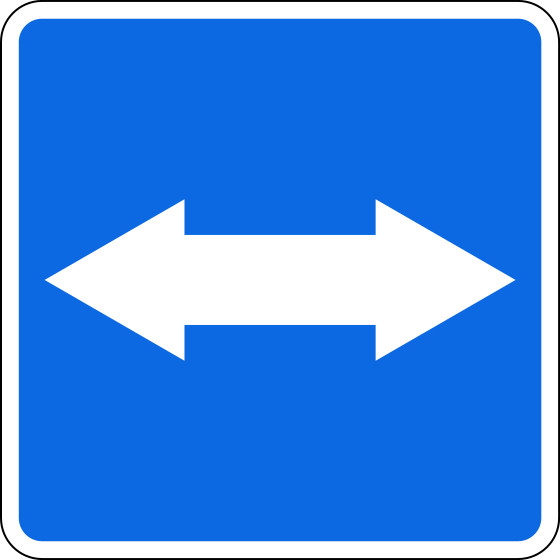
4.1.6. Turn right or left

Requires the driver to proceed only to the right or to the left. The sign also permits U-turns. The sign applies to the intersection of carriageways before which it is installed; the sign does not apply to route (public transport) vehicles.

Practical part

Exam routes — exactly the way the examiner drives them

60 real exam routes across 10 cities, 793 km in total. Every turn and stop on the map, with voice guidance.

  • All routes on the map
  • GPS mode on the real road
  • Practice mode with adjustable speed
  • On the web and in the app

One-off payment, no auto-renewal — by card on the Bank of Georgia secure page.

Chat with us