imecadine.ge

Stopping and parking

34 official tickets in this topic, with the correct answer and law explanation.

Where stopping is banned, where parking is banned, forced stops.

Parking of a vehicle is not prohibited:

1 In the zone of effect of a road sign prohibiting stopping
2 It is prohibited in all the places listed in this ticket
3 on the carriageway closer than 50 metres to a level crossing
4 At a vehicle exit from a courtyard
Law explanation
According to subparagraphs “a”, “b” and “d” of paragraph 7 of Article 37 of the Law of Georgia “On Road Traffic”, parking of vehicles is prohibited: a) where stopping is prohibited; b) on the carriageway closer than 50 metres to a level crossing; d) at a vehicle exit from a yard.

The driver of a vehicle must use the hazard warning lights:

1 to warn other road users of an impending danger
2 to gain an advantage over other road users
Law explanation
According to Article 52(1) of the Law of Georgia "On Road Traffic", hazard warning lights are used to warn other road users of a potential danger.

The driver of a vehicle is obliged to switch on the hazard warning lights (if fitted):

1 during a forced stop at a place where stopping is prohibited
2 When passing a pedestrian crossing at high speed
3 When making a U-turn beyond the intersection
Law explanation
According to Article 52(1)(b) of the Law of Georgia "On Road Traffic", hazard warning lights are used to warn other road users of possible danger. Hazard warning lights must be switched on: b) when forced to stop at a place where stopping is prohibited.

In the event of a forced stop at places where stopping is prohibited, the driver must immediately put out the warning triangle (or a similar effective device):

1 Both after switching on the hazard warning lights, and if such lights are not fitted or are out of order
2 only after switching on the hazard warning lights
3 only if there are no hazard warning lights or they are out of order
Law explanation
According to Article 52(2)(b) of the Law of Georgia "On Road Traffic", after switching on the hazard warning lights, and also if such lights are absent or out of order, the driver must immediately place a "Warning triangle", and in conditions of insufficient visibility, a flashing red lamp: b) when forced to stop at a place where stopping is prohibited, and where, given the visibility conditions, other drivers will not be able to notice the vehicle in time.
Ticket #1253 — situation image

Does the driver of the passenger car have the right to stop at the place indicated by the arrow to let a passenger alight?

1 does not have the right
2 Has the right
Law explanation
According to paragraph 1.4 of Chapter 1 (Horizontal markings) of Annex 2 of the Law of Georgia “On Road Traffic”, road marking 1.4, a solid yellow line, marks a place where stopping is prohibited; it is used on its own or together with sign 3.27; it is drawn along the edge of the carriageway or on top of the kerb.
Ticket #1263 — situation image

The driver of the passenger car has the right to stop:

1 only at place A
2 Only at place B
3 At neither place A nor place B
Law explanation
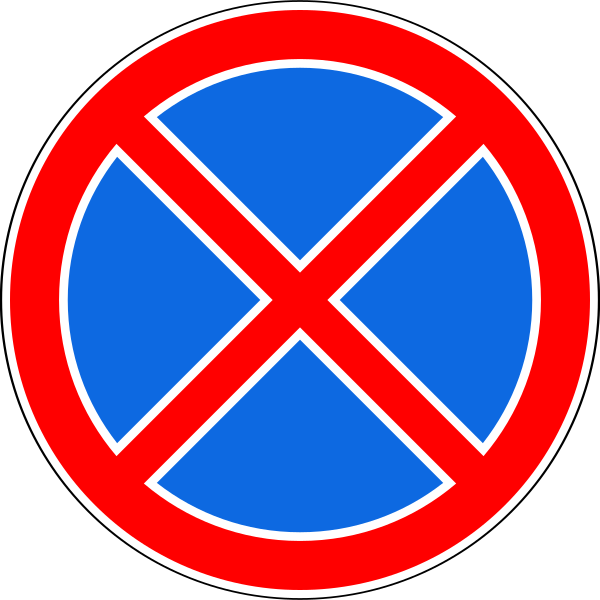
According to paragraph 1.4 of Chapter 1 (Horizontal markings) of Annex 2 of the Law of Georgia “On Road Traffic”, road marking 1.4, a solid yellow line, marks a place where stopping is prohibited; it is used on its own or together with sign 3.27; it is drawn along the edge of the carriageway or on top of the kerb. According to paragraph 3.27 of Chapter 3 (Prohibitory signs) of Annex 1 of the same Law and subparagraph “i” of the note to the same Chapter, road sign 3.27 “No stopping” - prohibits both stopping and parking of vehicles. Sign 3.27 may be used together with marking 1.4, and sign 3.28 – together with marking 1.10. In that case the zone of effect of the signs is determined by the length of the marking line.

Road sign used in this ticket

3.27. No stopping

Prohibits both stopping and parking of vehicles. The sign does not apply to route (public transport) vehicles. The sign applies from the place where it is installed to the nearest intersection behind it, and in a built-up area with no intersection – to the end of the built-up area. The sign's effect is also not interrupted at exits from adjacent areas or at intersections (junctions) with field, forest and other minor roads before which no corresponding sign is installed. The sign applies only to the side of the road on which it is installed.

Ticket #1269 — situation image

The driver of the passenger car has the right to stop:

1 only at place A
2 both at place A and at place B
3 Only at place B
Law explanation
According to Article 37(6)(a.a) and (a.c) of the Law of Georgia "On Road Traffic", stopping a vehicle on the carriageway is prohibited: a.a) on pedestrian and cyclist crossings and closer than 5 metres before them; a.c) at the intersection of carriageways, and also closer than 5 metres from the edges of the intersecting carriageways, except when stopping at three-way intersections (junctions) opposite side exits where there is a solid marking line or a dividing strip.

Road sign used in this ticket

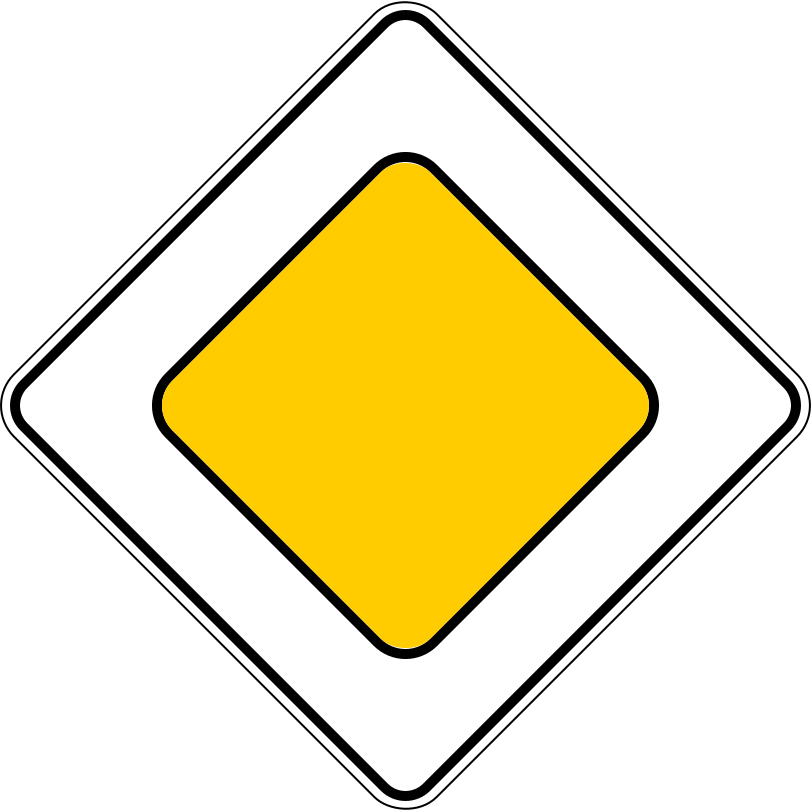
2.1. Priority road

A road on which drivers have priority when passing through unregulated intersections. The sign is installed at the beginning of the road and repeated immediately before every intersection. Sign 2.1 with plate 8.13 is installed in built-up areas before an intersection at which the main road changes direction; outside built-up areas − in advance, 150−300 m before the intersection, and before the intersection.

The strokes of a four-stroke engine are:

1 intake, compression, idle stroke and power stroke
2 Intake, compression, reverse stroke and exhaust
3 idle stroke, intake, power stroke and exhaust
4 intake, compression, power stroke and exhaust
Law explanation
The strokes of a four-stroke engine are: intake, compression, power stroke and exhaust.

List the types of engines according to the number of strokes:

1 one-stroke and four-stroke
2 one-stroke, two-stroke and four-stroke
3 Two-stroke, three-stroke and four-stroke
4 two-stroke and four-stroke
Law explanation
By the number of strokes, engines are of two types: two-stroke and four-stroke.

According to what are agricultural tractors classified?

1 By engine, transmission, drive, cooling and fuel used
2 By purpose, running gear, frame, engine power, transmission and tractive force
3 By running gear, overall dimensions, lighting system and suspension system
Law explanation
Agricultural tractors are classified according to purpose, running gear, frame, engine power, transmission and tractive force.

How are motor vehicles classified according to their purpose?

1 high-speed, slow-moving, heavy and light
2 heavy and light
3 transport, cargo and special
4 High-speed and slow-speed
Law explanation
According to purpose, motor vehicles are classified as transport, cargo and special vehicles.

List agricultural trailers and semi-trailers:

1 trailers for transporting agricultural cargo, trailers for transporting animals, trailers for distributing feed
2 single-axle trailers, two-axle trailers
3 self-propelled trailers, hay-carrying trailers, livestock-carrying trailers
Law explanation
Agricultural trailers and semi-trailers include: trailers for carrying agricultural goods, trailers for transporting animals, and trailers for distributing feed.

According to what features are internal combustion engines classified?

1 according to the combustion chamber volume, piston stroke, number of pistons, number of cylinders, arrangement of cylinders, working process, and the numbers of working strokes and idle strokes
2 according to purpose, type of fuel, cylinder firing order, combustion chamber volume, piston diameter, number of pistons
3 according to purpose, fuel mixture formation, fuel ignition, number of strokes, number of cylinders, arrangement of cylinders, type of fuel used, cooling system
Law explanation
Internal combustion engines are classified by purpose, mixture formation, fuel ignition, number of strokes, number of cylinders, cylinder arrangement, type of fuel used and cooling system.

What parts does a crank-and-connecting-rod mechanism consist of?

1 connecting rod, eccentric gear, shaft, flywheel
2 piston, piston pin, connecting rod, crankshaft
3 Crankshaft, piston rings, connecting rod
Law explanation
The crank mechanism consists of the piston, the piston pin, the connecting rod and the crankshaft.
Practical part

Exam routes — exactly the way the examiner drives them

60 real exam routes across 10 cities, 793 km in total. Every turn and stop on the map, with voice guidance.

  • All routes on the map
  • GPS mode on the real road
  • Practice mode with adjustable speed
  • On the web and in the app

One-off payment, no auto-renewal — by card on the Bank of Georgia secure page.

Chat with us