imecadine.ge

Residential zones and public transport

17 official tickets in this topic, with the correct answer and law explanation.

Pedestrian priority in yards and priority of route vehicles.

If there is no pedestrian crossing or intersection within the zone of visibility, a pedestrian is permitted to cross the road perpendicular to the axis of the carriageway, on a section where:

1 there is no dividing strip or barrier and the road is clearly visible in both directions
2 there is a dividing strip and the road is clearly visible in both directions
Law explanation
According to Article 24(8) of the Law of Georgia "On Road Traffic", if there is no pedestrian crossing or intersection within visibility, crossing the road is permitted perpendicular to the axis of the carriageway, on a section where there is no dividing strip or fence and the road is clearly visible in both directions.
Ticket #513 — situation image

Do pedestrians walking in a residential zone have the right to obstruct the movement of the white car without good reason?

1 they do not have the right
2 they are allowed, since in a residential zone a pedestrian has priority over other road users
Law explanation
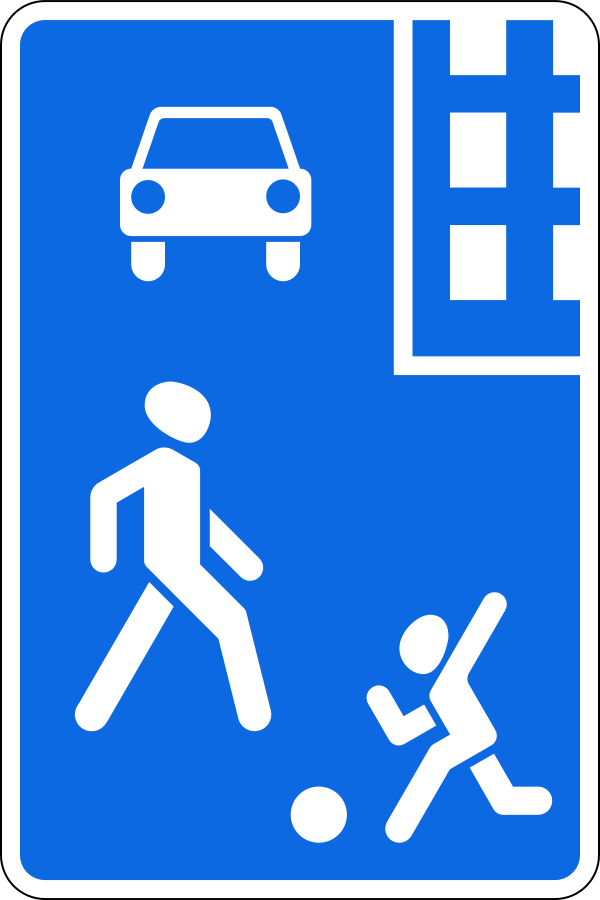
According to subparagraph “d” of paragraph 1 of Article 44 of the Law of Georgia “On Road Traffic”, in residential zones marked with the appropriate sign, a pedestrian must not obstruct the movement of vehicles without good reason. According to paragraph 5.21 of Chapter 5 (Special regulation signs) of Annex 1 to the same Law, road sign 5.21 “Residential zone” indicates an area (zone) where the rules established for traffic in a residential zone apply. The sign is installed at all entrances to such a residential zone.

Road sign used in this ticket

5.21. Residential zone

An area (zone) in which the traffic rules established for residential zones apply. The sign is installed at every entrance to the residential zone.

Ticket #515 — situation image

In a residential zone, the driver of a passenger car has the right to move at no more than:

1 at a speed of 20 km/h
2 at a speed of 40 km/h
3 At a speed of 60 km/h
Law explanation
According to Article 33(6) of the Law of Georgia "On Road Traffic", unless otherwise provided by this Law, in a built-up area vehicles are permitted to travel at a speed not exceeding 60 km/h, and in a residential zone at a speed not exceeding 20 km/h. According to Article 44(1)(b) of the same Law, in residential zones marked with the relevant sign, the driver must travel at a speed not exceeding 20 km/h. According to paragraph 5.21 of Chapter 5 (Special regulation signs) of Annex 1 to the same Law, road sign 5.21 "Residential zone" indicates a territory (zone) where the rules established for traffic in a residential zone apply. The sign is placed at all entrances to such a residential zone.

Road sign used in this ticket

5.21. Residential zone

An area (zone) in which the traffic rules established for residential zones apply. The sign is installed at every entrance to the residential zone.

Which of the actions listed below is not prohibited in places declared pedestrian zones and in residential zones?

1 Driving a car whose design speed exceeds 120 km/h
2 Training run
3 Through traffic of motor vehicles
4 standing of a vehicle with the engine running
Law explanation
According to Article 44(3) of the Law of Georgia "On Road Traffic", in a place designated as a pedestrian zone and in a residential zone, through traffic, driving instruction and parking with the engine running are prohibited; in addition, pedestrians have priority over other road users.

In places declared pedestrian zones and in residential zones, priority of movement over other road users is given to:

1 To drivers
2 to pedestrians
Law explanation
According to Article 44(3) of the Law of Georgia "On Road Traffic", in a place designated as a pedestrian zone and in a residential zone, through traffic, driving instruction and parking with the engine running are prohibited; in addition, pedestrians have priority over other road users.
Ticket #619 — situation image

Which of the given combinations of road signs is installed outside a built-up area before a level crossing without a barrier, at a distance of 150-300 metres, on the left side of the road?

1 II
2 IV
3 I
4 III
Law explanation
According to subparagraphs (a), (b) and (f) of the note to Chapter 1 (Warning signs) of Annex 1 to the Law of Georgia "On Road Traffic": a) signs 1.1 "Level crossing with barrier" and 1.2 "Level crossing without barrier" are placed outside a built-up area at a distance of 150−300 metres before the beginning of the dangerous section; b) signs 1.1 "Level crossing with barrier", 1.2 "Level crossing without barrier", 1.10 "Drawbridge", 1.11 "Quayside or river bank", 1.23 "Pedestrian crossing", 1.24 "Children" and 1.26 "Roadworks" are repeated outside a built-up area, and signs 1.24 and 1.26 also in a built-up area. The second sign is placed at a distance of not less than 50 metres from the beginning of the dangerous section; f) signs 1.4.1–1.4.3 "Approach to a level crossing" are placed on the right side of the road, and signs 1.4.4–1.4.6 "Approach to a level crossing" on the left side. Signs 1.4.1 and 1.4.4 are placed in the direction of travel together with the primary and duplicate sign 1.1 or 1.2. Signs 1.4.3 and 1.4.6 are placed in the direction of travel with the repeated sign 1.1 or 1.2, and signs 1.4.2 and 1.4.5 independently, at an equal distance between the primary and repeated sign 1.1 or 1.2.
Ticket #623 — situation image

Which of the given road signs indicates an exit to an embankment or the shore of a reservoir?

1 only III
2 Only I and II
3 only II
4 only I and IV
Law explanation
According to paragraph 1.11 of Chapter 1 (Warning signs) of Annex 1 to the Law of Georgia “On Road Traffic”, road sign 1.11 “Embankment exit” designates an exit onto an embankment or the shore of a reservoir.
Ticket #627 — situation image

Which of the given road signs indicates a section of road with dangerous bends?

1 III
2 IV
3 I
4 II
Law explanation
According to paragraphs 1.13.1 and 1.13.2 of Chapter 1 (Warning signs) of Annex 1 to the Law of Georgia “On Road Traffic”, road signs 1.13.1, 1.13.2 “Dangerous bends” indicate a section of road with dangerous bends: 1.13.1 – with the first bend to the right, 1.13.2 – with the first bend to the left.
Ticket #629 — situation image

Which of the road signs shown warns of the approach to a section of road with a steep ascent?

1 IV
2 II
3 III
4 I
Law explanation
According to paragraph 1.15 of Chapter 1 (Warning signs) of Annex 1 to the Law of Georgia “On Road Traffic”, road sign 1.15 “Steep ascent” warns of approaching a section of road with a steep ascent.
Ticket #637 — situation image

Which of the given road signs designates a section of road whose carriageway narrows on the left side?

1 I
2 IV
3 II
4 III
Law explanation
According to paragraphs 1.21.1–1.21.3 of Chapter 1 (Warning signs) of Annex 1 to the Law of Georgia "On Road Traffic", road signs 1.21.1–1.21.3 "Road narrows" indicate a section of road where the width of the carriageway narrows: 1.21.1 – on both sides; 1.21.2 – on the right; 1.21.3 – on the left.
Ticket #643 — situation image

Which of the given road signs indicates a section of road passing by a livestock (cattle) shed, farms and/or a place of regular livestock (cattle) driving, where their appearance on the carriageway is likely?

1 I
2 III
3 IV
4 II
Law explanation
According to paragraph 1.27 of Chapter 1 (Warning signs) of Annex 1 to the Law of Georgia "On Road Traffic", road sign 1.27 "Cattle crossing" denotes a road section passing by a livestock (cattle) shed, a farm and/or a place where livestock (cattle) are regularly driven across, where they may be expected to appear on the carriageway.
Ticket #644 — situation image

Which of the given road signs designates road sections passing by a nature reserve, hunting ground or forest, or other areas where wild animals may appear?

1 III
2 II
3 I
4 IV
Law explanation
According to paragraph 1.28 of Chapter 1 (Warning signs) of Annex 1 to the Law of Georgia "On Road Traffic", road sign 1.28 "Wild animals" denotes a section of road passing a nature reserve, a hunting ground or a forest, or another section where wild animals may be expected to appear.

According to the international standard, tractors undergo:

1 per-shift, periodic and seasonal technical maintenance, current repairs and major overhaul
2 periodic and seasonal technical maintenance, current repairs and major overhaul
3 Daily (per-shift) and seasonal technical maintenance, current repair and major overhaul
4 per-shift, periodic and seasonal technical maintenance, as well as current repairs
Law explanation
According to the international standard, tractors undergo per-shift, periodic and seasonal technical maintenance, routine repair and major overhaul.

Cleaning of open channels is carried out:

1 with milling-type ditch-cleaning machines
2 with a continuous-action channel-cleaning machine
3 With ditch-cleaning machines with active and passive working bodies
Law explanation
Open channels are cleaned by channel-cleaning machines with active and passive working tools.

Open ditches are constructed:

1 with trenching machines with active and combined as well as plough-type working elements
2 only with active and plough-type ditch-digging machines
3 Only with ditch-digging machines with active and combined working bodies
Law explanation
Open channels are dug both by ditching machines with active and combined working bodies and by those with plough-type working bodies.

The distance between the buckets of a continuous-action ditch-cleaning machine is taken within the following limits:

1 from 0.4 metres to 0.6 metres
2 from 0.2 metres to 0.4 metres
3 From 0.6 metres to 1.0 metre
Law explanation
The distance between the buckets of a continuous-action ditch-cleaning machine is taken within the range of 0.2 metres to 0.4 metres.

Levelling of spoil banks is carried out:

1 by means of the bulldozer blade
2 with a single-bucket excavator
3 with a milling working part
Law explanation
Levelling of spoil banks is performed with the bulldozer blade. Levelling of the slope and bottom of a ditch is performed with a passive blade.
Practical part

Exam routes — exactly the way the examiner drives them

60 real exam routes across 10 cities, 793 km in total. Every turn and stop on the map, with voice guidance.

  • All routes on the map
  • GPS mode on the real road
  • Practice mode with adjustable speed
  • On the web and in the app

One-off payment, no auto-renewal — by card on the Bank of Georgia secure page.

Chat with us