imecadine.ge

Prohibitory signs

48 official tickets in this topic, with the correct answer and law explanation.

Round signs that restrict or prohibit movement.

Ticket #766 — situation image

Which of the given road signs applies from the place where the sign is installed to the nearest intersection following it, and in a built-up area, if there is no intersection, to the end of the built-up area.

1 Only II and III
2 Only I, II and IV
3 only I
4 of all the given road signs
Law explanation
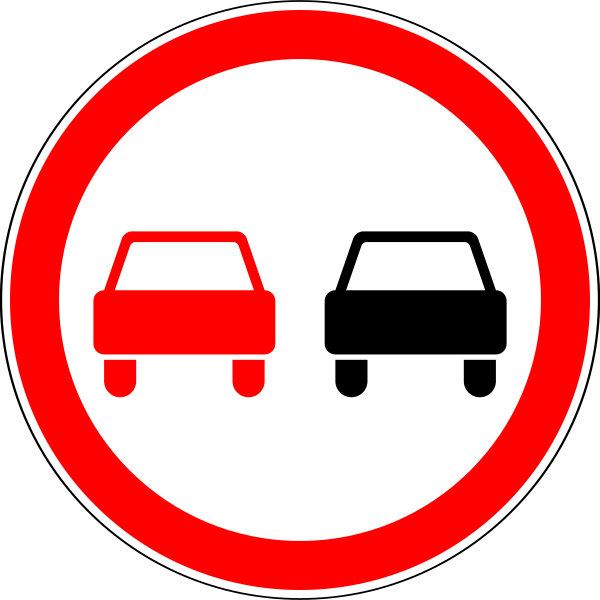
According to point “e” of the note to Chapter 3 (Prohibitory signs) of Annex 1 of the Law of Georgia “On Road Traffic”, the effect of signs 3.16, 3.20, 3.22, 3.24, 3.26–3.30 extends after the corresponding sign, from the place where the sign is placed to the nearest junction, and in a built-up area where there is no junction – to the end of the built-up area. The effect of the signs also extends past exits from adjacent areas and intersections (joinings) with field, forest and other minor roads before which the corresponding sign is not placed. The signs shown in the picture are: 3.20 “No overtaking”, 3.26 “Use of horn prohibited”, 3.2 “No entry for any vehicles” and 3.29 “No parking on odd-numbered days”.

Road sign used in this ticket

3.20. No overtaking

Prohibits overtaking all types of motor vehicles (except vehicles moving at less than 30 km/h). Overtaking motorcycles without a sidecar, mopeds and bicycles is permitted without crossing into the oncoming lane. The sign applies from the place where it is installed to the nearest intersection behind it, and in a built-up area with no intersection – to the end of the built-up area. The sign's effect is also not interrupted at exits from adjacent areas or at intersections (junctions) with field, forest and other minor roads before which no corresponding sign is installed.
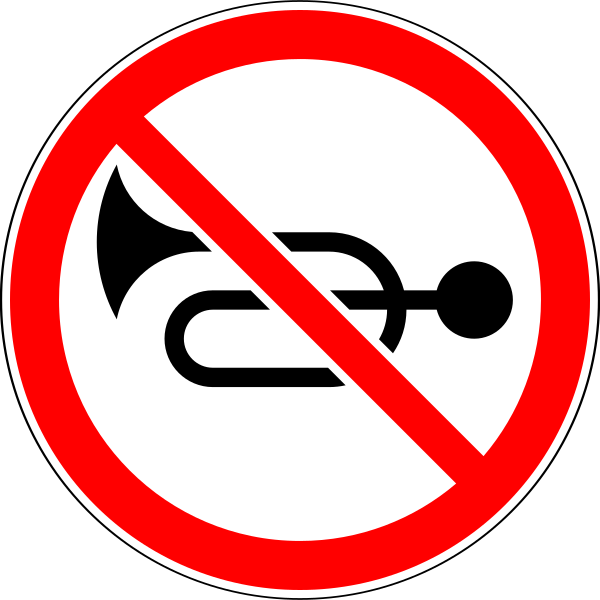
3.26. Use of horn prohibited

Prohibits the use of the horn, except when the signal is used to prevent a road traffic accident. The sign applies from the place where it is installed to the nearest intersection behind it, and in a built-up area with no intersection – to the end of the built-up area. The sign's effect is also not interrupted at exits from adjacent areas or at intersections (junctions) with field, forest and other minor roads before which no corresponding sign is installed.

3.2. No vehicles

Prohibits the movement of all types of vehicles. The sign indicates that traffic is prohibited in both directions. The sign does not apply to route (public transport) vehicles. The sign does not apply to vehicles serving an enterprise located in the designated zone, or serving or belonging to persons who live or work in that zone. In such cases the vehicle must enter and leave the zone at the intersection nearest to its destination. The sign does not apply to vehicles driven by a person with a significant or severe disability status, or to vehicles carrying such persons.
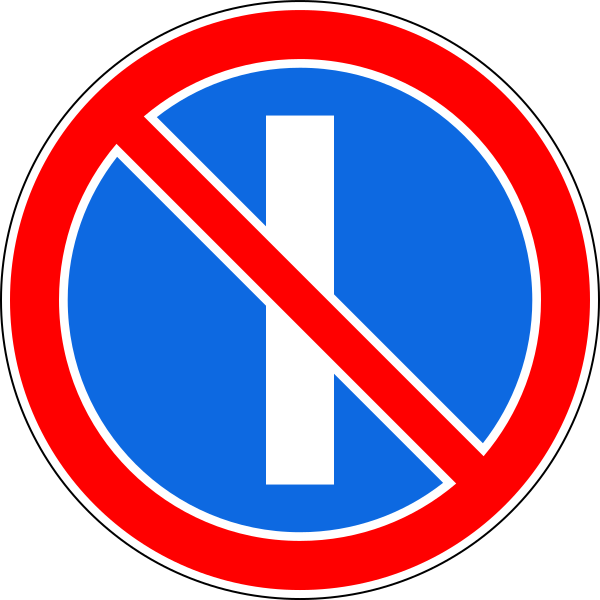
3.29. No parking on odd days of the month

Prohibits the parking of vehicles on odd-numbered days of the month. When signs 3.29 and 3.30 are used together, the time for moving a vehicle from one side of the road to the other is from 19:00 to 21:00. During this period parking is permitted on both sides of the carriageway. The sign does not apply to postal vehicles with a white diagonal stripe on a blue background on the body, or to taxis with the taximeter switched on. The sign does not apply to vehicles driven by a person with a significant or severe disability status, or to vehicles carrying such persons. The sign applies from the place where it is installed to the nearest intersection behind it, and in a built-up area with no intersection – to the end of the built-up area. The sign's effect is also not interrupted at exits from adjacent areas or at intersections (junctions) with field, forest and other minor roads before which no corresponding sign is installed. The sign applies only to the side of the road on which it is installed.

What is the unit of measurement of the operational productivity of a single-bucket excavator?

1 m³/h
2 m²/h
3 m/h
4 ha/h
Law explanation
The unit of operational productivity of a single-bucket excavator is m³/h.

The following types of transmission are found in road construction machines:

1 hydraulic
2 mechanical
3 Combined
4 pneumatic
Law explanation
Road-construction machines use pneumatic-type transmission.

A component element of a hydraulic control system is:

1 Hydraulic pump
2 the actuating mechanism
3 Hydraulic distributor
4 Pressure-reducing safety valve
Law explanation
A hydraulic distributor is a component of the hydraulic control system.

The running gear of road construction machines is:

1 with pneumatic wheels
2 Tracked
3 a walker (ambler)
4 on an air cushion
Law explanation
The running gear of construction machines is the walking type.

The running gear of road construction machines is:

1 Floating
2 Combined
3 Rigid-wheeled
4 a walker (ambler)
Law explanation
The running gear of construction machines is the walking type.

What is a negative characteristic of pneumatic-wheeled running gear?

1 High transport speed
2 Regulation of pressure on the supports
3 High efficiency
4 High ground pressure
Law explanation
A disadvantage of a pneumatic-tyred running gear is its high ground pressure.

If the wheel formula of a pneumatic-tyred running gear is 6x4, how many wheels are driving wheels?

1 10
2 4
3 6
Law explanation
If the wheel formula of a pneumatic-tyred running gear is 6x4, there are 4 driving wheels.
Practical part

Exam routes — exactly the way the examiner drives them

60 real exam routes across 10 cities, 793 km in total. Every turn and stop on the map, with voice guidance.

  • All routes on the map
  • GPS mode on the real road
  • Practice mode with adjustable speed
  • On the web and in the app

One-off payment, no auto-renewal — by card on the Bank of Georgia secure page.

Chat with us