imecadine.ge

Duties of the driver, passenger and pedestrian

26 official tickets in this topic, with the correct answer and law explanation.

Basic duties, identification signs and the international convention.

May a pedestrian move on the carriageway if there is no footpath, pavement or verge, or if it is impossible to use them?

1 is not allowed
2 is allowed, but when moving on the carriageway it must be as close as possible to the edge of the carriageway
Law explanation
According to Article 24(4) of the Law of Georgia "On Road Traffic", if there is no footpath, pavement or roadside, or it is impossible to use them, a pedestrian may walk on the carriageway. If there is a cycle path and the traffic intensity allows it, pedestrians are entitled to walk on it, but must not hinder the movement of bicycles and mopeds. According to paragraph 6 of the same Article, in the cases provided for by paragraphs 2, 4 and 5 of this Article, a pedestrian walking on the carriageway must keep as close as possible to the edge of the carriageway.

A driver involved in a road traffic accident is obliged to:

1 only switch on the hazard warning lights
2 only immediately stop the vehicle (not move it from the spot)
3 both immediately stop the vehicle (not move it from the spot) and switch on the hazard warning lights
Law explanation
According to subparagraph “a” of paragraph 1 of Article 27 of the Law of Georgia “On Road Traffic”, a driver involved in a road traffic accident must immediately stop the vehicle (not move it from the spot) and switch on the hazard warning lights.

A driver involved in a road traffic accident is obliged to:

1 only avoid changing anything at the scene of the accident or destroying traces that may be useful in establishing liability
2 perform all the actions listed in this ticket
3 only take the necessary measures to ensure traffic safety at the scene of the road traffic accident
4 Only write down the surnames of the eyewitnesses
Law explanation
According to Article 27(1)(d) of the Law of Georgia "On Road Traffic", a driver involved in a road traffic accident must take measures to ensure traffic safety at the scene of the accident, avoid changing anything at the scene or destroying traces that may be useful for establishing liability, and write down the surnames of eyewitnesses.
Ticket #390 — situation image

How many carriageways does the given road have?

1 three
2 four
3 one
4 two
Law explanation
According to paragraph 15 of Article 5 of the Law of Georgia "On Road Traffic", the carriageway of a road (carriageway) is an element of the road intended for the movement of trackless vehicles (except the pavement, kerb-side strip, cycle path and footpath). According to paragraph 12 of the same Article, a road is the entire surface of a road or street open to traffic. A road may have either one carriageway or several carriageways clearly separated by a dividing strip or located at different levels. This term may include tram tracks, the pavement, the kerb-side strip, the dividing strip and the cycle path.
Ticket #391 — situation image

How many carriageways does the given road have?

1 one
2 two
3 three
Law explanation
According to paragraph 15 of Article 5 of the Law of Georgia "On Road Traffic", the carriageway of a road (carriageway) is an element of the road intended for the movement of trackless vehicles (except the pavement, kerb-side strip, cycle path and footpath). According to paragraph 12 of the same Article, a road is the entire surface of a road or street open to traffic. A road may have either one carriageway or several carriageways clearly separated by a dividing strip or located at different levels. This term may include tram tracks, the pavement, the kerb-side strip, the dividing strip and the cycle path.

Before entering a pedestrian crossing, the driver is obliged to make sure that:

1 the surface of the crossing is not icy
2 will not be forced to stop on it
3 no other vehicle is moving on the crossing from the opposite direction
Law explanation
According to paragraph 6 of Article 25 of the Law of Georgia “On Road Traffic”, a driver must not enter a pedestrian crossing without first making sure that they will not be forced to stop on it.

Priority (right of way) is:

1 The right of a road user to move first in the intended direction relative to other road users
2 the obligation of a road user not to perform a manoeuvre if it would force another road user to change speed or direction suddenly
Law explanation
According to paragraph 84 of Article 5 of the Law of Georgia “On Road Traffic”, right of way (priority) – the right of a road user to move first in the intended direction in relation to other road users.

"Insufficient visibility" is considered to be, when passing through a tunnel, at night, in fog, rain, snow and other natural phenomena, a reduction in the visibility of the road:

1 at a distance of less than 500 metres
2 At a distance of less than 300 metres
3 At a distance of less than 600 metres
Law explanation
According to Article 5(7) of the Law of Georgia "On Road Traffic", insufficient visibility is a reduction of road visibility to a distance of less than 300 metres when passing through a tunnel, during the hours of darkness, or in fog, rain, snow and other natural phenomena.

A "dividing strip" is:

1 any of the longitudinal strips, marked or unmarked by longitudinal road markings, into which the carriageway may be divided
2 a structurally separated road element dividing adjacent carriageways and not intended for the movement of trackless vehicles on it
3 the part of the road normally used for the movement of trackless vehicles
Law explanation
According to paragraph 9 of Article 5 of the Law of Georgia “On Road Traffic”, a dividing strip is a structurally separated element of the road which separates adjacent carriageways and is not intended for the movement of trackless vehicles on it.

Road sign used in this ticket
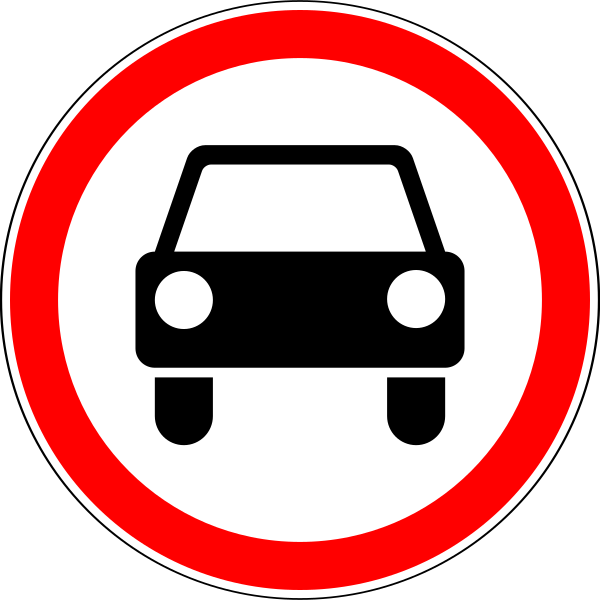
3.3. No motor vehicles

Prohibits the movement of all types of motor vehicles. The sign indicates that traffic is prohibited in both directions. The sign does not apply to route (public transport) vehicles. The sign does not apply to vehicles serving an enterprise located in the designated zone, or serving or belonging to persons who live or work in that zone. In such cases the vehicle must enter and leave the zone at the intersection nearest to its destination. The sign does not apply to vehicles driven by a person with a significant or severe disability status, or to vehicles carrying such persons.
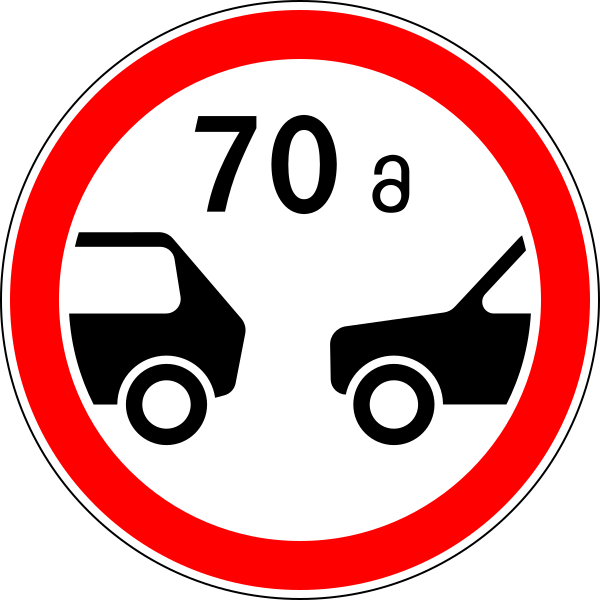
3.16. Minimum distance limit

Prohibits vehicles from travelling at a distance between them shorter than that shown on the sign. The sign applies from the place where it is installed to the nearest intersection behind it, and in a built-up area with no intersection – to the end of the built-up area. The sign's effect is also not interrupted at exits from adjacent areas or at intersections (junctions) with field, forest and other minor roads before which no corresponding sign is installed.
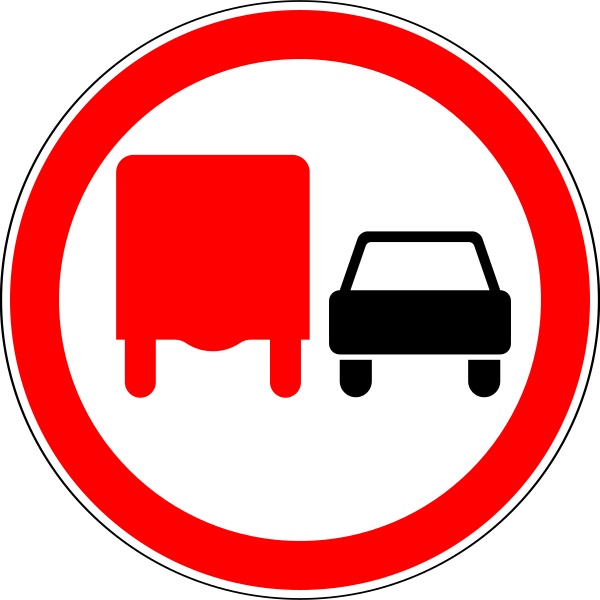
3.22. No overtaking by trucks

Prohibits trucks with a maximum permitted mass of more than 3.5 tonnes from overtaking other vehicles (except vehicles moving at less than 30 km/h), and prohibits tractors from overtaking other vehicles (except horse-drawn vehicles and bicycles). The sign applies from the place where it is installed to the nearest intersection behind it, and in a built-up area with no intersection – to the end of the built-up area. The sign's effect is also not interrupted at exits from adjacent areas or at intersections (junctions) with field, forest and other minor roads before which no corresponding sign is installed.

An "intersection" is:

1 intersections of roads with exits from adjacent areas
2 an at-grade crossing, junction or fork of roads, including the areas formed by such a crossing, junction or fork
3 a crossing of carriageways located at different levels
Law explanation
According to paragraph 13 of Article 5 of the Law of Georgia “On Road Traffic”, junction - a crossing, joining or branching of roads at the same level, including the areas formed by such crossing, joining or branching. Intersections of exits from adjacent areas with roads are not considered junctions.

A "built-up area" is:

1 any road intended for heavy pedestrian traffic
2 Any territory inhabited by people
3 A built-up territory whose entrances and exits are marked with the corresponding road signs
Law explanation
According to Article 5(17) of the Law of Georgia "On Road Traffic", a built-up area is a developed territory whose entry and exit are marked by the corresponding road signs.

"Laden mass" is:

1 the mass of the vehicle without the driver, passengers and cargo, as determined by the manufacturer
2 The mass of the vehicle without the driver, passengers and load, but with a full fuel supply and the necessary set of tools
3 the actual mass of the laden vehicle at a given time, including the driver and passengers
Law explanation
According to Article 5(18) of the Law of Georgia "On Road Traffic", laden mass (actual mass) is the actual mass of a laden vehicle at a given moment, including the driver and passengers.

"Unladen mass" is:

1 The mass of the vehicle, as determined by the manufacturer, without the driver, passengers and load, but including a full fuel supply and the necessary set of tools
2 the mass of the vehicle without the driver, passengers and cargo, as determined by the registration service
3 the actual mass of the unladen vehicle at a given time, including the driver and passengers
Law explanation
According to Article 5(19) of the Law of Georgia "On Road Traffic", unladen mass (unladen weight) is the mass of the vehicle as determined by the manufacturer, without the driver, passengers and load, but including a full supply of fuel and the necessary set of tools.

"Adjacent area" is:

1 an at-grade crossing, junction or fork of roads, including the areas formed by such a crossing, junction or fork
2 An element of the road intended for the movement of trackless vehicles (except the pavement, shoulder, cycle path and footpath)
3 A territory directly adjoining the road and not intended for through traffic of vehicles (courtyard, residential estate, car park, petrol station, institution, etc.)
Law explanation
According to paragraph 38 of Article 5 of the Law of Georgia "On Road Traffic", an adjacent area is an area directly adjoining the road and not intended for through traffic of vehicles (a yard, residential estate, car park, petrol station, institution, etc.)

A "traffic lane" is:

1 any of the longitudinal strips into which the carriageway may be divided, whether or not marked by longitudinal road markings, but which has sufficient width for the movement in one row of motor vehicles other than motorcycles
2 a structurally separated road element dividing adjacent carriageways
3 The entire surface of a road or street open to traffic
Law explanation
According to Article 5(45) of the Law of Georgia "On Road Traffic", a "lane" is any of the longitudinal strips, marked or unmarked by longitudinal road markings, into which the carriageway may be divided, and which is wide enough for motor vehicles other than motorcycles to move in single file.

"Maximum permissible mass" is:

1 the maximum mass of the laden vehicle declared permissible by the competent authority of the state in which the vehicle is registered
2 the mass of the vehicle in equipped condition, loaded with cargo and passengers, the limit of which is set by the vehicle manufacturer
3 the actual mass of the laden vehicle at a given time, including the driver and passengers
Law explanation
According to Article 5(52) of the Law of Georgia "On Road Traffic", "maximum permissible mass" (permissible weight) is the maximum mass of a laden vehicle declared permissible by the competent authority of the state in which the vehicle is registered.

A "slow-moving vehicle" is:

1 a motor vehicle whose design speed does not exceed 40 km/h, or which cannot exceed this speed, or is prohibited from exceeding it for a reason not related to traffic flows
2 A motorised or non-motorised vehicle whose design speed does not exceed 45 km/h
3 Any vehicle that travels on the road at a speed not exceeding 50 km/h
Law explanation
According to Article 5(53) of the Law of Georgia "On Road Traffic", a "slow-moving vehicle" is a power-driven vehicle whose design speed does not exceed 40 km/h, or which cannot exceed that speed or is prohibited from exceeding it for a reason not related to traffic flows.

"Limited visibility" is:

1 Driving through a tunnel, during the hours of darkness, and when road visibility is reduced to less than 300 metres due to fog, rain, snow or other natural phenomena
2 a circumstance in which a sharp bend, the end of an ascent, vegetation, a roadside structure or an obstacle on the road reduces the visibility of the road in the direction of travel to such an extent that driving at the maximum permitted speed on that road section may create a danger
Law explanation
According to paragraph 89 of Article 5 of the Law of Georgia “On Road Traffic”, “restricted visibility” - a circumstance in which a sharp bend, the end of an upward slope, greenery, a roadside structure or an obstacle on the road reduces the visibility of the road in the direction of travel to such an extent that travelling at the maximum permitted speed on that section of road may create a danger.

The "gross mass" of a vehicle is:

1 The mass of the vehicle in equipped condition, filled with load, crew and passengers, the limit of which is set by the vehicle manufacturer
2 the mass of the vehicle without the crew, passengers and cargo
3 the part of the vehicle's mass which, by bearing on the axle, produces a load on the road
4 The mass of the loaded vehicle, crew and passengers at a given moment in time
Law explanation
According to paragraph 80 of Article 5 of the Law of Georgia “On Road Traffic”, “gross mass” – the mass of a vehicle in equipped condition, loaded with cargo, driver and passengers, the limit of which is set by the vehicle's manufacturer. The gross mass of a combination of vehicles is calculated as the sum of the gross masses of the vehicles forming it.

If the driver cannot determine whether the road has a surface (due to darkness, snow, mud or another reason) and there are no priority signs, they are considered to be:

1 on a secondary road
2 on the main road
3 On a road equivalent to a motorway
Law explanation
According to paragraph 8 of Article 36 of the Law of Georgia "On Road Traffic", if the driver cannot determine whether the road has a surface (due to darkness, snow, mud or another reason) and there are no priority signs, they are considered to be on a secondary road.
Practical part

Exam routes — exactly the way the examiner drives them

60 real exam routes across 10 cities, 793 km in total. Every turn and stop on the map, with voice guidance.

  • All routes on the map
  • GPS mode on the real road
  • Practice mode with adjustable speed
  • On the web and in the app

One-off payment, no auto-renewal — by card on the Bank of Georgia secure page.

Chat with us