imecadine.ge

Full ticket list

898 official tickets — category B, B1, with the correct answer and law explanation.

When driving in rainy weather, the driver must pay particular attention:

1 to a slow-moving vehicle
2 towards pedestrians, because a dangerous situation may arise due to the possible speed of pedestrians
3 in relation to trucks carrying cargo, because there is a high risk of cargo falling from the vehicle body onto the road
Law explanation
According to Article 25(10)(g) of the Law of Georgia "On Road Traffic", when driving on the road, the driver must take into account the following circumstances: g) when driving in rainy weather, the driver must pay particular attention to pedestrians, because a dangerous situation may arise due to their possible speed.

Up to what age is it prohibited to leave a child unattended in a stationary vehicle?

1 under the age of 12
2 Under 6 years of age
3 under the age of 9
4 under the age of 7
Law explanation
According to Article 26(9) of the Law of Georgia "On Road Traffic", it is prohibited to leave a child under 6 years of age unattended in a stopped vehicle.

Carrying a child under 12 years of age is permitted:

1 None of the answers listed in this ticket is correct
2 By motorcycle
3 With the front seat of a passenger car
4 By moped
Law explanation
According to subparagraphs “a” and “b” of paragraph 6 of Article 26 of the Law of Georgia “On Road Traffic”, it is prohibited to carry a child under 12 years of age: a) in the front seat of a passenger car; b) on a moped or a motorcycle.

In the case of a limb injury of a person injured in a road traffic accident, a tourniquet to stop arterial bleeding should be applied:

1 below the site
2 above the place
3 On the spot
Law explanation
If a person injured in a road traffic accident has injured limbs, a tourniquet to stop arterial bleeding must be applied above the wound.

In the absence of material for making a splint, in case of a fracture of a leg bone of a person injured in a road traffic accident, they must:

1 Secure the injured leg and the healthy leg to each other using a bandage; it is necessary to place soft cloth between the legs
2 apply a bandage along the entire length of the injured leg
Law explanation
If a person injured in a road traffic accident has a fractured leg bone and we have no material to make a splint, the injured leg must be secured to the healthy leg using a bandage. It is also essential to place soft fabric between the legs.

If the driver is turning to enter another road at the entrance to which there is a pedestrian crossing, they must do so:

1 only at low speed and, if necessary, stop and let pass the pedestrians who have stepped onto or are stepping onto the crossing
2 at any speed, since it has priority over pedestrians who have stepped onto or are stepping onto the crossing
3 only at high speed, in order to pass the said section of road in time
Law explanation
According to Article 25(2)(a) of the Law of Georgia "On Road Traffic", at a pedestrian crossing, subject to the requirements established by Article 21(6), Article 33(2) and Article 34(11) of this Law, the following requirements must be met: a) if the movement of vehicles is regulated by a traffic light or a traffic controller, during a signal prohibiting movement the driver must stop before the pedestrian crossing or at the transverse marking in front of it, and when permitted to continue moving, must not obstruct or endanger pedestrians who have stepped onto the pedestrian crossing. If the driver is turning to enter another road at the entrance to which there is a pedestrian crossing, he/she must make this turn only at low speed, and if necessary must stop and let pedestrians who have stepped onto or are stepping onto the crossing pass.

If on a road with pedestrian crossings the traffic of vehicles is regulated by a traffic controller, during a signal prohibiting movement drivers must stop:

1 before the pedestrian crossing or at the transverse marking located before it
2 in the lane of the opposite direction
3 in front of the traffic controller
Law explanation
According to Article 25(2)(a) of the Law of Georgia "On Road Traffic", at a pedestrian crossing, subject to the requirements established by Article 21(6), Article 33(2) and Article 34(11) of this Law, the following requirements must be met: a) if the movement of vehicles is regulated by a traffic light or a traffic controller, during a signal prohibiting movement the driver must stop before the pedestrian crossing or at the transverse marking in front of it.

If the movement of vehicles is regulated neither by a traffic light nor by a traffic controller, when approaching a pedestrian crossing the driver:

1 must reduce speed appropriately so as not to endanger pedestrians who have stepped onto or are stepping onto this crossing, and, if necessary, must stop and let the pedestrians pass
2 as having priority over pedestrians, has the right to pass the pedestrian crossing at any speed
3 must give an audible signal and pass the pedestrian crossing without stopping
Law explanation
According to Article 25(2)(b) of the Law of Georgia "On Road Traffic", at a pedestrian crossing, subject to the requirements established by Article 21(6), Article 33(2) and Article 34(11) of this Law, the following requirements must be met: b) if the movement of vehicles is regulated neither by a traffic light nor by a traffic controller, when approaching a pedestrian crossing the driver must reduce speed appropriately so as not to endanger pedestrians who have stepped onto or are stepping onto the crossing, and if necessary must stop and let the pedestrians cross.

Drivers who intend to pass a route vehicle located at a stop duly marked on the side corresponding to the direction of travel must:

1 reduce speed and, if necessary, stop, in order to ensure that passengers can safely board or alight from public transport
2 increase speed so as to pass quickly and not delay the process of passengers boarding and alighting from public transport
3 stop next to the kerb and not move off until the public transport vehicle continues moving
Law explanation
According to Article 25(4) of the Law of Georgia "On Road Traffic", a driver who intends to pass a route vehicle standing at a properly marked stop on the side corresponding to the direction of travel must reduce speed and, if necessary, stop in order to allow passengers to get on or off public transport safely.

Before entering a pedestrian crossing, the driver is obliged to make sure that:

1 the surface of the crossing is not icy
2 will not be forced to stop on it
3 no other vehicle is moving on the crossing from the opposite direction
Law explanation
According to paragraph 6 of Article 25 of the Law of Georgia “On Road Traffic”, a driver must not enter a pedestrian crossing without first making sure that they will not be forced to stop on it.

Priority (right of way) is:

1 The right of a road user to move first in the intended direction relative to other road users
2 the obligation of a road user not to perform a manoeuvre if it would force another road user to change speed or direction suddenly
Law explanation
According to paragraph 84 of Article 5 of the Law of Georgia “On Road Traffic”, right of way (priority) – the right of a road user to move first in the intended direction in relation to other road users.

"Insufficient visibility" is considered to be, when passing through a tunnel, at night, in fog, rain, snow and other natural phenomena, a reduction in the visibility of the road:

1 at a distance of less than 500 metres
2 At a distance of less than 300 metres
3 At a distance of less than 600 metres
Law explanation
According to Article 5(7) of the Law of Georgia "On Road Traffic", insufficient visibility is a reduction of road visibility to a distance of less than 300 metres when passing through a tunnel, during the hours of darkness, or in fog, rain, snow and other natural phenomena.

A "dividing strip" is:

1 any of the longitudinal strips, marked or unmarked by longitudinal road markings, into which the carriageway may be divided
2 a structurally separated road element dividing adjacent carriageways and not intended for the movement of trackless vehicles on it
3 the part of the road normally used for the movement of trackless vehicles
Law explanation
According to paragraph 9 of Article 5 of the Law of Georgia “On Road Traffic”, a dividing strip is a structurally separated element of the road which separates adjacent carriageways and is not intended for the movement of trackless vehicles on it.

Road sign used in this ticket
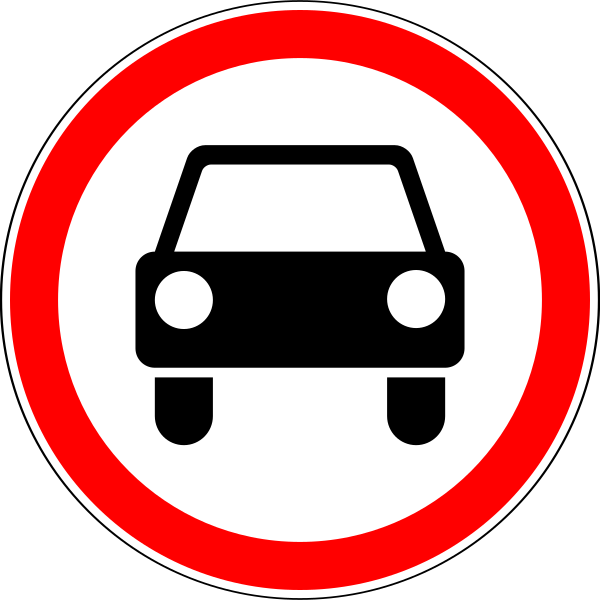
3.3. No motor vehicles

Prohibits the movement of all types of motor vehicles. The sign indicates that traffic is prohibited in both directions. The sign does not apply to route (public transport) vehicles. The sign does not apply to vehicles serving an enterprise located in the designated zone, or serving or belonging to persons who live or work in that zone. In such cases the vehicle must enter and leave the zone at the intersection nearest to its destination. The sign does not apply to vehicles driven by a person with a significant or severe disability status, or to vehicles carrying such persons.
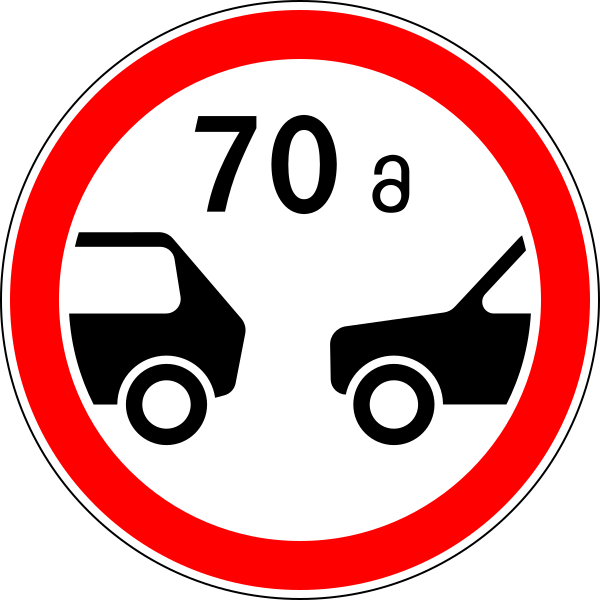
3.16. Minimum distance limit

Prohibits vehicles from travelling at a distance between them shorter than that shown on the sign. The sign applies from the place where it is installed to the nearest intersection behind it, and in a built-up area with no intersection – to the end of the built-up area. The sign's effect is also not interrupted at exits from adjacent areas or at intersections (junctions) with field, forest and other minor roads before which no corresponding sign is installed.
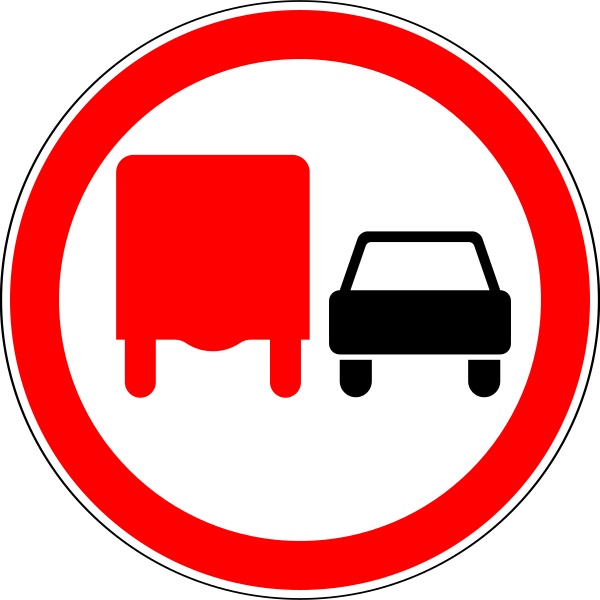
3.22. No overtaking by trucks

Prohibits trucks with a maximum permitted mass of more than 3.5 tonnes from overtaking other vehicles (except vehicles moving at less than 30 km/h), and prohibits tractors from overtaking other vehicles (except horse-drawn vehicles and bicycles). The sign applies from the place where it is installed to the nearest intersection behind it, and in a built-up area with no intersection – to the end of the built-up area. The sign's effect is also not interrupted at exits from adjacent areas or at intersections (junctions) with field, forest and other minor roads before which no corresponding sign is installed.

"Overtaking" means:

1 the movement of vehicles in lanes for traffic in the same direction faster than vehicles moving in lanes located closer to the edge of the carriageway
2 passing one or more vehicles moving ahead in the same direction in the same lane, by leaving the occupied lane
3 passing one or more vehicles moving in the opposite direction in the adjacent traffic lane
Law explanation
According to paragraph 10 of Article 5 of the Law of Georgia “On Road Traffic”, overtaking - passing one or more vehicles moving ahead in the same lane in the same direction by leaving the occupied lane.

"Stopping" means:

1 a deliberate interruption of the vehicle's movement in the traffic flow
2 a deliberate interruption of the vehicle's movement due to the requirements of traffic control devices or of the traffic controller
3 the deliberate halting of a vehicle's movement for up to 5 minutes, or longer if this is necessary for passengers to board or alight or for the vehicle to be loaded or unloaded
Law explanation
According to paragraph 11 of Article 5 of the Law of Georgia “On Road Traffic”, stopping − the intentional interruption of a vehicle's movement for up to 5 minutes, or longer if necessary for passengers to get on or off or for loading or unloading the vehicle. Intentional interruption of a vehicle's movement in a traffic flow, due to the requirements of traffic control devices or of a traffic controller, is not considered stopping.

An "intersection" is:

1 intersections of roads with exits from adjacent areas
2 an at-grade crossing, junction or fork of roads, including the areas formed by such a crossing, junction or fork
3 a crossing of carriageways located at different levels
Law explanation
According to paragraph 13 of Article 5 of the Law of Georgia “On Road Traffic”, junction - a crossing, joining or branching of roads at the same level, including the areas formed by such crossing, joining or branching. Intersections of exits from adjacent areas with roads are not considered junctions.

"Give way (not to impede)" is:

1 the obligation of a road user not to continue or resume movement, or not to perform a manoeuvre, if this would force a road user having priority to suddenly change the direction or speed of movement
2 the right of a road user, in comparison with other road users, to move first in the intended direction
Law explanation
According to paragraph 14 of Article 5 of the Law of Georgia “On Road Traffic”, give way (not obstruct) - the obligation of a road user not to continue or resume movement or not to perform a manoeuvre if this would force a road user who has priority to suddenly change direction of travel or speed.

In the case of a fracture of the pelvis and femur of a person injured in a road traffic accident, until the "emergency medical service" arrives, he/she should:

1 Lay the casualty on their back, place a tightly rolled pad or clothing under the knees, and give a painkiller
2 lay them on the uninjured side, put a cold compress on the injured area and give a painkiller
Law explanation
In the case of a fracture of the pelvis or the femur, before the ambulance arrives the injured person should be laid on their back, a tightly rolled pad or clothing should be placed under their knees, and they should be given a painkiller.

A "built-up area" is:

1 any road intended for heavy pedestrian traffic
2 Any territory inhabited by people
3 A built-up territory whose entrances and exits are marked with the corresponding road signs
Law explanation
According to Article 5(17) of the Law of Georgia "On Road Traffic", a built-up area is a developed territory whose entry and exit are marked by the corresponding road signs.

"Laden mass" is:

1 the mass of the vehicle without the driver, passengers and cargo, as determined by the manufacturer
2 The mass of the vehicle without the driver, passengers and load, but with a full fuel supply and the necessary set of tools
3 the actual mass of the laden vehicle at a given time, including the driver and passengers
Law explanation
According to Article 5(18) of the Law of Georgia "On Road Traffic", laden mass (actual mass) is the actual mass of a laden vehicle at a given moment, including the driver and passengers.
Practical part

Exam routes — exactly the way the examiner drives them

60 real exam routes across 10 cities, 793 km in total. Every turn and stop on the map, with voice guidance.

  • All routes on the map
  • GPS mode on the real road
  • Practice mode with adjustable speed
  • On the web and in the app

One-off payment, no auto-renewal — by card on the Bank of Georgia secure page.

Chat with us