imecadine.ge

Full ticket list

898 official tickets — category B, B1, with the correct answer and law explanation.

Ticket #1263 — situation image

The driver of the passenger car has the right to stop:

1 only at place A
2 Only at place B
3 At neither place A nor place B
Law explanation
According to paragraph 1.4 of Chapter 1 (Horizontal markings) of Annex 2 of the Law of Georgia “On Road Traffic”, road marking 1.4, a solid yellow line, marks a place where stopping is prohibited; it is used on its own or together with sign 3.27; it is drawn along the edge of the carriageway or on top of the kerb. According to paragraph 3.27 of Chapter 3 (Prohibitory signs) of Annex 1 of the same Law and subparagraph “i” of the note to the same Chapter, road sign 3.27 “No stopping” - prohibits both stopping and parking of vehicles. Sign 3.27 may be used together with marking 1.4, and sign 3.28 – together with marking 1.10. In that case the zone of effect of the signs is determined by the length of the marking line.

Road sign used in this ticket

3.27. No stopping

Prohibits both stopping and parking of vehicles. The sign does not apply to route (public transport) vehicles. The sign applies from the place where it is installed to the nearest intersection behind it, and in a built-up area with no intersection – to the end of the built-up area. The sign's effect is also not interrupted at exits from adjacent areas or at intersections (junctions) with field, forest and other minor roads before which no corresponding sign is installed. The sign applies only to the side of the road on which it is installed.

If a person injured in a road traffic accident has a wound to the eye, they must:

1 lay them on the side of the healthy eye and place a clean dressing on the injured eye
2 lay them on their back and raise the head forward. Apply a clean dressing to the injured eye
3 seat them in a semi-sitting position, tilt the head back and place a clean dressing on the injured eye
Law explanation
In the case of an eye wound sustained by a person injured in a road traffic accident, the injured person must be laid on his/her back with the head raised forward. A clean dressing must be placed over the injured eye.

In case of an injury to an arm bone below the elbow of a person injured in a road traffic accident, the tourniquet to stop arterial bleeding should be applied:

1 above the wound, up to the elbow
2 above the elbow, near the shoulder
Law explanation
In the case of an injury to the arm bone below the elbow of a person injured in a road traffic accident, a tourniquet to stop arterial bleeding must be applied above the elbow, near the shoulder.

When calling an ambulance for persons injured in a road traffic accident, we must inform the dispatcher of:

1 only the nearest landmark to the scene of the road traffic accident, the number of injured persons, their sex and age
2 the exact location of the road traffic accident (street, house number and nearest landmark), the number of injured persons, their sex, approximate age, the presence of vital signs, and also about severe bleeding
Law explanation
When calling an ambulance for persons injured in a road traffic accident, we must tell the dispatcher the exact location of the road traffic accident (street, house number and nearest landmark), the number of injured persons, their sex, approximate age, the presence of vital signs, and also any severe bleeding.

If a person injured in a road traffic accident has injuries to the hairy part of the head, in order to provide first aid, they must:

1 Apply an improvised bandage to the neck, apply a pressure bandage with a sterile dressing to the wound, lay the injured person on their side with the legs bent at the knees, and place ice or a cold compress on the head
2 an improvised bandage should be applied to the neck, a sterile cotton pad placed on the wound, and the injured person laid on their back
Law explanation
If a person injured in a road traffic accident has injuries to the hairy part of the head, then, in order to provide first aid, an improvised collar should be placed on their neck, a pressure bandage made with a sterile bandage should be applied to the wound, the injured person should be laid on their side with the legs bent at the knees, and ice or a cold compress should be applied to the head.
Ticket #1269 — situation image

The driver of the passenger car has the right to stop:

1 only at place A
2 both at place A and at place B
3 Only at place B
Law explanation
According to Article 37(6)(a.a) and (a.c) of the Law of Georgia "On Road Traffic", stopping a vehicle on the carriageway is prohibited: a.a) on pedestrian and cyclist crossings and closer than 5 metres before them; a.c) at the intersection of carriageways, and also closer than 5 metres from the edges of the intersecting carriageways, except when stopping at three-way intersections (junctions) opposite side exits where there is a solid marking line or a dividing strip.

Road sign used in this ticket

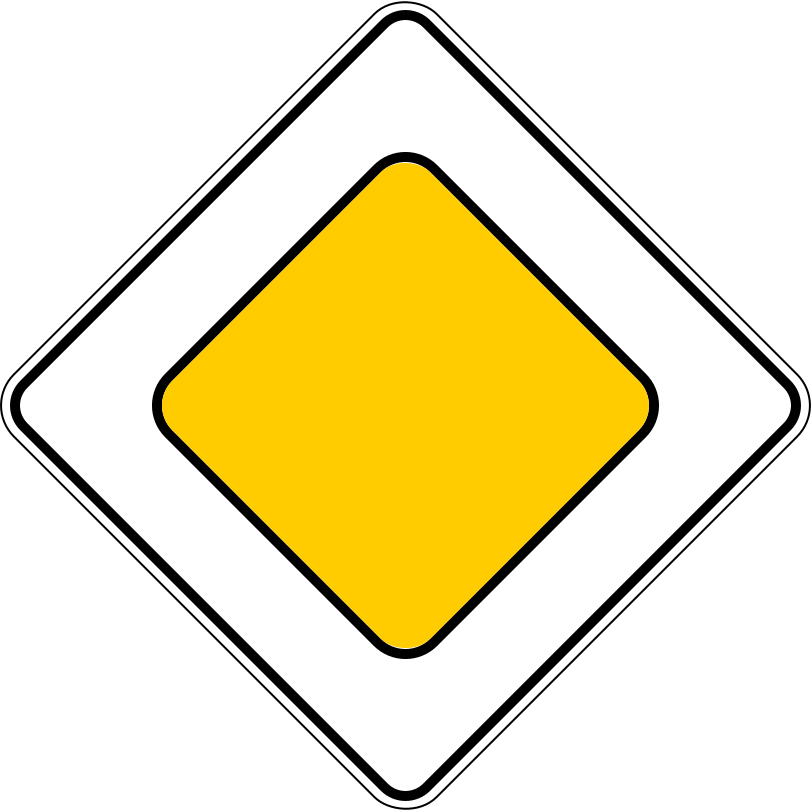
2.1. Priority road

A road on which drivers have priority when passing through unregulated intersections. The sign is installed at the beginning of the road and repeated immediately before every intersection. Sign 2.1 with plate 8.13 is installed in built-up areas before an intersection at which the main road changes direction; outside built-up areas − in advance, 150−300 m before the intersection, and before the intersection.

Ticket #1270 — situation image

The driver of which vehicle has an obligation to give way when moving in the direction of the arrow?

1 the passenger car driver
2 the cyclist
Law explanation
According to paragraph 6 of Article 43 of the Law of Georgia “On Road Traffic”, at an unregulated crossing of a cycle path with a road outside an intersection, riders of bicycles and mopeds must give way to drivers of vehicles travelling on that road.
Ticket #1271 — situation image

At what maximum speed does the driver of a category "B" car have the right to continue moving in the zone of operation of the road sign?

1 At a speed of 90 km/h
2 At a speed of 60 km/h
3 at a speed of 80 km/h
4 At a speed of 110 km/h
Law explanation
According to subparagraph “b.b” of paragraph 7 and paragraphs 9 and 10 of Article 33 of the Law of Georgia “On Road Traffic”: 7. Except in the cases established by this Law, outside built-up areas, and in built-up areas on a section of road where the corresponding sign permits travel at more than 60 km/h, a category B vehicle towing a light trailer is permitted to travel on all roads at no more than 80 km/h. 9. In addition to the maximum speed limits defined by paragraphs 6−8 of this Article, the driver is prohibited from: a) exceeding the maximum design speed established for the vehicle; b) exceeding the speed indicated on the “Speed limit” identification sign attached to the vehicle; c) exceeding the maximum speed established by a road sign. 10. Even if a higher speed is permitted on the road by the corresponding road sign or signal, the driver is prohibited from exceeding the maximum speed limit established for him by paragraphs 6−9 of this Article. According to paragraphs 3.24 and 8.14 of Annex 1 of the same Law, road signs: - 3.24. “Maximum speed limit” − prohibits travelling at a speed (km/h) higher than that shown on the sign. - 8.14. “Lane” − indicates the lane to which the sign or traffic light applies. The plate is placed above the lane.
Ticket #1273 — situation image

At what speed does the driver of a category "B" car have the right to continue moving in the lane marked by the road sign?

1 not more than 50 km/h
2 At a speed of not less than 50 km/h and not more than 110 km/h
3 at a speed of not less than 50 km/h and not more than 90 km/h
4 At a speed of not less than 50 km/h and not more than 70 km/h
Law explanation
According to paragraph 4.6 of Chapter 4 (Mandatory signs) of Annex 1 to the Law of Georgia "On Road Traffic", 4.6 "Minimum speed limit" sets the minimum speed limit for travel on the road. The sign applies from the place where it is installed to the nearest intersection after the sign, and in a built-up area where there is no intersection, to the end of the built-up area. According to paragraph 8.14 of Chapter 8 (Additional information signs (plates)) of the same Annex, 8.14 "Traffic lane" indicates the traffic lane to which the sign or traffic light applies. The plate is placed above the traffic lane. According to Article 33(7)(b.a) of the same Law, except in cases established by this Law, outside built-up areas, and also in built-up areas on a section of road where travel at more than 60 km/h is permitted by the relevant sign, a category B vehicle, if it is not towing a light trailer, is permitted to travel on a motorway at a speed not exceeding 110 km/h, and on other roads at a speed not exceeding 90 km/h.

Road sign used in this ticket

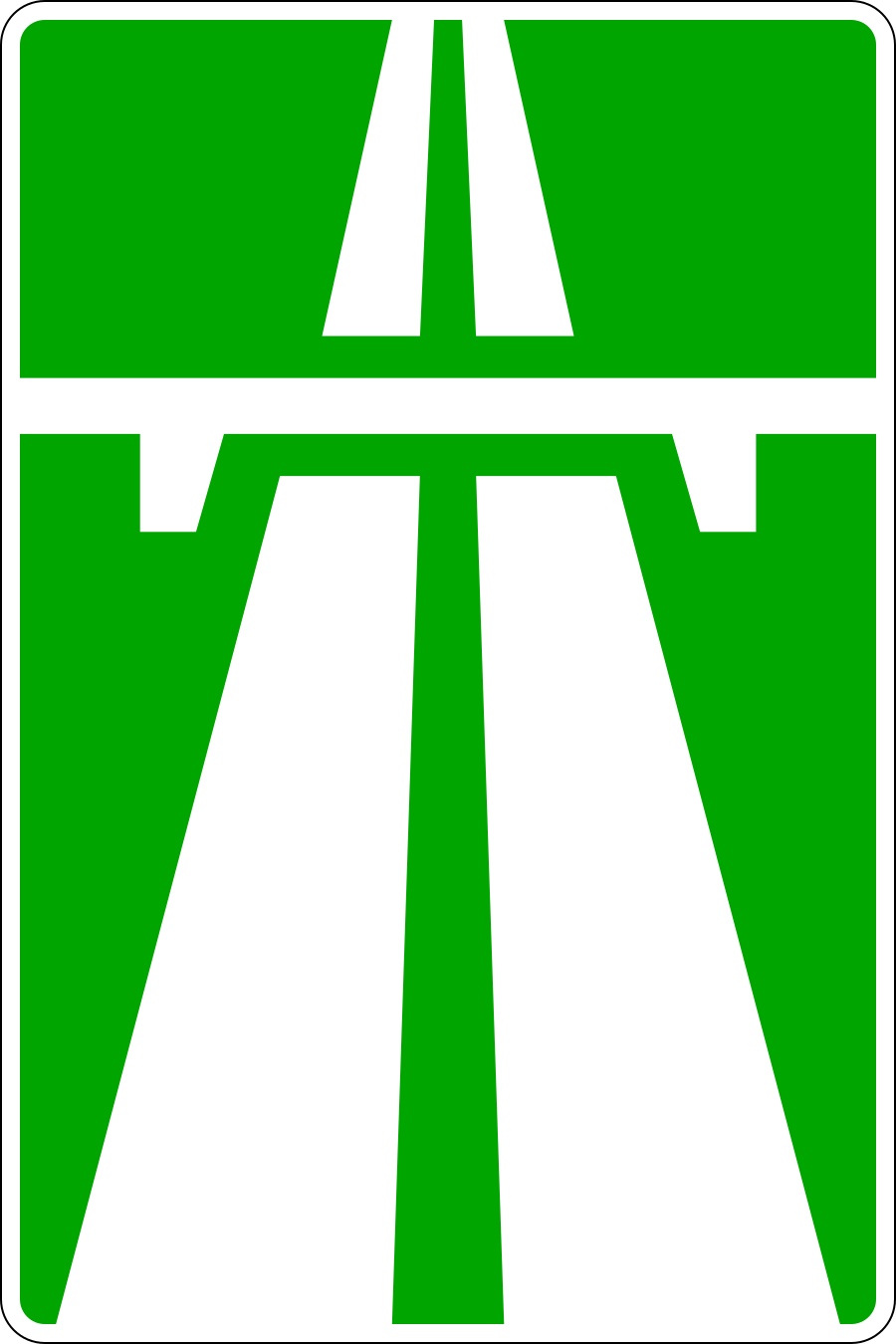
5.1. Motorway

A motorway on which the requirements of the rules governing traffic on motorways apply. The sign is installed at the beginning of the motorway or near it with plate 8.1.1.

Ticket #1275 — situation image

The driver of which vehicle has the obligation to give way when moving in the direction of the arrow?

1 the driver of the tractor
2 the driver of the passenger car
Law explanation
According to Article 36(4)(c) of the Law of Georgia "On Road Traffic", at an uncontrolled intersection, at the intersection of roads of equal importance, the driver of a trackless vehicle must give way to a vehicle approaching from the right.
Ticket #1276 — situation image

In the given situation, is the driver of the passenger car obliged, when moving in the direction of the arrow, to stop at the light signal prohibiting movement of the traffic light located at the exit from the intersection?

1 is obliged
2 is not obliged
Law explanation
According to Article 36(3)(e) of the Law of Georgia "On Road Traffic", at a controlled intersection, a driver who has entered the intersection on a permissive traffic light signal may move in the intended direction regardless of the prohibitive signals of the traffic light at the exit from the intersection, provided that this does not obstruct the movement of other road users in the direction in which traffic is open. If, while he/she is moving through the intersection, there are "Stop" lines (and/or road signs 7.16) in front of the traffic lights on the road, the driver must follow the signal of each traffic light.
Ticket #1278 — situation image

In the given situation, is the driver of the passenger car obliged, when moving in the direction of the arrow, to stop at the prohibiting light signal of the traffic light?

1 is obliged
2 is not obliged
Law explanation
According to Article 36(3)(e) of the Law of Georgia "On Road Traffic", at a controlled intersection, a driver who has entered the intersection on a permissive traffic light signal may move in the intended direction regardless of the prohibitive signals of the traffic light at the exit from the intersection, provided that this does not obstruct the movement of other road users in the direction in which traffic is open. If, while he/she is moving through the intersection, there are "Stop" lines (and/or road signs 7.16) in front of the traffic lights on the road, the driver must follow the signal of each traffic light.

Road sign used in this ticket

2.1. Priority road

A road on which drivers have priority when passing through unregulated intersections. The sign is installed at the beginning of the road and repeated immediately before every intersection. Sign 2.1 with plate 8.13 is installed in built-up areas before an intersection at which the main road changes direction; outside built-up areas − in advance, 150−300 m before the intersection, and before the intersection.

In order to remove a foreign body from the airways of a person injured in a road traffic accident, it is essential to:

1 slap them several times on the back with the palm; if this is unsuccessful, stand behind the injured person, clasp your hands into a fist against the abdomen at the level of the lower ribs, simultaneously press on the ribs and sharply push with the fists into the abdominal area in an inward and upward direction
2 Put the injured person on their knees face down and strike them on the back with a fist several times
Law explanation
To remove a foreign body from the airways of a person injured in a road traffic accident, we must strike the person several times on the back with the palm of the hand; if this is unsuccessful, we should stand behind the injured person, clasp our hands into a fist at the abdomen at the level of the lower ribs, simultaneously press on the ribs and push the fists sharply into the abdominal area in an inward and upward direction.
Ticket #1281 — situation image

In which direction may the driver of the passenger car continue moving at this signal of the traffic controller?

1 in all directions
2 Only in directions A and D
3 only in directions A, B and D
4 only in directions B and C
Law explanation
According to Article 30(5)(c) of the Law of Georgia "On Road Traffic", the signals of the traffic controller have the following meaning: right arm extended forward − this gesture means the "Stop" signal for all drivers moving from the traffic controller's right side and back; at the same time, from the traffic controller's left side, trams may move to the left, and trackless vehicles may move in all directions. From the traffic controller's chest side, all vehicles may move only to the right. Pedestrians may cross the carriageway behind the traffic controller's back. According to Article 28(2) of the same Law, the signals of the traffic controller take precedence over traffic light signals, the requirements of road signs and road markings, and the requirements of the traffic rules. When the traffic controller is directing traffic at an intersection, prohibitory and mandatory road signs remain in effect, unless the traffic controller specifically indicates that their requirements are to be disregarded.

Road sign used in this ticket

3.1. No entry

Prohibits the entry of all vehicles in the given direction. The sign does not apply to route (public transport) vehicles.

Ticket #1282 — situation image

In which direction can the driver of the passenger car continue moving if the traffic controller specifically indicates movement to the left?

1 Only to the left
2 in all directions
3 only to the left and in the reverse direction (U-turn)
4 only straight ahead
Law explanation
According to paragraph 2 of Article 28 of the Law of Georgia “On Road Traffic”, the signals of a traffic controller take precedence over traffic light signals, the requirements of road signs and road markings, and the requirements of the traffic rules. When traffic at an intersection is being regulated by a traffic controller, prohibitory and mandatory road signs remain in effect, except when the traffic controller specifically indicates that their requirements are to be disregarded.

Road sign used in this ticket

3.1. No entry

Prohibits the entry of all vehicles in the given direction. The sign does not apply to route (public transport) vehicles.

Is it permitted to give medicines to a person injured in a road traffic accident who is unconscious?

1 is not allowed
2 is permitted
Law explanation
It is not permitted to give medicines to an unconscious person injured in a road traffic accident.

In the absence of material for making a splint, in the case of a fracture of an arm bone of a person injured in a road traffic accident, he/she should:

1 Hang the arm, bent at the elbow, from the neck and secure it to the torso with a bandage
2 secure the straightened arm to the torso by wrapping a bandage
Law explanation
If there is no material to make a splint and a person injured in a road traffic accident has a fractured arm bone, the arm, bent at the elbow, must be suspended from the neck and secured to the body with a bandage.

How does the braking distance of a passenger car change when driving with a trailer, if the trailer does not have a braking system?

1 does not change
2 decreases
3 Increases
Law explanation
The greater the mass of a vehicle, the more force and time are needed to brake it. The braking distance of a passenger car increases when it is towing a trailer that has no braking system.

At night and in conditions of insufficient visibility, we perceive the speed of an oncoming vehicle as:

1 as it is in reality
2 more than in reality
3 less than in reality
Law explanation
In daylight, the human eye judges the speed of an oncoming vehicle by comparison with other reference points in space (road signs, markings, roadside greenery, etc.), whereas during the hours of darkness and in conditions of insufficient visibility orientation relies only on the light of the headlights; therefore we perceive the speed of an oncoming vehicle as lower than it really is.

When starting to move a vehicle with a manual gearbox, during prolonged acceleration in first gear, fuel consumption:

1 decreases
2 does not change
3 Increases
Law explanation
When a vehicle with a manual gearbox is driven in first gear, the speed is low, while the engine runs at high revolutions and requires more fuel. When starting off, prolonged acceleration of the vehicle in first gear increases fuel consumption.
Practical part

Exam routes — exactly the way the examiner drives them

60 real exam routes across 10 cities, 793 km in total. Every turn and stop on the map, with voice guidance.

  • All routes on the map
  • GPS mode on the real road
  • Practice mode with adjustable speed
  • On the web and in the app

One-off payment, no auto-renewal — by card on the Bank of Georgia secure page.

Chat with us