imecadine.ge

Hazard warning lights

13 official tickets in this topic, with the correct answer and law explanation.

When hazard lights and the warning triangle are mandatory.

Ticket #344 — situation image

When the car is stopped at the place shown in the picture, outside a built-up area, the driver:

1 is obliged to switch on the hazard warning lights
2 is obliged to place a "warning triangle" behind the car
3 is obliged to switch on the hazard warning lights and place an "Emergency stop sign" behind the car
4 is not obliged to switch on the hazard warning lights and place an "Emergency stop sign" behind the car
Law explanation
According to Article 37(1) of the Law of Georgia "On Road Traffic", a vehicle that stops or is parked outside a built-up area must, as far as possible, be off the carriageway. According to Article 52(1)(b) and Article 52(2)(b) of the same Law: 1. Hazard warning lights are used to warn other road users of possible danger. Hazard warning lights must be switched on when forced to stop at a place where stopping is prohibited; 2. After switching on the hazard warning lights, and also if such lights are absent or out of order, the driver must immediately place the "warning triangle", and in conditions of insufficient visibility a flashing red lamp, when forced to stop at places where stopping is prohibited and where, taking into account visibility conditions, other drivers will not be able to notice the vehicle in time.
Ticket #473 — situation image

In the given situation, does the driver violate the requirements established for a forced stop, if immediate removal of the broken-down car from the road is impossible?

1 Violates
2 Does not violate
Law explanation
According to Article 42(e) of the Law of Georgia "On Road Traffic", in tunnels marked with a road sign the following rule applies: in the event of a forced stop, the driver must ensure compliance with the requirements established by this Law in connection with forced stops in places where stopping is prohibited. According to Article 52(1)(b), paragraph 2(b) and paragraph 3 of the same Law: – hazard warning lights must be switched on when forced to stop in a place where stopping is prohibited; – after switching on the hazard warning lights, and also if such lights are not fitted or are out of order, the driver must immediately place a "warning triangle", and in conditions of insufficient visibility a flashing red lamp, when forced to stop in a place where stopping is prohibited; – the "warning triangle" and the flashing red lamp must be placed at a distance from the vehicle that, in the specific conditions, ensures timely warning of other drivers of the danger, but this distance must not be less than 15 metres in a built-up area and less than 30 metres outside a built-up area.

In the absence or malfunction of hazard warning lights, the following must be attached to the rear of the towed power-driven vehicle:

1 Maximum speed limit sign
2 the emergency stop sign
3 Sign indicating other dangers
Law explanation
According to Article 45(7) of the Law of Georgia "On Road Traffic", at any time of day or night the towing motor vehicle must have its dipped headlights switched on, and the towed motor vehicle must have its hazard warning lights switched on, and if these are absent or faulty, a warning triangle must be attached to the rear of that vehicle.

If dazzled by the headlights of a power-driven vehicle coming from the opposite direction, the driver must:

1 slow down, move into the extreme right lane as quickly as possible and, if necessary, stop
2 without changing lanes, reduce speed, stop and switch on the hazard warning lights. Resuming movement is permitted only after vision has been fully restored
3 by periodically switching the headlights, alert the driver of the oncoming vehicle to this problem
4 switch on the main-beam headlights
Law explanation
According to paragraph 5 of Article 36 of the Law of Georgia “On Road Traffic”, the driver must not enter a junction if there is a traffic jam such that he will probably be forced to stop at the junction and thereby obstruct traffic in the transverse direction. This rule applies even if the traffic light signals permit movement.

In a built-up area, during a forced stop in places where stopping is prohibited, the driver must place the warning triangle (or a similar effective device) from the vehicle at a distance of not less than:

1 At a distance of 10 metres
2 At a distance of 5 metres
3 at a distance of 15 metres
Law explanation
According to Article 52(2)(b) and paragraphs 3 and 4 of the Law of Georgia "On Road Traffic": 2. After switching on the hazard warning lights, and also if there are no such lights or they are out of order, the driver must immediately place a "warning triangle", and in conditions of insufficient visibility a flashing red lamp: b) when making a forced stop in a place where stopping is prohibited, and where, taking visibility conditions into account, other drivers would not be able to notice the vehicle in time. 3. The "warning triangle" and the flashing red lamp must be placed at a distance from the vehicle that ensures timely warning of other drivers of the danger in the specific conditions, but this distance must not be less than 15 metres in a built-up area and not less than 30 metres outside a built-up area. 4. If there is no warning triangle or flashing red lamp, the driver must ensure timely warning of approaching drivers by other similar effective means.

Outside built-up areas, in the event of a forced stop in places where stopping is prohibited, the driver must place the warning triangle (or a similar effective device) from the vehicle at a distance of not less than:

1 At a distance of 20 metres
2 at a distance of 15 metres
3 at a distance of 30 metres
Law explanation
According to subparagraph “b” of paragraph 2 and paragraphs 3 and 4 of Article 52 of the Law of Georgia “On Road Traffic”: 2. After switching on the hazard warning lights, and also if such lights are absent or out of order, the driver must immediately place a “warning triangle”, and in conditions of insufficient visibility a flashing red lamp: b) when forced to stop at a place where stopping is prohibited, and where, given the visibility conditions, other drivers will not be able to notice the vehicle in time. 3. The “warning triangle” and the flashing red lamp must be placed at a distance from the vehicle that, in the specific conditions, ensures that other drivers are warned of the danger in good time, but this distance must not be less than 15 metres in a built-up area and less than 30 metres in a non-built-up area.

In the event of a forced stop at a place where stopping is prohibited, if there is no warning triangle and no flashing red lamp:

1 The driver must ensure timely warning of approaching drivers by other similar effective means
2 timely warning of approaching drivers is not necessary
Law explanation
According to Article 52(4) of the Law of Georgia "On Road Traffic", if there is no warning triangle or flashing red lamp, the driver must ensure timely warning of approaching drivers by other similar effective means.
Ticket #1045 — situation image

Is the driver of the passenger car obliged to switch on the hazard warning lights and place the warning triangle in case of a forced stop at the place shown in the picture?

1 is obliged only to place an emergency stop sign behind the car, at a distance of 15 metres
2 is obliged to switch on only the hazard warning lights
3 is not obliged
Law explanation
According to Article 52(1)(b) of the Law of Georgia "On Road Traffic", hazard warning lights are used to warn other road users of a potential danger. Hazard warning lights must be switched on: b) when forced to stop in a place where stopping is prohibited. According to Article 37(6)(a.c) of the same Law, it is prohibited to stop a vehicle on the carriageway: a.c) at the intersection of carriageways, and also closer than 5 metres from the edges of intersecting carriageways, except when stopping takes place at three-way intersections (junctions) opposite side exits where there is a solid marking line or a dividing strip.
Ticket #1047 — situation image

In the given situation, does the driver violate the requirements established for a forced stop, if immediate removal of the broken-down car from the road is impossible?

1 Does not violate
2 Violates
Law explanation
According to subparagraph “c.a” of paragraph 1 of Article 38 of the Law of Georgia “On Road Traffic”, on a motorway and at motorway entrances and exits, the driver is prohibited from stopping or parking the car (and/or its trailer), except at specially marked places designated for parking. A driver who is forced to stop due to circumstances beyond his control must take all measures to remove the car (and/or its trailer) from the carriageway, and if this cannot be done immediately − switch on the hazard warning lights (if fitted) and mark the car (and/or its trailer) with the appropriate sign at a sufficient distance so as to warn approaching drivers in good time. According to paragraph 3 of Article 52 of the same Law, the “warning triangle” and the flashing red lamp must be placed at such a distance from the vehicle as will, in the specific conditions, ensure that other drivers are warned of the danger in good time, but this distance must not be less than 15 metres in a built-up area and not less than 30 metres outside a built-up area.

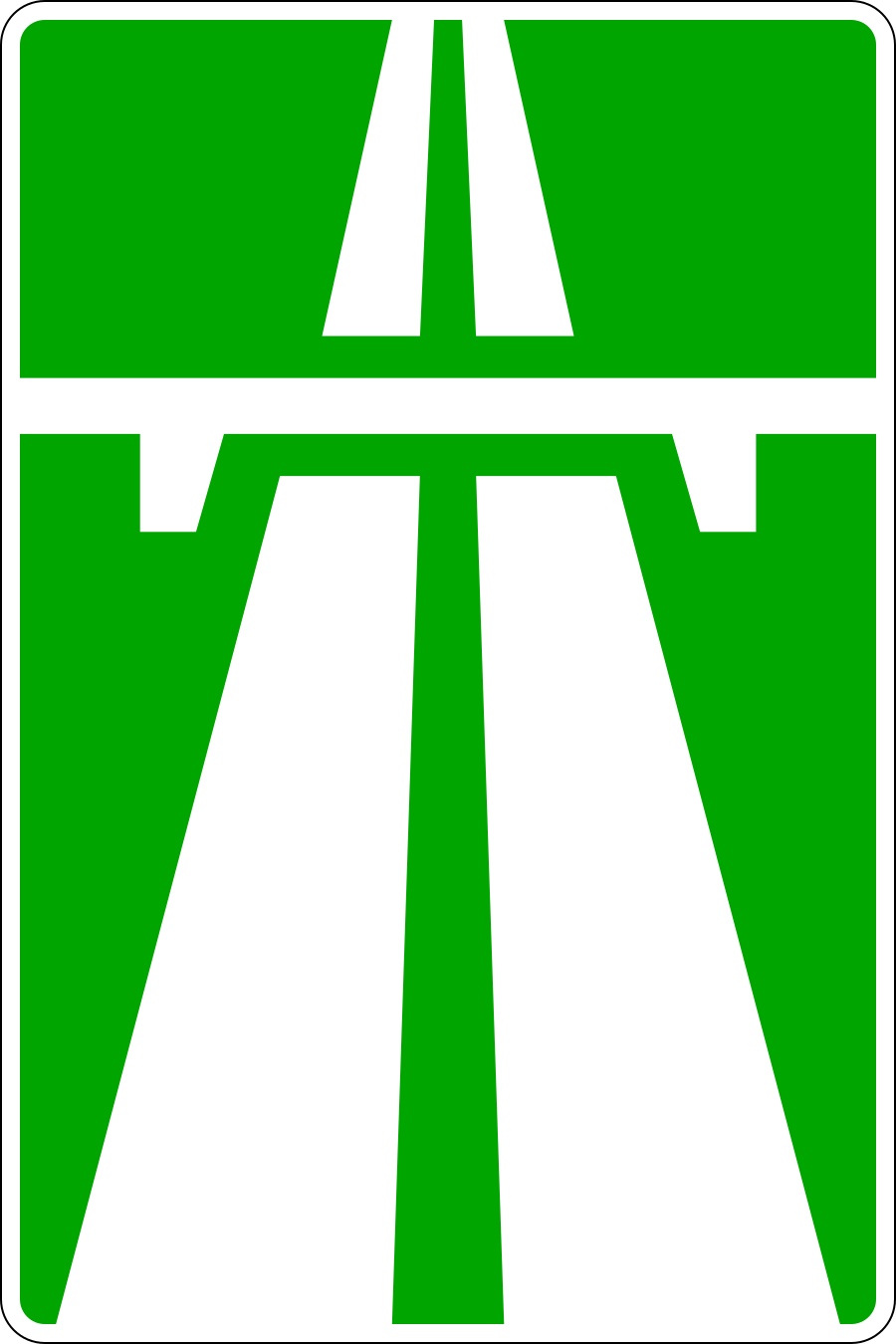
Road sign used in this ticket

5.1. Motorway

A motorway on which the requirements of the rules governing traffic on motorways apply. The sign is installed at the beginning of the motorway or near it with plate 8.1.1.

The driver of a vehicle forcibly stopped on a motorway due to a technical malfunction is obliged to:

1 immediately contact the technical service and, until its representative arrives, move the vehicle into the extreme right lane of the carriageway, switch on the hazard warning lights and the dipped-beam headlights
2 Take all measures to remove the car from the carriageway and, if this cannot be done immediately, switch on the hazard warning lights (if fitted) and mark the car with the appropriate sign at a sufficient distance to warn approaching drivers in time
Law explanation
According to Article 38(1)(c.a) of the Law of Georgia "On Road Traffic", on a motorway and at motorway entrances and exits, the driver is prohibited from stopping or parking the motor vehicle (and/or its trailer), except in specially marked places designated for parking. A driver who is forced to stop due to circumstances beyond his control must take all measures to move the motor vehicle (and/or its trailer) off the carriageway, and if this cannot be done immediately, switch on the hazard warning lights (if fitted) and mark the motor vehicle (and/or its trailer) with the appropriate sign at a sufficient distance to warn approaching drivers in time.

If a vehicle involved in a road traffic accident cannot be immediately driven away or towed and constitutes an obstacle for other road users, the driver of such a vehicle is obliged to switch on:

1 hazard warning lights
2 Low-beam or high-beam headlights and rear side lights
3 Sound signal
Law explanation
According to subparagraph “a” of paragraph 1 of Article 52 of the Law of Georgia “On Road Traffic”, hazard warning lights are used to warn other road users of a possible danger. Hazard warning lights must be switched on: a) if a vehicle involved in a road traffic accident or a broken-down vehicle cannot immediately be removed or towed away and this obstructs other road users.

After switching on the hazard warning lights on a vehicle involved in a road traffic accident, and also if such lights are not fitted or are out of order, the driver must immediately:

1 switch on the main-beam headlights
2 sound the horn
3 place a warning triangle, and in conditions of insufficient visibility, a flashing red lamp
Law explanation
According to Article 52(1)(a) of the Law of Georgia "On Road Traffic", hazard warning lights are used to warn other road users of possible danger. The hazard warning lights must be switched on: a) if a vehicle involved in a road traffic accident or a broken-down vehicle cannot be removed or towed away immediately and this obstructs other road users; according to paragraph 2(a) of the same Article, after switching on the hazard warning lights, and also if such lights are absent or out of order, the driver must immediately place a "Warning triangle", and in conditions of insufficient visibility, a flashing red lamp: a) in the event of a road traffic accident.
Ticket #1267 — situation image

Will the truck driver violate the traffic rules when moving in the direction of the arrow?

1 will violate
2 will not violate
Law explanation
According to paragraph 3.22 of Chapter 3 (Prohibitory signs) of Annex 1 of the Law of Georgia “On Road Traffic”, road sign 3.22 “No overtaking by lorries” - prohibits lorries with a maximum permissible mass of more than 3.5 tonnes from overtaking other vehicles (except vehicles travelling at less than 30 km/h), and also prohibits tractors from overtaking other vehicles (except animal-drawn vehicles and bicycles).
Practical part

Exam routes — exactly the way the examiner drives them

60 real exam routes across 10 cities, 793 km in total. Every turn and stop on the map, with voice guidance.

  • All routes on the map
  • GPS mode on the real road
  • Practice mode with adjustable speed
  • On the web and in the app

One-off payment, no auto-renewal — by card on the Bank of Georgia secure page.

Chat with us