imecadine.ge

Full ticket list

822 official tickets — category D1, with the correct answer and law explanation.

The driver is prohibited from further movement of the vehicle if:

1 during the dark time of day, the dipped-beam and main-beam headlights are both off at the same time (or are absent) and/or the rear position lights are off, on a road without artificial lighting or with insufficient visibility
2 the horn does not work
3 the windscreen wipers do not operate in the established mode
4 the tightness of the fuel supply system is compromised
Law explanation
According to Article 21(13) of the Law of Georgia "On Road Traffic", the driver is prohibited from driving when the service braking system, the steering mechanism or the coupling device of a vehicle combination is faulty, and also at night with both dipped and main-beam headlights simultaneously out of order (not lit) (or in their absence) and/or with the rear position lights out of order, on a road that has no artificial lighting or where visibility is insufficient. Driving a power-driven vehicle in fog, rain or snow is prohibited when the windscreen wiper on the driver's side is not working.

The driver is prohibited from further movement of the vehicle if:

1 the seat belts are not in working order
2 The exhaust gas system is faulty
3 the windscreen wiper on the driver's side does not work during fog, rain or snow
4 The rear-view mirror provided for by the vehicle's design is missing
Law explanation
According to Article 21(13) of the Law of Georgia "On Road Traffic", the driver is prohibited from driving when the service braking system, the steering mechanism or the coupling device of a vehicle combination is faulty, and also at night with both dipped and main-beam headlights simultaneously out of order (not lit) (or in their absence) and/or with the rear position lights out of order, on a road that has no artificial lighting or where visibility is insufficient. Driving a power-driven vehicle in fog, rain or snow is prohibited when the windscreen wiper on the driver's side is not working.
If a person injured in a road traffic accident is not breathing but has a pulse in the carotid artery, how often should the pulse be checked?

1 every 5 minutes
2 Every 2 minutes
3 every 6 minutes
Law explanation
If a person injured in a road traffic accident is not breathing but has a pulse in the carotid artery, the pulse must be checked once every 2 minutes.

Is a driver involved in a road traffic accident obliged to make sure that there are no injured or dead as a result of the accident?

1 is obliged
2 Is not obliged if they ensure that an ambulance is called
3 Is not obliged if the road traffic accident did not occur through their fault
4 is obliged only if they are a doctor
Law explanation
According to subparagraph "b" of paragraph 1 of Article 27 of the Law of Georgia "On Road Traffic", a driver involved in a road traffic accident is obliged to: b) make sure that no one has been injured or killed as a result of the road traffic accident.

If there is no urgent need for them to go to a medical institution or to transport the injured, a driver involved in a road traffic accident is obliged:

1 take their vehicle to the nearest patrol police unit and report the incident there
2 Remain at the scene of the accident and wait for an authorised person to arrive
3 draw up a diagram of the accident, take statements from eyewitnesses and submit these documents to the nearest patrol police unit
Law explanation
According to subparagraph "c" of paragraph 1 of Article 27 of the Law of Georgia "On Road Traffic", a driver involved in a road traffic accident is obliged to: c) immediately notify the relevant service within the system of the Ministry of Internal Affairs of Georgia of the incident and, if there is no urgent need for them to go to a medical facility or to transport an injured person, remain at the scene of the road traffic accident and wait for the authorised person to arrive.

The driver involved in a road traffic accident is obliged to immediately report the incident to:

1 The Ministry of Labour, Health and Social Affairs of Georgia
2 of the local self-government body
3 To the relevant service within the system of the Ministry of Internal Affairs of Georgia
Law explanation
According to subparagraph "c" of paragraph 1 of Article 27 of the Law of Georgia "On Road Traffic", a driver involved in a road traffic accident is obliged to: c) immediately notify the relevant service within the system of the Ministry of Internal Affairs of Georgia of the incident and, if there is no urgent need for them to go to a medical facility or to transport an injured person, remain at the scene of the road traffic accident and wait for the authorised person to arrive.

Is a driver involved in a road traffic accident obliged to give first aid to a person injured as a result of the accident?

1 is not obliged
2 is obliged
3 Is not obliged only if they ensure that an ambulance is called
4 is obliged only if they are a doctor
Law explanation
According to subparagraph “e” of paragraph 1 of Article 27 of the Law of Georgia “On Road Traffic”, a driver involved in a road traffic accident must: e) take the necessary measures to provide first aid to a person injured as a result of the road traffic accident, call an ambulance, and in case of urgent necessity send the injured person to the nearest medical facility in another passing vehicle, and if this is impossible, take them there themselves, except where there is reasonable suspicion that transporting them may harm the injured person.

If there is an urgent need to transport persons injured in an accident to a medical facility, the driver involved in the road traffic accident is obliged to:

1 Send the injured person to the nearest medical facility by another passing vehicle and, if this is impossible, do so personally
2 Wait at the scene for an authorised officer of the patrol police and take the injured person to a medical facility only with their permission
Law explanation
According to subparagraph “e” of paragraph 1 of Article 27 of the Law of Georgia “On Road Traffic”, a driver involved in a road traffic accident must: e) take the necessary measures to provide first aid to a person injured as a result of the road traffic accident, call an ambulance, and in case of urgent necessity send the injured person to the nearest medical facility in another passing vehicle, and if this is impossible, take them there themselves, except where there is reasonable suspicion that transporting them may harm the injured person.

Can drivers involved in a road traffic accident, after assessing the existing circumstances and on the basis of mutual agreement, draw up a preliminary diagram of the accident, sign it and go to the nearest unit of the patrol police to register this fact?

1 they may, only if no one was injured as a result of the road traffic accident
2 they cannot, since they are obliged to remain at the scene of the accident until the authorised person arrives
Law explanation
According to paragraph 2 of Article 27 of the Law of Georgia “On Road Traffic”, if no one was injured as a result of a road traffic accident, the drivers, having assessed the circumstances, may by agreement draw up a sketch of the accident in advance, sign it and go to the nearest unit of the patrol police to formalise this fact.

If a driver involved in a road traffic accident is forced to leave the scene because he/she needs to go to a medical facility, he/she must, at the medical facility:

1 State their own identity and that of the injured person and the eyewitnesses of the accident, and present an approximate diagram of the road traffic accident
2 state their identity (present an identity document and the vehicle registration documents) and, if this is not impossible, return to the scene of the accident
Law explanation
According to Article 27(3) of the Law of Georgia "On Road Traffic", if, in the circumstances defined by subparagraphs (c) and (e) of paragraph 1 of this Article, the driver is forced to leave the scene of a road traffic accident because of the need to go to a medical facility, he/she must state his/her identity at the medical facility (present an identity document and the vehicle registration documents) and, if this is not impossible, return to the scene of the accident.

If a person injured in a road traffic accident has fractures of the ribs and breastbone, they must be transported:

1 lying on the back
2 lying on the side
3 in a sitting or semi-sitting position
Law explanation
In the case of fractures of the ribs and breastbone of a person injured in a road traffic accident, the injured person must be transported in a sitting or semi-sitting position.

If a vehicle involved in a road traffic accident cannot be immediately driven away or towed and constitutes an obstacle for other road users, the driver of such a vehicle is obliged to switch on:

1 hazard warning lights
2 Low-beam or high-beam headlights and rear side lights
3 Sound signal
Law explanation
According to subparagraph “a” of paragraph 1 of Article 52 of the Law of Georgia “On Road Traffic”, hazard warning lights are used to warn other road users of a possible danger. Hazard warning lights must be switched on: a) if a vehicle involved in a road traffic accident or a broken-down vehicle cannot immediately be removed or towed away and this obstructs other road users.

After switching on the hazard warning lights on a vehicle involved in a road traffic accident, and also if such lights are not fitted or are out of order, the driver must immediately:

1 switch on the main-beam headlights
2 sound the horn
3 place a warning triangle, and in conditions of insufficient visibility, a flashing red lamp
Law explanation
According to Article 52(1)(a) of the Law of Georgia "On Road Traffic", hazard warning lights are used to warn other road users of possible danger. The hazard warning lights must be switched on: a) if a vehicle involved in a road traffic accident or a broken-down vehicle cannot be removed or towed away immediately and this obstructs other road users; according to paragraph 2(a) of the same Article, after switching on the hazard warning lights, and also if such lights are absent or out of order, the driver must immediately place a "Warning triangle", and in conditions of insufficient visibility, a flashing red lamp: a) in the event of a road traffic accident.

A motorcycle, bus, passenger car and truck may be driven only by a person:

1 whose state of health meets the health requirements for driving vehicles established by the legislation of Georgia
2 that meets all the conditions listed in this ticket
3 who, in accordance with the procedure established by the legislation of Georgia, has been granted the right to drive a vehicle of the relevant category and/or subcategory, and this right has not been suspended or terminated
Law explanation
According to Article 54(1) of the Law of Georgia "On Road Traffic", only a person may drive a vehicle of the category and/or subcategory defined by this Article: a) whose state of health meets the health requirements for driving a vehicle established by the legislation of Georgia; b) who has been granted the right to drive a vehicle of the relevant category and/or subcategory in accordance with the procedure established by the legislation of Georgia, and this right has not been suspended, revoked or terminated (cancelled).
Ticket #1102 — situation image

Will the driver of the black car violate the traffic rules when moving in the direction of the arrow?

1 will not violate
2 will violate
Law explanation
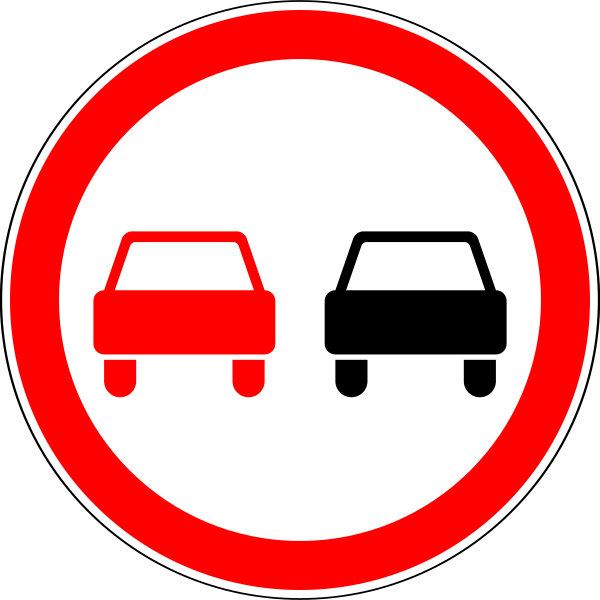
According to paragraph 3.20 of Chapter 3 (Prohibitory signs) of Annex 1 to the Law of Georgia "On Road Traffic", road sign 3.20 "No overtaking" prohibits overtaking all motor vehicles, except vehicles travelling at a speed of less than 30 km/h. Overtaking a motorcycle without a sidecar, a moped and a bicycle is permitted without moving into the oncoming traffic lane. According to subparagraph (e) of the note to the same Chapter, e) signs 3.16, 3.20, 3.22, 3.24, 3.26–3.30 apply after the respective sign, from the place where the sign is installed to the nearest intersection, and in a built-up area where there is no intersection, to the end of the built-up area.

Road sign used in this ticket

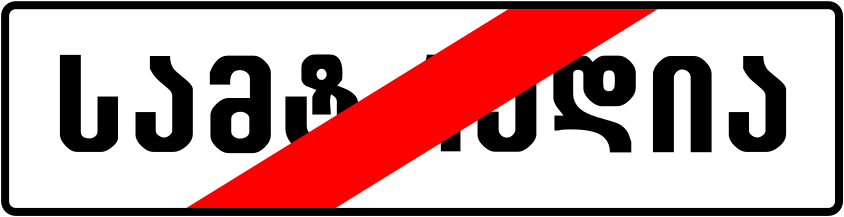
5.24.1. End of built-up area

Indicates the end of the built-up area marked with signs 5.23.1 and 5.23.2, respectively. The sign is installed at every exit from the built-up area, at the actual boundary of the built-up zone.

3.20. No overtaking

Prohibits overtaking all types of motor vehicles (except vehicles moving at less than 30 km/h). Overtaking motorcycles without a sidecar, mopeds and bicycles is permitted without crossing into the oncoming lane. The sign applies from the place where it is installed to the nearest intersection behind it, and in a built-up area with no intersection – to the end of the built-up area. The sign's effect is also not interrupted at exits from adjacent areas or at intersections (junctions) with field, forest and other minor roads before which no corresponding sign is installed.

A driver entitled to drive vehicles of subcategory "D1" has the right to drive a motor vehicle designed for the carriage of passengers whose:

1 The number of seats, in addition to the driver's seat, exceeds 16 but does not exceed 30, and the length does not exceed 8 metres
2 the number of seats, excluding the driver's seat, exceeds 8 but does not exceed 16, and the length does not exceed 8 metres
3 the number of seats, excluding the driver's seat, does not exceed 8, and the length does not exceed 5 metres
Law explanation
According to Article 54(3)(d) of the Law of Georgia "On Road Traffic", vehicles within categories "A", "B", "C", "CE", "D" and "DE" for whose driving it is mandatory to obtain the relevant driving licence are divided into the following subcategories: d) "D1" − a motor vehicle intended for the carriage of passengers, whose number of seats, excluding the driver's seat, exceeds 8 but does not exceed 16 and whose length does not exceed 8 metres, as well as a subcategory "D1" motor vehicle coupled to a trailer whose maximum permissible mass does not exceed 750 kg.

A driver holding a driving licence for subcategory "D1" vehicles also has the right to drive a subcategory "D1" motor vehicle with a trailer whose maximum permissible mass:

1 Exceeds 1,200 kg
2 exceeds 750 kg but does not exceed 1200 kg
3 Does not exceed 750 kg
Law explanation
According to Article 54(3)(d) of the Law of Georgia "On Road Traffic", vehicles within categories "A", "B", "C", "CE", "D" and "DE" for whose driving it is mandatory to obtain the relevant driving licence are divided into the following subcategories: d) "D1" − a motor vehicle intended for the carriage of passengers, whose number of seats, excluding the driver's seat, exceeds 8 but does not exceed 16 and whose length does not exceed 8 metres, as well as a subcategory "D1" motor vehicle coupled to a trailer whose maximum permissible mass does not exceed 750 kg.

Does a driver entitled to drive vehicles of category "D1E" have the right to drive a vehicle of category "D1" with a trailer whose maximum permissible mass exceeds 750 kg, if the total maximum permissible mass of such a combination does not exceed 12000 kg?

1 does not have the right
2 Has the right
Law explanation
According to subparagraph “f” of paragraph 3 of Article 54 of the Law of Georgia “On Road Traffic”, vehicles established within categories “A”, “B”, “C”, “CE”, “D” and “DE”, for which obtaining the appropriate driving right is mandatory, are divided into the following subcategories: f) “D1E” − a subcategory “D1” motor vehicle coupled to a trailer that is not designed for carrying passengers and whose maximum permissible mass exceeds 750 kg but does not exceed the unladen mass of the motor vehicle, and the total maximum permissible mass of such a combination does not exceed 12 000 kg.

Does a person holding a driving licence for subcategories "C1E" and "D1" also have the right to drive a subcategory "D1E" vehicle?

1 Has the right
2 does not have the right
Law explanation
According to Article 56(5) of the Law of Georgia "On Road Traffic", a person entitled to drive vehicles of subcategory "C1E" who is also entitled to drive vehicles of subcategory "D1" is also entitled to drive vehicles of subcategory "D1E".

Does a person entitled to drive vehicles of category "DE" and subcategory "C1" also have the right to drive vehicles of subcategory "C1E"?

1 does not have the right
2 Has the right
Law explanation
According to paragraph 6 of Article 56 of the Law of Georgia “On Road Traffic”, a person entitled to drive vehicles of category “DE” who is also entitled to drive vehicles of subcategory “C1” also has the right to drive vehicles of subcategory “C1E”.
Practical part

Exam routes — exactly the way the examiner drives them

60 real exam routes across 10 cities, 793 km in total. Every turn and stop on the map, with voice guidance.

  • All routes on the map
  • GPS mode on the real road
  • Practice mode with adjustable speed
  • On the web and in the app

One-off payment, no auto-renewal — by card on the Bank of Georgia secure page.

Chat with us