imecadine.ge

Duties of the driver, passenger and pedestrian

50 official tickets in this topic, with the correct answer and law explanation.

Basic duties, identification signs and the international convention.

A "slow-moving vehicle" is:

1 a motor vehicle whose design speed does not exceed 40 km/h, or which cannot exceed this speed, or is prohibited from exceeding it for a reason not related to traffic flows
2 A motorised or non-motorised vehicle whose design speed does not exceed 45 km/h
3 Any vehicle that travels on the road at a speed not exceeding 50 km/h
Law explanation
According to Article 5(53) of the Law of Georgia "On Road Traffic", a "slow-moving vehicle" is a power-driven vehicle whose design speed does not exceed 40 km/h, or which cannot exceed that speed or is prohibited from exceeding it for a reason not related to traffic flows.

A "truck" is:

1 any power-driven vehicle intended for the carriage of goods
2 Any power-driven vehicle intended for the carriage of goods whose gross mass does not exceed 3,500 kg
3 A motor vehicle intended for the carriage of goods, whose maximum permissible mass exceeds 3,500 kg
Law explanation
According to Article 5(71) of the Law of Georgia "On Road Traffic", "goods vehicle" – a motor vehicle intended for the carriage of goods whose maximum permissible mass exceeds 3 500 kg.

"Axle load" is:

1 the maximum axle load mass set by the manufacturer, the sum of which determines the limit of the gross mass of the vehicle
2 the part of the vehicle's actual mass which, by bearing on the axle, produces a load on the road
Law explanation
According to paragraph 88 of Article 5 of the Law of Georgia “On Road Traffic”, “axle load” is the part of the actual mass of a vehicle which, by bearing on the axle, creates a load on the road. When determining the load on each driving or non-driving axle, structurally separate axles located on one line in the transverse section of the vehicle are considered as one single axle.

"Limited visibility" is:

1 Driving through a tunnel, during the hours of darkness, and when road visibility is reduced to less than 300 metres due to fog, rain, snow or other natural phenomena
2 a circumstance in which a sharp bend, the end of an ascent, vegetation, a roadside structure or an obstacle on the road reduces the visibility of the road in the direction of travel to such an extent that driving at the maximum permitted speed on that road section may create a danger
Law explanation
According to paragraph 89 of Article 5 of the Law of Georgia “On Road Traffic”, “restricted visibility” - a circumstance in which a sharp bend, the end of an upward slope, greenery, a roadside structure or an obstacle on the road reduces the visibility of the road in the direction of travel to such an extent that travelling at the maximum permitted speed on that section of road may create a danger.

A "passenger car" is:

1 a motorcycle with a gross mass of up to 2500 kg
2 A motor vehicle (other than a motorcycle or moped) with a maximum permissible mass not exceeding 3,500 kg, with not more than 8 seats in addition to the driver's seat
3 A motor vehicle with a gross mass of up to 4,500 kg, with more than 8 but not more than 12 seats in addition to the driver's seat
Law explanation
According to Article 5(46) of the Law of Georgia "On Road Traffic", a "passenger car" is a motor vehicle (other than a motorcycle) with a maximum permissible mass of up to 3500 kg, with no more than 8 seats in addition to the driver's seat.

A "light trailer" is:

1 A trailer whose unladen weight does not exceed 850 kg
2 A trailer whose gross mass does not exceed 950 kg
3 a trailer whose maximum permitted mass does not exceed 750 kg
Law explanation
According to Article 5(48) of the Law of Georgia "On Road Traffic", a "light trailer" is a trailer whose maximum permissible mass does not exceed 750 kg.

The "gross mass" of a vehicle is:

1 The mass of the vehicle in equipped condition, filled with load, crew and passengers, the limit of which is set by the vehicle manufacturer
2 the mass of the vehicle without the crew, passengers and cargo
3 the part of the vehicle's mass which, by bearing on the axle, produces a load on the road
4 The mass of the loaded vehicle, crew and passengers at a given moment in time
Law explanation
According to paragraph 80 of Article 5 of the Law of Georgia “On Road Traffic”, “gross mass” – the mass of a vehicle in equipped condition, loaded with cargo, driver and passengers, the limit of which is set by the vehicle's manufacturer. The gross mass of a combination of vehicles is calculated as the sum of the gross masses of the vehicles forming it.

When determining the load on each driving or non-driving axle, structurally separate axles located on one line in the transverse section of the vehicle are considered as:

1 Independent axles
2 One solid axle in the case of a non-driven axle, independent axles in the case of a driven axle
3 one solid axle
Law explanation
According to paragraph 88 of Article 5 of the Law of Georgia “On Road Traffic”, axle load is the part of the actual mass of a vehicle which, by bearing on the axle, creates a load on the road. When determining the load on each driving or non-driving axle, structurally separate axles located on one line in the transverse section of the vehicle are considered as one single axle.

If the driver cannot determine whether the road has a surface (due to darkness, snow, mud or another reason) and there are no priority signs, they are considered to be:

1 on a secondary road
2 on the main road
3 On a road equivalent to a motorway
Law explanation
According to paragraph 8 of Article 36 of the Law of Georgia "On Road Traffic", if the driver cannot determine whether the road has a surface (due to darkness, snow, mud or another reason) and there are no priority signs, they are considered to be on a secondary road.

If the requirements of a temporary road sign installed on a vehicle of an organisation carrying out road works contradict the requirements of a road sign permanently installed on the same section of road, the driver is obliged to follow:

1 the requirements of the permanently installed road sign
2 The requirements of the temporary road sign installed on the vehicle of the organisation carrying out the road works
Law explanation
According to Article 28(5) of the Law of Georgia "On Road Traffic", if a road sign is installed on a portable stand temporarily placed on the road or on a vehicle of an organisation carrying out roadworks (hereinafter − temporary road sign), and its requirements contradict the requirements of a road sign permanently installed on the same section of road, the driver must comply with the requirements of the temporary road sign.

A motorcycle, bus, passenger car and truck may be driven only by a person:

1 whose state of health meets the health requirements for driving vehicles established by the legislation of Georgia
2 that meets all the conditions listed in this ticket
3 who, in accordance with the procedure established by the legislation of Georgia, has been granted the right to drive a vehicle of the relevant category and/or subcategory, and this right has not been suspended or terminated
Law explanation
According to Article 54(1) of the Law of Georgia "On Road Traffic", only a person may drive a vehicle of the category and/or subcategory defined by this Article: a) whose state of health meets the health requirements for driving a vehicle established by the legislation of Georgia; b) who has been granted the right to drive a vehicle of the relevant category and/or subcategory in accordance with the procedure established by the legislation of Georgia, and this right has not been suspended, revoked or terminated (cancelled).

A person holding a category "B" driving licence has the right to drive a car with no more than 8 seats, excluding the driver's seat, whose permissible maximum mass:

1 Exceeds 4,500 kg
2 Exceeds 3,500 kg but does not exceed 4,500 kg
3 does not exceed 3 500 kg
Law explanation
According to Article 54(2)(b) of the Law of Georgia "On Road Traffic", vehicles for whose driving it is mandatory to obtain the relevant driving licence are divided into the following categories: b) "B" − a motor vehicle (other than vehicles belonging to subcategory "A1" or category "A") whose maximum permissible mass does not exceed 3 500 kg and whose number of seats, excluding the driver's seat, does not exceed 8, as well as a category "B" motor vehicle coupled to a trailer whose maximum permissible mass does not exceed 750 kg, or a category "B" motor vehicle coupled to a trailer whose maximum permissible mass exceeds 750 kg but does not exceed the unladen mass of the motor vehicle, provided the total maximum permissible mass of such a combination does not exceed 3 500 kg.

A person holding a driving licence for category "B" vehicles has the right to drive a passenger car with a maximum permissible mass not exceeding 3 500 kg whose number of seats, excluding the driver's seat:

1 exceeds 16
2 does not exceed 8
3 exceeds 8 but does not exceed 16
Law explanation
According to Article 54(2)(b) of the Law of Georgia "On Road Traffic", vehicles for which obtaining the relevant driving licence is mandatory are divided into the following categories: b) "B" – a motor car (except vehicles belonging to subcategory "A1" or category "A") whose maximum permissible mass does not exceed 3 500 kg and whose number of seats, excluding the driver's seat, does not exceed 8, as well as a category "B" motor car coupled to a trailer whose maximum permissible mass does not exceed 750 kg, or a category "B" motor car coupled to a trailer whose maximum permissible mass exceeds 750 kg but does not exceed the unladen mass of the motor car, and the total maximum permissible mass of such a combination does not exceed 3 500 kg

Does a driver holding a category "B" driving licence have the right to drive a category "B" car with a trailer whose permissible maximum mass exceeds 750 kg but does not exceed the unladen mass of the car, if the total permissible maximum mass of such a combination does not exceed 3 500 kg?

1 Has the right
2 does not have the right
Law explanation
According to Article 54(2)(b) of the Law of Georgia "On Road Traffic", vehicles for which obtaining the relevant driving licence is mandatory are divided into the following categories: b) "B" – a motor car (except vehicles belonging to subcategory "A1" or category "A") whose maximum permissible mass does not exceed 3 500 kg and whose number of seats, excluding the driver's seat, does not exceed 8, as well as a category "B" motor car coupled to a trailer whose maximum permissible mass does not exceed 750 kg, or a category "B" motor car coupled to a trailer whose maximum permissible mass exceeds 750 kg but does not exceed the unladen mass of the motor car, and the total maximum permissible mass of such a combination does not exceed 3 500 kg

Does a driver holding a category "BE" driving licence have the right to drive a category "B" car with a coupled trailer whose permissible maximum mass exceeds 750 kg, if the total permissible maximum mass of such a combination exceeds 3500 kg?

1 does not have the right
2 Has the right
Law explanation
According to Article 54(2)(e) of the Law of Georgia "On Road Traffic", vehicles for which obtaining the relevant driving licence is mandatory are divided into the following categories: e) "BE" – a category "B" motor car coupled to a trailer whose maximum permissible mass exceeds 750 kg and the unladen mass of the motor car, as well as a category "B" motor car coupled to a trailer whose maximum permissible mass exceeds 750 kg, where the total maximum permissible mass of such a combination exceeds 3 500 kg.

A person holding a category "B" driving licence also has the right to drive vehicles of which subcategory?

1 "C1"
2 "B1"
3 "A1" and "B1"
4 "A1"
Law explanation
According to Article 56(1) of the Law of Georgia "On Road Traffic", a person entitled to drive vehicles of category "A", "B", "C" or "D" is also entitled to drive vehicles of subcategory "A1", "B1", "C1" or "D1" established within the granted category.

A person entitled to drive vehicles of category "B" has the right to drive a wheeled agricultural tractor whose maximum permissible mass:

1 Exceeds 4,250 kg but does not exceed 12,000 kg
2 Does not exceed 4,250 kg
3 exceeds 4250 kg but does not exceed 8250 kg
Law explanation
According to paragraph 9 of Article 56 of the Law of Georgia “On Road Traffic”, a person holding the right to drive category “B” vehicles is entitled to drive a wheeled agricultural tractor whose maximum permissible mass does not exceed 4250 kg, as well as such a motor vehicle coupled to a trailer, if the total maximum permissible mass of such a combination does not exceed 4 250 kg.

A person holding a category "B" driving licence also has the right to drive a wheeled agricultural tractor with a coupled trailer, if the total permissible maximum mass of such a combination:

1 exceeds 4250 kg but does not exceed 5500 kg
2 Does not exceed 4,250 kg
3 exceeds 4250 kg but does not exceed 75000 kg
Law explanation
According to paragraph 9 of Article 56 of the Law of Georgia “On Road Traffic”, a person holding the right to drive vehicles of category “B” is entitled to drive a wheeled agricultural tractor whose maximum permissible mass does not exceed 4 250 kg, as well as such a power-driven vehicle coupled to a trailer, if the total maximum permissible mass of such a combination does not exceed 4 250 kg.
Ticket #1219 — situation image

Which identification sign is fixed to the rear of a power-driven vehicle fitted with studded tyres?

1 only I
2 only II
3 all three
4 only III
Law explanation
According to subparagraph “b” of paragraph 1 of Article 19 of the Law of Georgia “On Road Traffic”, the driver, and in the cases provided for by subparagraph “d” of paragraph 1 of Article 18 of this Law − the enterprise, must affix the following identification signs to the vehicles specified in this paragraph: b) “Studs” – a white equilateral triangle pointing upwards with a red border, with the black letter “K” inscribed in it (the side of the triangle is at least 200 mm, the width of the border – 1/10 of the side) – affixed to the rear of a vehicle fitted with studded tyres.
Ticket #1220 — situation image

Which identification sign is attached to the front and rear of a vehicle carrying dangerous goods?

1 only III
2 only I
3 only II
4 Only I and II
Law explanation
According to Article 19(1)(c) of the Law of Georgia "On Road Traffic", the driver, and in the cases provided for in Article 18(1)(d) of this Law, the enterprise, is obliged to fix the following identification signs on the vehicles specified in this paragraph: c) "Dangerous goods" – a 400X300 mm rectangular orange plate with a 15 mm wide black border around it − on the front and rear of a vehicle carrying such goods, and in the case of a tank – also on the sides (the United Nations number of the goods must be indicated in the lower part of the plate, and the hazard identification number in the upper part. They must be separated by a 15 mm thick black horizontal line crossing the plate at half its height).

Road sign used in this ticket

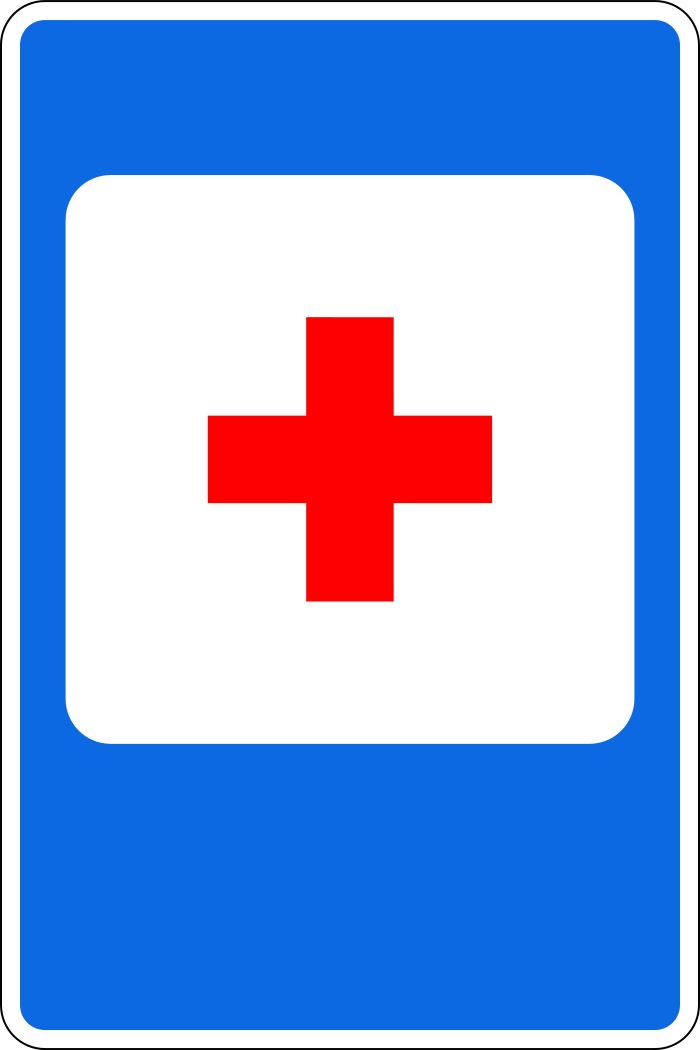
6.1. First aid station

Sign indicating a first aid station.

Practical part

Exam routes — exactly the way the examiner drives them

60 real exam routes across 10 cities, 793 km in total. Every turn and stop on the map, with voice guidance.

  • All routes on the map
  • GPS mode on the real road
  • Practice mode with adjustable speed
  • On the web and in the app

One-off payment, no auto-renewal — by card on the Bank of Georgia secure page.

Chat with us