imecadine.ge

Full ticket list

1236 official tickets — category B+C1 Mil, with the correct answer and law explanation.

At night or in conditions of insufficient visibility, a load protruding beyond the dimensions of the vehicle by more than one metre at the front and/or rear, or by more than 0.4 metres at the side from the outer edge of the position light, must additionally be marked:

1 only at the front, with a white lamp or reflector
2 Both at the front – with a white lamp or reflector, and at the rear – with a red lamp or reflector
3 Only at the rear – with a red lamp or reflector
Law explanation
According to Article 47(13) of the Law of Georgia "On Road Traffic", a load projecting more than 1 metre beyond the vehicle's overall dimensions at the front and/or rear, or more than 0.4 metres at the side beyond the outer edge of the position light, must be marked with the identification sign "Oversized (large-dimension) load", and at night or in conditions of insufficient visibility, with a white lamp or reflector at the front and a red lamp or reflector at the rear.

If there is suspicion of a neck or spinal injury of a person injured in a road traffic accident and their life is in danger, how should the injured person be moved by dragging without a helper (by one person)?

1 with the injured person in a sitting position, stand between their legs, slide the arms under their shoulders and clasp them together behind their back. Lift using the legs and move the injured person backwards by dragging
2 with the injured person in a sitting position, slide the arms under their shoulders from behind, fix the lower jaw and neck, and move them backwards by dragging
Law explanation
Moving an injured person by dragging without an assistant, when a neck or spinal injury is suspected and their life is in danger, should be done as follows: place the injured person in a sitting position. Stand behind the injured person, slide your arms under their armpits, fix the lower jaw and neck, and drag them backwards in this way.
Ticket #589 — situation image

Will the driver of the truck violate the traffic rules when moving in the direction of the arrow, if he is moving at a speed of 50 km/h?

1 will violate
2 will not violate
Law explanation
According to Article 33(7)(d.b) of the Law of Georgia "On Road Traffic", except in cases established by this Law, outside built-up areas, and also in built-up areas on a section of road where travel at more than 60 km/h is permitted by the relevant sign, vehicles of categories C and CE, as well as of subcategories C1 and C1E, when carrying passengers in the body in the established manner, are permitted to travel on all roads at a speed not exceeding 60 km/h.
Ticket #590 — situation image

In the given situation, how many traffic rules does the driver of the towing truck moving in the direction of the arrow violate, if it is moving at a speed of 60 km/h?

1 two
2 none
3 three
4 one
Law explanation
According to subparagraph “d” of paragraph 8 of Article 33 of the Law of Georgia “On Road Traffic”, unless otherwise provided by this Law, in built-up or non-built-up areas a motor vehicle towing another motor vehicle is permitted to move at a speed not exceeding 50 km/h. According to paragraph 5 of Article 45 of the same Law, the distance between the towing and towed vehicles when towing with a flexible coupling must be 4−6 metres, and when towing with a rigid coupling – not more than 4 metres. According to paragraph 9 of the same Article, when towing a motor vehicle, flags, a warning device or a 200X200 mm plate with alternating red and white diagonal stripes 50 mm wide with a retroreflective surface are used to mark flexible connecting links. At least two warning devices (flags) are fixed to a flexible connecting link. The violations here are: the speed and one flag on the towing device

Road sign used in this ticket

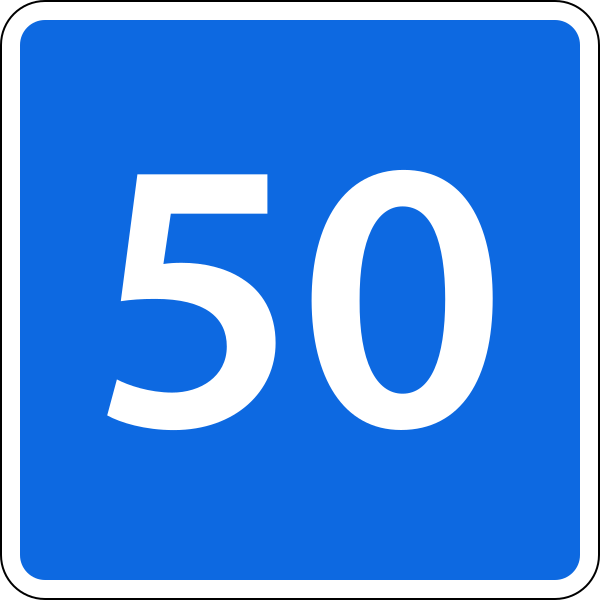
7.2. Recommended speed

Indicates the speed at which it is recommended to travel on the given section of road. The sign is installed at the beginning of the road. The sign applies up to the nearest intersection, and when used with a warning sign − over the entire length of the hazardous section.

Ticket #591 — situation image

In the given situation, how many traffic rules does the driver of the towing goods vehicle travelling in the direction of the arrow violate if travelling at a speed of 70 km/h?

1 three
2 two
3 none
4 one
Law explanation
According to Article 33(8)(d) of the Law of Georgia "On Road Traffic", unless otherwise established by this Law, in built-up areas and outside built-up areas a power-driven vehicle towing another power-driven vehicle is permitted to travel at a speed not exceeding 50 km/h. According to Article 45(4) of the same Law, when towing by a rigid or flexible coupling, it is prohibited to carry passengers in a towed bus, trolleybus or in the body of a goods vehicle. According to Article 45(5) of the same Law, when towing by a flexible coupling, the distance between the towing and towed vehicles must be 4–6 metres. According to paragraph 9 of the same Article, when towing a power-driven vehicle, the flexible connecting link is marked with flags, a warning device or a 200x200 mm plate on which alternating red and white stripes 50 mm wide with a retroreflective surface are drawn diagonally. At least two warning devices (flags) are attached to the flexible connecting link. The violations here are: the speed; there are no flags on the towing device; and passengers are being carried in the body of the towed goods vehicle.

If a person injured in a road traffic accident has a wound in the abdominal area, they must be transported:

1 in a half-sitting position with the legs straightened
2 lying on the side with the legs bent at the knees
3 In a sitting position
4 lying on the back with the legs bent at the knees
Law explanation
In the case of a wound to the abdominal area, the injured person must be transported lying on the back with the legs bent at the knees.

If a person injured in a road traffic accident has fainted, in order to provide first aid, they must:

1 lay them on their back, place a pillow under their head and let them inhale ammonia (smelling salts)
2 Lay the casualty on their back and raise the legs. Let them inhale ammonia, and rub the temples with eau de cologne (or another alcohol-containing liquid)
3 Lay the casualty on their side with the legs bent
Law explanation
In the case of fainting, the victim should be laid on their back with the legs raised. Have them inhale ammonia spirit (smelling salts) and rub their temples with eau de cologne (or another alcohol-containing liquid).
Ticket #594 — situation image

In which direction does the truck driver have the right to continue moving, if the permissible maximum mass of the truck is 15 tonnes?

1 only straight ahead and to the right
2 only straight ahead, to the right and in the reverse direction (U-turn)
3 in all directions
4 Only straight ahead, to the left and in the reverse direction (U-turn)
Law explanation
According to paragraph 3.18.2 of Chapter 3 (Prohibitory signs) of Annex 1 to the Law of Georgia "On Road Traffic", road sign 3.18.2 "No left turn" prohibits turning left at the nearest intersection of carriageways. According to paragraph 8.11 of Chapter 8 (Additional information signs) of the same Annex, road sign (plate) 8.11 "Maximum permissible mass limit" indicates that the sign applies only to vehicles whose maximum permissible mass exceeds that indicated on the plate.
Ticket #595 — situation image

In which direction does the driver of the truck have the right to continue moving, if the maximum permissible mass of the truck is 9 tonnes?

1 Only straight ahead, to the left and in the reverse direction (U-turn)
2 only right, left and in the reverse direction (U-turn)
3 only straight ahead and to the right
Law explanation
According to paragraphs 3.18.2 and 3.32 of Chapter 3 (Prohibitory signs) of Annex 1 to the Law of Georgia “On Road Traffic”, road sign: - 3.18.2 “No left turn” prohibits turning left at the nearest crossing of carriageways; - 3.32 “No vehicles carrying dangerous goods” prohibits the movement of vehicles carrying dangerous goods which, according to legislation, must be marked with the appropriate identification sign. According to paragraph 8.11 of Chapter 8 (Additional information signs) of the same Annex, road sign (plate) 8.11 “Maximum permissible mass limit” indicates that the sign applies only to vehicles whose maximum permissible mass exceeds that indicated on the plate.

In case of a concussion of a person injured in a road traffic accident, they must be transported:

1 Lying on the back, with a cushion placed under the neck and lower back
2 lying on the side
Law explanation
In the case of concussion, the injured person should be laid on his/her side and taken in this position to the nearest medical facility.

If a person injured in a road traffic accident has a penetrating chest wound, they must be transported:

1 lying on the back
2 lying on the stomach
3 lying on the uninjured side or in a semi-sitting position
Law explanation
An injured person with a penetrating chest wound may be transported lying on the uninjured side or in a semi-sitting position.

In case of an injury to one arm of a person injured in a road traffic accident, the jacket or shirt should be removed:

1 on both arms at the same time
2 first on the healthy arm, then on the injured arm
3 first on the injured arm, then on the healthy arm
Law explanation
If one arm is injured, the casualty's jacket or shirt should first be removed from the uninjured arm and then from the injured arm.

In case of traumatic shock, in order to provide first aid, a person injured in a road traffic accident must:

1 give them a painkiller, lay them on their back and place a tightly rolled dressing or clothing under their head
2 If necessary, stop the bleeding and cover with warm items; if damage to the internal abdominal organs is not suspected, give a warm drink
3 remove their clothing, give them a painkiller, and put cold compresses on the forehead
Law explanation
In the event of traumatic shock, the following first aid should be given to the injured person: if necessary, stop the bleeding, cover them with something warm, and, if we do not suspect damage to the internal organs of the abdominal cavity, give them a warm drink.

The characteristic signs of bleeding from a large artery of a person injured in a road traffic accident are:

1 clothing quickly becomes soaked with dark-coloured blood flowing from the wound in a weak stream
2 The clothing is soaked with blood only at the site of the wound, from which blood flows in a weak stream
3 the clothing is soaked with bright red blood flowing from the wound in a pulsating stream
Law explanation
When an artery is damaged, the blood is bright scarlet and flows from the wound in a pulsating stream. Arterial bleeding is life-threatening, especially when a large artery is damaged, since the casualty may lose a large amount of blood in a short period of time.
Ticket #601 — situation image

Which of the given road signs warns of approaching a level crossing with a barrier?

1 III
2 IV
3 I
4 II
Law explanation
According to paragraph 1.1 of Chapter 1 (Warning signs) of Annex 1 to the Law of Georgia "On Road Traffic", road sign 1.1 "Level crossing with barrier" warns of approaching a level crossing with a barrier.

Road sign used in this ticket

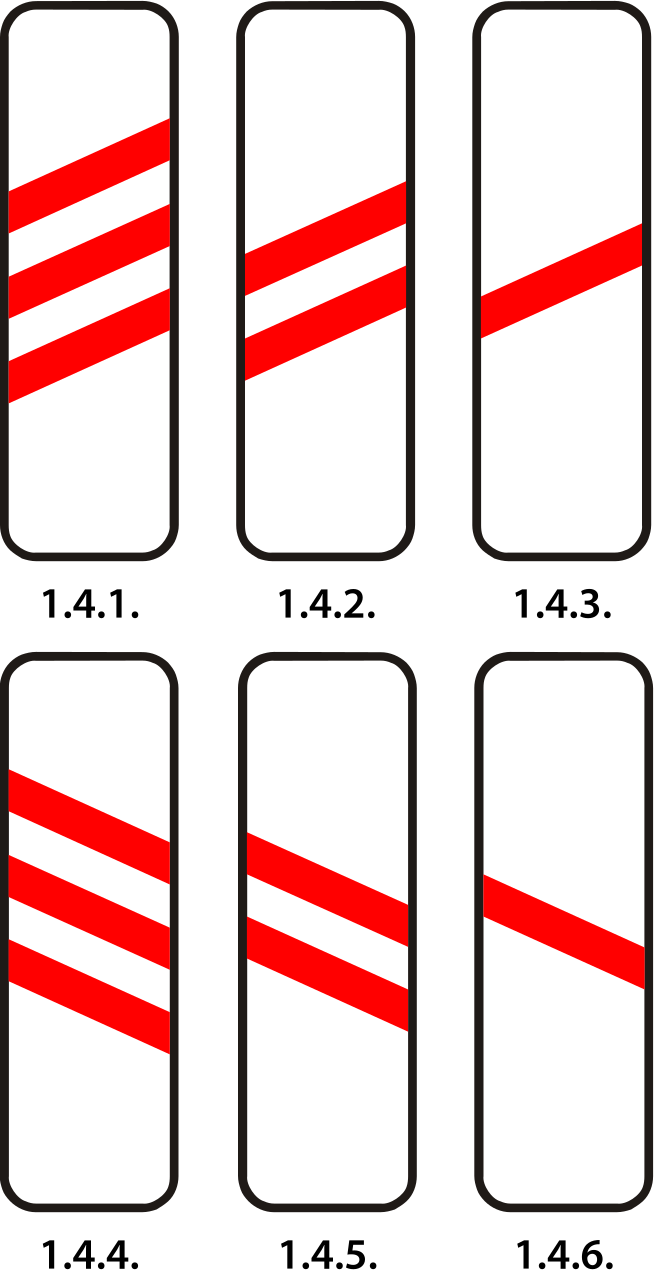
1.4.1.-1.4.6. Approach to a level crossing

Additionally warns the driver outside built-up areas of approaching a railway level crossing. Signs 1.4.1−1.4.3 are installed on the right side of the road, and signs 1.4.4−1.4.6 on the left side. Signs 1.4.1 and 1.4.4 are installed together with the main and repeated sign 1.1 or 1.2 in the direction of travel, signs 1.4.3 and 1.4.6 together with the repeated sign 1.1 or 1.2 in the direction of travel, and signs 1.4.2 and 1.4.5 independently, at an equal distance between the main and the repeated sign 1.1 or 1.2.

Ticket #602 — situation image

Which of the given road signs is installed repeatedly outside built-up areas?

1 all
2 Only I and III
3 only II and IV
4 Only I and II
Law explanation
According to subparagraph "b" of the note to Chapter 1 (Warning signs) of Annex 1 to the Law of Georgia "On Road Traffic", signs 1.2 "Level crossing without barrier" and 1.11 "Embankment exit" are repeated outside built-up areas. The second sign is placed at a distance of not less than 50 metres from the beginning of the dangerous section.

Road sign used in this ticket

1.34. Other dangers

A section of road where a danger may arise that is not covered by other warning signs. Outside built-up areas the sign is placed 150−300 m before the start of the hazardous section, in built-up areas – 50–100 m before it.

Ticket #603 — situation image

Which of the given road signs is installed repeatedly outside built-up areas?

1 Only I and II
2 all
3 Only I and III
4 only II and IV
Law explanation
According to subparagraph (b) of the note to Chapter 1 (Warning signs) of Annex 1 to the Law of Georgia "On Road Traffic", signs 1.1 "Level crossing with barrier" and 1.10 "Exit onto embankment" are repeated outside built-up areas. The second sign is placed at a distance of at least 50 metres from the beginning of the dangerous section.
Ticket #604 — situation image

Which of the given road signs is installed repeatedly outside built-up areas?

1 all
2 none
3 Only I and III
4 only II and IV
Law explanation
According to subparagraph (b) of the note to Chapter 1 (Warning signs) of Annex 1 to the Law of Georgia "On Road Traffic", signs 1.1, 1.2, 1.10, 1.11, 1.23, 1.24 and 1.26 are repeated outside built-up areas, and signs 1.24 and 1.26 also in built-up areas. The second sign is installed at a distance of not less than 50 metres from the beginning of the dangerous section.
Ticket #605 — situation image

Which of the given road signs is installed repeatedly outside built-up areas?

1 Only II and III
2 only II and IV
3 Only I and II
4 all
Law explanation
According to subparagraph “b” of the note to Chapter 1 (Warning signs) of Annex 1 to the Law of Georgia “On Road Traffic”, signs 1.1, 1.2, 1.10, 1.11, 1.23, 1.24 and 1.26 are repeated outside built-up areas, and signs 1.24 “Children” and 1.26 “Road works” − also in built-up areas. The second sign is placed at a distance of at least 50 metres from the beginning of the dangerous section.

Road sign used in this ticket

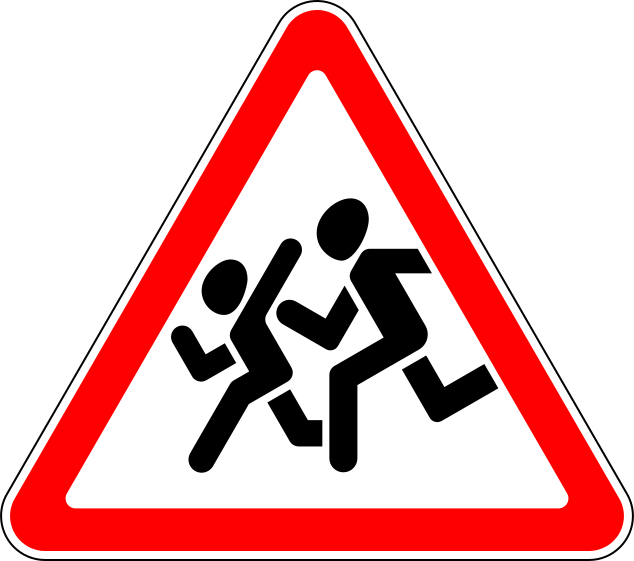
1.24. Children

Warns of a children's facility near the section of road, from which children are likely to appear on the carriageway. Outside built-up areas the sign is placed 150−300 m before the start of the hazardous section, in built-up areas – 50–100 m before it. The sign is repeated in built-up and non-built-up areas at least 50 m before the start of the hazardous section.

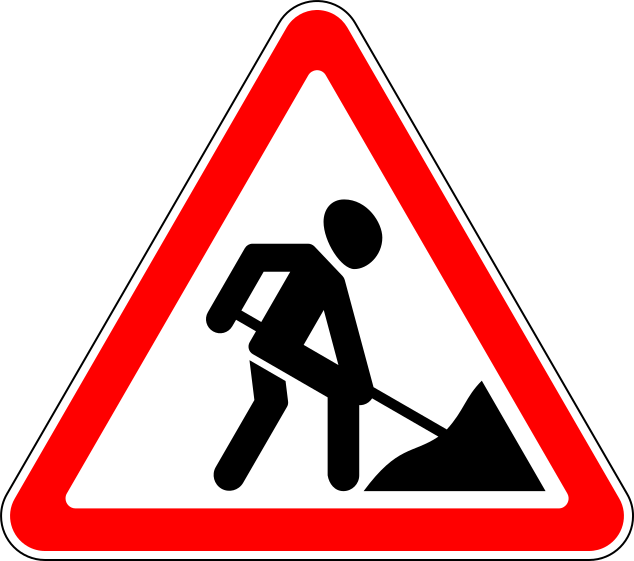
1.26. Road works

A section of road on which works are being carried out. Outside built-up areas the sign is placed 150−300 m before the start of the hazardous section, in built-up areas – 50–100 m before it. The sign is repeated in built-up and non-built-up areas at least 50 m before the start of the hazardous section. When short-term work is carried out on the carriageway, the sign is installed 10−15 m from the work site, without plate 8.1.1.

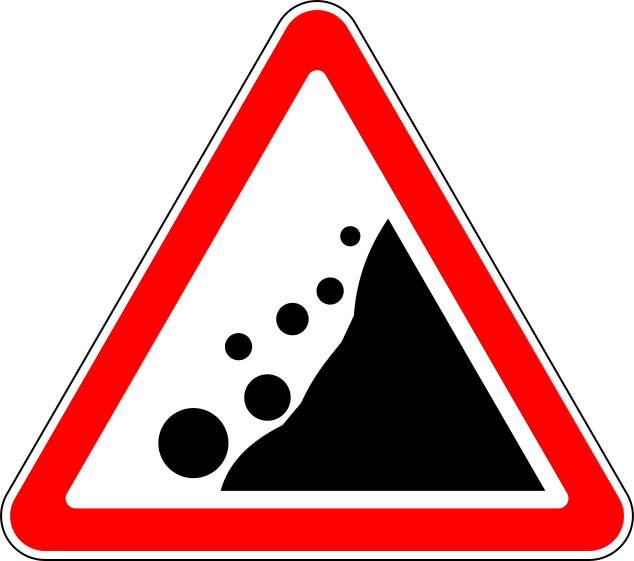
1.29. Falling rocks

A section of road whose carriageway is not protected against avalanches, landslides or falling rocks. Outside built-up areas the sign is placed 150−300 m before the start of the hazardous section, in built-up areas – 50–100 m before it.

Ticket #606 — situation image

Which of the road signs shown is repeated in a built-up area?

1 only II and IV
2 all
3 Only I and II
4 Only II and III
Law explanation
According to subparagraph “b” of the note to Chapter 1 (Warning signs) of Annex 1 of the Law of Georgia “On Road Traffic”, signs 1.23 “Pedestrian crossing”, 1.24 “Children” and 1.26 “Roadworks” are repeated outside built-up areas, and signs 1.24 and 1.26 − in built-up areas as well. The second sign is placed at a distance of no less than 50 metres from the beginning of the hazardous section.
Practical part

Exam routes — exactly the way the examiner drives them

60 real exam routes across 10 cities, 793 km in total. Every turn and stop on the map, with voice guidance.

  • All routes on the map
  • GPS mode on the real road
  • Practice mode with adjustable speed
  • On the web and in the app

One-off payment, no auto-renewal — by card on the Bank of Georgia secure page.

Chat with us