imecadine.ge

Stopping and parking

50 official tickets in this topic, with the correct answer and law explanation.

Where stopping is banned, where parking is banned, forced stops.

Parking of a vehicle is not prohibited:

1 In the zone of effect of a road sign prohibiting stopping
2 It is prohibited in all the places listed in this ticket
3 on the carriageway closer than 50 metres to a level crossing
4 At a vehicle exit from a courtyard
Law explanation
According to subparagraphs “a”, “b” and “d” of paragraph 7 of Article 37 of the Law of Georgia “On Road Traffic”, parking of vehicles is prohibited: a) where stopping is prohibited; b) on the carriageway closer than 50 metres to a level crossing; d) at a vehicle exit from a yard.

The driver of a vehicle must use the hazard warning lights:

1 to warn other road users of an impending danger
2 to gain an advantage over other road users
Law explanation
According to Article 52(1) of the Law of Georgia "On Road Traffic", hazard warning lights are used to warn other road users of a potential danger.

The driver of a vehicle is obliged to switch on the hazard warning lights (if fitted):

1 during a forced stop at a place where stopping is prohibited
2 When passing a pedestrian crossing at high speed
3 When making a U-turn beyond the intersection
Law explanation
According to Article 52(1)(b) of the Law of Georgia "On Road Traffic", hazard warning lights are used to warn other road users of possible danger. Hazard warning lights must be switched on: b) when forced to stop at a place where stopping is prohibited.

In the event of a forced stop at places where stopping is prohibited, the driver must immediately put out the warning triangle (or a similar effective device):

1 Both after switching on the hazard warning lights, and if such lights are not fitted or are out of order
2 only after switching on the hazard warning lights
3 only if there are no hazard warning lights or they are out of order
Law explanation
According to Article 52(2)(b) of the Law of Georgia "On Road Traffic", after switching on the hazard warning lights, and also if such lights are absent or out of order, the driver must immediately place a "Warning triangle", and in conditions of insufficient visibility, a flashing red lamp: b) when forced to stop at a place where stopping is prohibited, and where, given the visibility conditions, other drivers will not be able to notice the vehicle in time.
Ticket #1043 — situation image

When stopping at which place shown in the picture will the driver of a bus carrying a group of children violate the traffic rules if they do not switch on the hazard warning lights?

1 only at place A
2 both at place A and at place B
3 Only at place B
Law explanation
According to Article 26(4) of the Law of Georgia "On Road Traffic", a bus carrying a group of children must display the identification sign "Transporting children". When the bus stops, the driver must switch on the hazard warning lights. Adults accompanying the children must ensure that the children board and leave the bus, as well as cross the carriageway, safely.
Ticket #1044 — situation image

Does the driver of a bus carrying a group of children violate the traffic rules by stopping at the place indicated in the picture, if the hazard warning lights are not switched on on the bus?

1 Violates
2 Does not violate
Law explanation
According to Article 26(4) of the Law of Georgia "On Road Traffic", a bus carrying a group of children must display the identification sign "Transporting children". When the bus stops, the driver must switch on the hazard warning lights. Adults accompanying the children must ensure that the children board and leave the bus, as well as cross the carriageway, safely.
Ticket #1247 — situation image

The driver of the passenger car has the right to stop:

1 both at place A and at place B
2 Only at place B
3 only at place A
Law explanation
According to paragraph 3.27 of Chapter 3 (Prohibitory signs) of Annex 1 to the Law of Georgia "On Road Traffic", road sign 3.27 "No stopping" prohibits both stopping and parking of a vehicle. According to subparagraph (g.d) of the note to the same Chapter, the zone of application of signs 3.27–3.30 is reduced by installing repeated signs 3.27–3.30 with plate 8.2.3 at the end of their zone of application, or by using plate 8.2.2, or by installing sign 7.4 "Parking place" with plate 8.2.1.

Road sign used in this ticket

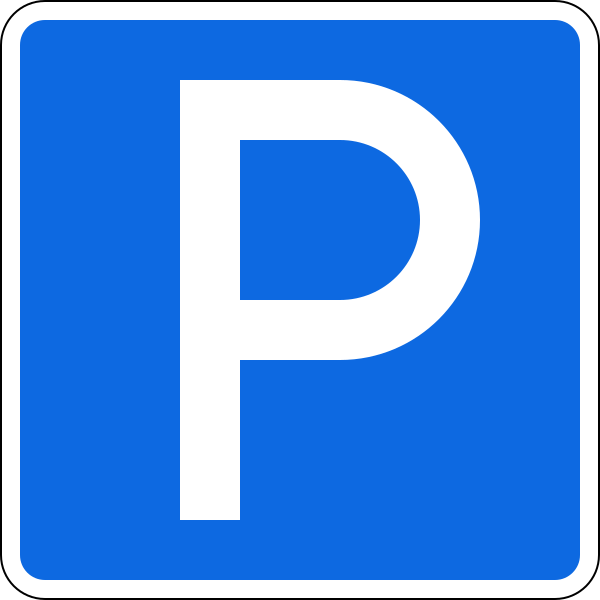
7.4. Parking place

A place intended for parking vehicles. The zone of operation of the sign is determined by road markings; in their absence, the sign applies up to the nearest intersection or is limited by plate 8.2.1.

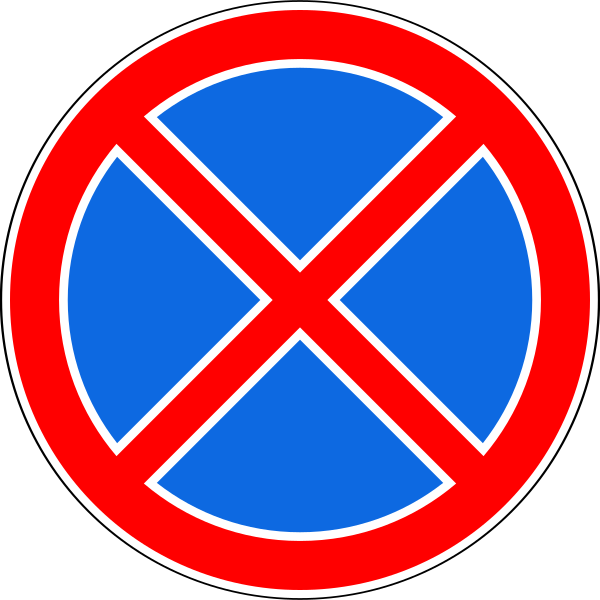
3.27. No stopping

Prohibits both stopping and parking of vehicles. The sign does not apply to route (public transport) vehicles. The sign applies from the place where it is installed to the nearest intersection behind it, and in a built-up area with no intersection – to the end of the built-up area. The sign's effect is also not interrupted at exits from adjacent areas or at intersections (junctions) with field, forest and other minor roads before which no corresponding sign is installed. The sign applies only to the side of the road on which it is installed.

Ticket #1253 — situation image

Does the driver of the passenger car have the right to stop at the place indicated by the arrow to let a passenger alight?

1 does not have the right
2 Has the right
Law explanation
According to paragraph 1.4 of Chapter 1 (Horizontal markings) of Annex 2 of the Law of Georgia “On Road Traffic”, road marking 1.4, a solid yellow line, marks a place where stopping is prohibited; it is used on its own or together with sign 3.27; it is drawn along the edge of the carriageway or on top of the kerb.
Ticket #1263 — situation image

The driver of the passenger car has the right to stop:

1 only at place A
2 Only at place B
3 At neither place A nor place B
Law explanation
According to paragraph 1.4 of Chapter 1 (Horizontal markings) of Annex 2 of the Law of Georgia “On Road Traffic”, road marking 1.4, a solid yellow line, marks a place where stopping is prohibited; it is used on its own or together with sign 3.27; it is drawn along the edge of the carriageway or on top of the kerb. According to paragraph 3.27 of Chapter 3 (Prohibitory signs) of Annex 1 of the same Law and subparagraph “i” of the note to the same Chapter, road sign 3.27 “No stopping” - prohibits both stopping and parking of vehicles. Sign 3.27 may be used together with marking 1.4, and sign 3.28 – together with marking 1.10. In that case the zone of effect of the signs is determined by the length of the marking line.

Road sign used in this ticket

3.27. No stopping

Prohibits both stopping and parking of vehicles. The sign does not apply to route (public transport) vehicles. The sign applies from the place where it is installed to the nearest intersection behind it, and in a built-up area with no intersection – to the end of the built-up area. The sign's effect is also not interrupted at exits from adjacent areas or at intersections (junctions) with field, forest and other minor roads before which no corresponding sign is installed. The sign applies only to the side of the road on which it is installed.

Ticket #1269 — situation image

The driver of the passenger car has the right to stop:

1 only at place A
2 both at place A and at place B
3 Only at place B
Law explanation
According to Article 37(6)(a.a) and (a.c) of the Law of Georgia "On Road Traffic", stopping a vehicle on the carriageway is prohibited: a.a) on pedestrian and cyclist crossings and closer than 5 metres before them; a.c) at the intersection of carriageways, and also closer than 5 metres from the edges of the intersecting carriageways, except when stopping at three-way intersections (junctions) opposite side exits where there is a solid marking line or a dividing strip.

Road sign used in this ticket

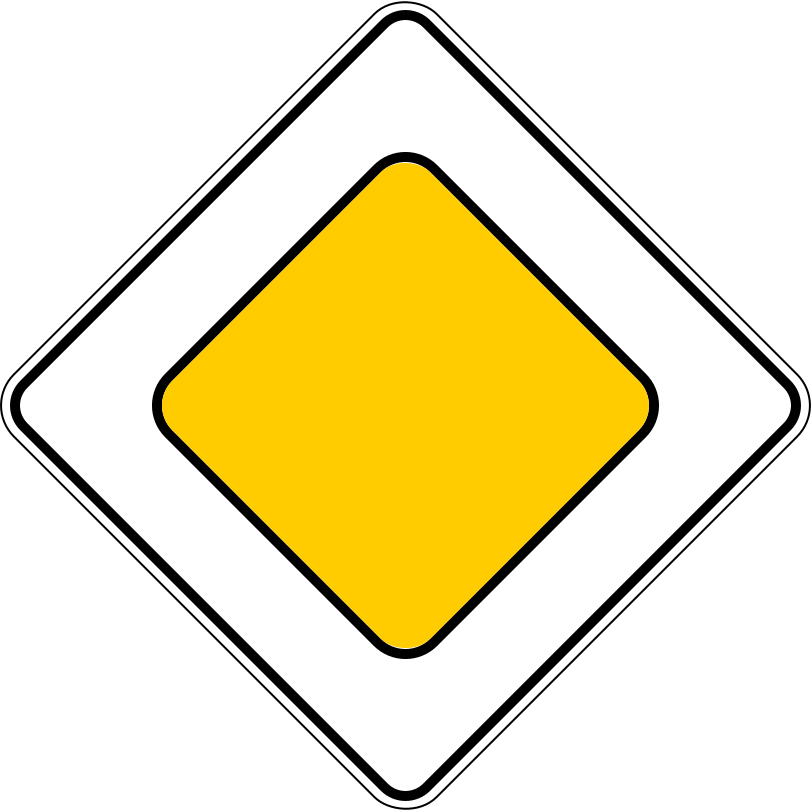
2.1. Priority road

A road on which drivers have priority when passing through unregulated intersections. The sign is installed at the beginning of the road and repeated immediately before every intersection. Sign 2.1 with plate 8.13 is installed in built-up areas before an intersection at which the main road changes direction; outside built-up areas − in advance, 150−300 m before the intersection, and before the intersection.

Practical part

Exam routes — exactly the way the examiner drives them

60 real exam routes across 10 cities, 793 km in total. Every turn and stop on the map, with voice guidance.

  • All routes on the map
  • GPS mode on the real road
  • Practice mode with adjustable speed
  • On the web and in the app

One-off payment, no auto-renewal — by card on the Bank of Georgia secure page.

Chat with us