imecadine.ge

Passing through intersections

82 official tickets in this topic, with the correct answer and law explanation.

Priority at controlled, uncontrolled and roundabout intersections.

Ticket #119 — situation image

Towards the driver of which vehicle does the driver of the red passenger car have the obligation to give way when moving in the direction of the arrow?

1 only to the driver of the blue car
2 in relation to both the motorcycle driver and the driver of the blue car
3 only to the driver of the motorcycle
Law explanation
According to subparagraphs “a”, “b” and “c” of paragraph 4 of Article 36 of the Law of Georgia “On Road Traffic”, at an unregulated intersection: a) at a crossing of roads of unequal importance, the driver of a vehicle travelling on a secondary road must give way to a vehicle approaching on the main road, regardless of the direction of its further movement; b) if the main road changes direction at the intersection, drivers travelling on this road must follow among themselves the rules for passing through intersections of roads of equal importance. Drivers travelling on secondary roads must also follow the same rules among themselves; c) at a crossing of roads of equal importance, the driver of a trackless vehicle must give way to a vehicle approaching from the right. Drivers of rail vehicles must also follow the same rule among themselves. At such an intersection, a rail vehicle has priority over a trackless vehicle, regardless of the direction of its movement.

Road sign used in this ticket

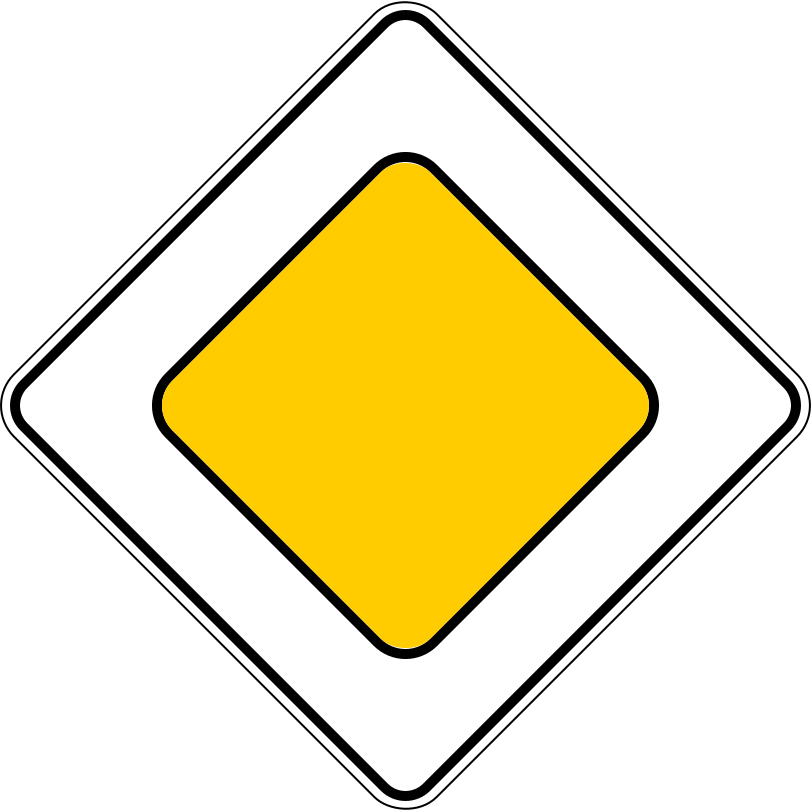
2.1. Priority road

A road on which drivers have priority when passing through unregulated intersections. The sign is installed at the beginning of the road and repeated immediately before every intersection. Sign 2.1 with plate 8.13 is installed in built-up areas before an intersection at which the main road changes direction; outside built-up areas − in advance, 150−300 m before the intersection, and before the intersection.

8.13. Direction of the main road

Indicates the direction of the main road at an intersection. The plate is used with signs 2.1, 2.3 and 2.4 when the main road changes direction at the intersection.

Ticket #120 — situation image

Towards the driver of which car does the driver of the green passenger car have an obligation to give way when moving in the direction of the arrow?

1 only to the driver of the black passenger car
2 only to the driver of the truck
3 to the drivers of none of the cars
4 in relation to the drivers of both the truck and the black passenger car
Law explanation
According to Article 36(4)(a) and (d) of the Law of Georgia "On Road Traffic", at an uncontrolled intersection: a) at the intersection of roads of unequal importance, the driver of a vehicle moving on the minor road must give way to a vehicle approaching on the main road, regardless of its further direction of travel; d) when turning left or turning around, the driver of a trackless vehicle must give way to a vehicle moving straight ahead or to the right from the opposite direction on a road of equal importance. Drivers of rail vehicles must follow the same rule among themselves.

Road sign used in this ticket

2.3. Give way

The driver on this road must give way to drivers moving on the road being crossed, and where plate 8.13 is present – to drivers on the main road. Outside built-up areas, sign 2.3 is placed in advance, 150−300 m before the intersection, with plate 8.1.1 if sign 2.3 is installed before the intersection, or with plate 8.1.2 if sign 2.4 is installed before the intersection. The sign applies to the intersection of carriageways before which the corresponding sign is installed.

2.1. Priority road

A road on which drivers have priority when passing through unregulated intersections. The sign is installed at the beginning of the road and repeated immediately before every intersection. Sign 2.1 with plate 8.13 is installed in built-up areas before an intersection at which the main road changes direction; outside built-up areas − in advance, 150−300 m before the intersection, and before the intersection.

Ticket #128 — situation image

The driver of which car has the obligation to give way when moving in the direction of the arrow?

1 the driver of the red car
2 the driver of the white car
Law explanation
According to subparagraph “a” of paragraph 4 of Article 36 of the Law of Georgia “On Road Traffic”, at an unregulated intersection, at a crossing of roads of unequal importance, the driver of a vehicle travelling on a secondary road must give way to a vehicle approaching on the main road, regardless of the direction of its further movement.

Road sign used in this ticket

2.3. Give way

The driver on this road must give way to drivers moving on the road being crossed, and where plate 8.13 is present – to drivers on the main road. Outside built-up areas, sign 2.3 is placed in advance, 150−300 m before the intersection, with plate 8.1.1 if sign 2.3 is installed before the intersection, or with plate 8.1.2 if sign 2.4 is installed before the intersection. The sign applies to the intersection of carriageways before which the corresponding sign is installed.

8.13. Direction of the main road

Indicates the direction of the main road at an intersection. The plate is used with signs 2.1, 2.3 and 2.4 when the main road changes direction at the intersection.

5.19.1. Pedestrian crossing

A place on the road designated as a pedestrian crossing. The sign is installed on the right side of the road. If marking 1.14 is absent at the crossing, the sign is installed at the near boundary of the crossing.

Ticket #134 — situation image

In what order should the cars pass through the intersection when moving in the direction of the arrows?

1 The yellow car must pass first, then the grey car, and finally the red car
2 the grey car must pass first, then the red car, and finally the yellow car
3 the grey car must pass first, then the yellow car, and finally the red car
Law explanation
According to subparagraphs “a”, “b” and “c” of paragraph 4 of Article 36 of the Law of Georgia “On Road Traffic”, at an unregulated intersection: a) at a crossing of roads of unequal importance, the driver of a vehicle travelling on a secondary road must give way to a vehicle approaching on the main road, regardless of the direction of its further movement; b) if the main road changes direction at the intersection, drivers travelling on this road must follow among themselves the rules for passing through intersections of roads of equal importance. Drivers travelling on secondary roads must also follow the same rules among themselves; c) at a crossing of roads of equal importance, the driver of a trackless vehicle must give way to a vehicle approaching from the right. Drivers of rail vehicles must also follow the same rule among themselves. At such an intersection, a rail vehicle has priority over a trackless vehicle, regardless of the direction of its movement.

Road sign used in this ticket

2.1. Priority road

A road on which drivers have priority when passing through unregulated intersections. The sign is installed at the beginning of the road and repeated immediately before every intersection. Sign 2.1 with plate 8.13 is installed in built-up areas before an intersection at which the main road changes direction; outside built-up areas − in advance, 150−300 m before the intersection, and before the intersection.

8.13. Direction of the main road

Indicates the direction of the main road at an intersection. The plate is used with signs 2.1, 2.3 and 2.4 when the main road changes direction at the intersection.

Ticket #171 — situation image

Is the driver of the passenger car obliged to give way to pedestrians when moving in the direction of the arrow?

1 is obliged
2 is not obliged
Law explanation
According to Article 25(3) of the Law of Georgia "On Road Traffic", subject to the requirements established by Article 20(2) and Article 34(11) of this Law, in the absence of a pedestrian crossing marked on the carriageway by the corresponding road marking, road sign or traffic lights, a driver turning to enter another road must give way to pedestrians who have stepped onto the carriageway of that road. The driver must exercise particular caution towards pedestrians crossing the carriageway to board a route vehicle or after getting off it.
Ticket #365 — situation image

The width of the carriageway is insufficient for turning from the left lane. Over which vehicle does the driver of the truck have priority when moving in the direction of the arrow?

1 only to the blue passenger car
2 only to the motorcycle
3 to none of the vehicles
4 only to the white passenger car
Law explanation
According to Article 32(7)(b) and paragraph 8 of the Law of Georgia "On Road Traffic": 7. Before turning right or left to exit onto another road or to enter an adjacent area, without violating the requirements established by Article 20(2) of this Law and by paragraphs 1 and 2 of this Article, if the driver of a vehicle intends to leave the road: b) on the left-hand side, the vehicle must, as far as possible, approach the centre line of the carriageway (on a two-way road) or the left-hand edge of the carriageway (on a one-way road), and if he/she intends to exit onto another two-way road, the turn must be performed so that, on leaving the intersection of carriageways, the vehicle does not end up on the side for opposing traffic. 8. If, because of the dimensions of the vehicle or for another reason, the driver cannot perform the turn in accordance with the requirements established by paragraph 7 of this Article, deviation from these rules is permitted provided that traffic safety is ensured and no obstruction is created for other road users.
Ticket #504 — situation image

In what order must the vehicles pass through the intersection when moving in the direction of the arrows?

1 the moped must pass first, then the tram, and finally the passenger car
2 first the tram must pass, then the passenger car, and finally the moped
3 The tram must pass first, then the moped, and finally the passenger car
Law explanation
According to subparagraphs “a” and “d” of paragraph 4 of Article 36 of the Law of Georgia “On Road Traffic”: a) at an intersection of unequal roads, the driver of a vehicle moving on the secondary road must give way to a vehicle approaching from the main road, regardless of the direction of its further movement; d) when turning left or making a U-turn, the driver of a trackless vehicle must give way to a vehicle moving on an equal road from the opposite direction straight ahead or to the right. Drivers of rail vehicles must also follow the same rule among themselves.

Road sign used in this ticket

2.3. Give way

The driver on this road must give way to drivers moving on the road being crossed, and where plate 8.13 is present – to drivers on the main road. Outside built-up areas, sign 2.3 is placed in advance, 150−300 m before the intersection, with plate 8.1.1 if sign 2.3 is installed before the intersection, or with plate 8.1.2 if sign 2.4 is installed before the intersection. The sign applies to the intersection of carriageways before which the corresponding sign is installed.

Ticket #511 — situation image

In what order must the vehicles pass through the intersection when moving in the direction of the arrows?

1 first the bicycle must pass, then the white car, and finally the green car
2 The green car must pass first, then the bicycle, and finally the white car
3 The white car must start moving first, then the green car must pass, then the bicycle, and finally the white car
Law explanation
According to Article 36(4)(c) and (d) of the Law of Georgia "On Road Traffic", at an uncontrolled intersection: c) at the intersection of roads of equal importance, the driver of a trackless vehicle must give way to a vehicle approaching from the right. Drivers of rail vehicles must follow the same rule among themselves. At such an intersection a rail vehicle has priority over a trackless vehicle, regardless of its direction of travel; d) when turning left or making a U-turn, the driver of a trackless vehicle must give way to vehicles travelling straight ahead or turning right from the opposite direction on a road of equal importance. Drivers of rail vehicles must follow the same rule among themselves.
Ticket #512 — situation image

In what order must the vehicles pass through the intersection when moving in the direction of the arrows?

1 the green car must pass first, then the red car, and finally the bicycle
2 first the bicycle must pass, then the green car, and finally the red car
3 The red car must pass first, then the bicycle, and finally the green car
Law explanation
According to Article 36(4)(d) of the Law of Georgia "On Road Traffic", at an uncontrolled intersection, when turning left or turning around, the driver of a trackless vehicle must give way to a vehicle on a road of equal importance moving from the opposite direction straight ahead or to the right. Drivers of rail vehicles must follow the same rule among themselves. According to Article 44(1)(e) of the same Law, in residential zones marked with the corresponding sign, when leaving a residential zone, a road user must give way to other road users at intersections. According to paragraph 5.22 of Chapter 5 (Special regulation signs) of Annex 1 to the same Law, road sign 5.22 "End of residential zone" indicates the end of a residential zone marked with sign 5.21. The sign is placed at all exits from the residential zone.

Road sign used in this ticket

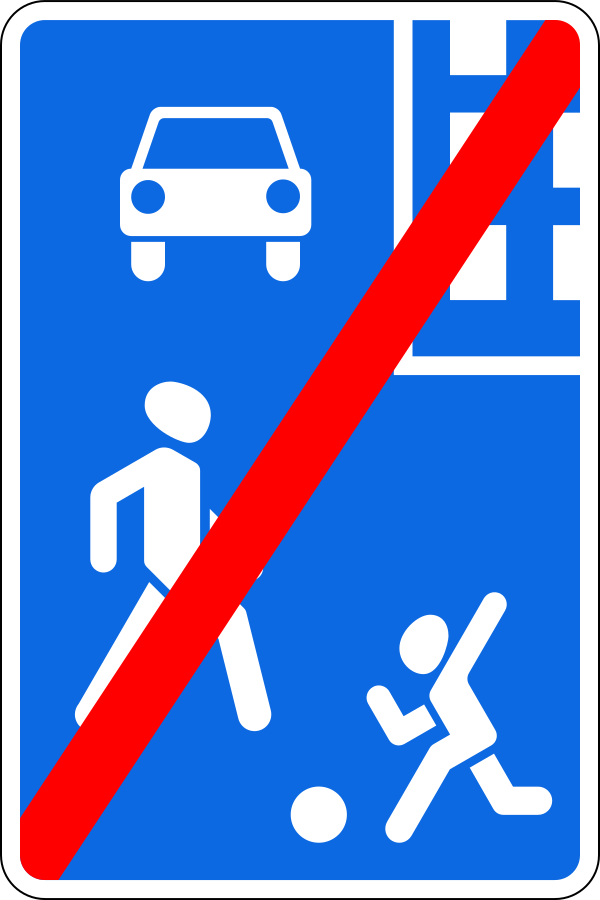
5.22. End of residential zone

Indicates the end of the residential zone marked with sign 5.21. The sign is installed at every exit from the residential zone.

Is the driver entitled to enter an intersection where a traffic jam has formed such that they will probably be forced to stop at the intersection and thereby create an obstacle to traffic in the transverse direction?

1 is allowed if the traffic light signal permits movement
2 does not have the right
Law explanation
According to paragraph 5 of Article 36 of the Law of Georgia “On Road Traffic”, the driver must not enter a junction if there is a traffic jam such that he will probably be forced to stop at the junction and thereby obstruct traffic in the transverse direction. This rule applies even if the traffic light signals permit movement.
Ticket #1025 — situation image

In what order must the vehicles pass through the intersection when moving in the direction of the arrows, if the emergency vehicle does not have its flashing blue special beacon switched on?

1 the passenger car must pass first, then the motorcycle, and finally the emergency service vehicle
2 the emergency service vehicle must pass first, then the passenger car, and finally the motorcycle
3 The motorcycle must pass first, then the passenger car, and finally the emergency service vehicle
Law explanation
According to Article 51(1) of the Law of Georgia "On Road Traffic", the driver of an emergency or special service vehicle who has switched on the flashing blue special light on the vehicle and is performing an official task may, while ensuring road traffic safety, deviate from the requirements established by Articles 25, 31–41 and 44 of this Law, as well as by Annexes No. 1 and No. 2 to this Law. In addition to the flashing blue special light, a flashing red light may also be switched on. To obtain priority over other road users, the driver of this vehicle must switch on the flashing blue special light and the audible signal. According to Article 36(4)(a), (b) and (c) of the same Law, at an uncontrolled intersection: a) at the intersection of roads of unequal importance, the driver of a vehicle travelling on the secondary road must give way to a vehicle approaching on the main road, regardless of its further direction of travel; b) if the main road changes direction at an intersection, drivers travelling on this road must follow among themselves the rules for passing intersections of roads of equal importance. Drivers travelling on the secondary roads must follow the same rules among themselves; c) at the intersection of roads of equal importance, the driver of a trackless vehicle must give way to a vehicle approaching from the right. Drivers of rail vehicles must follow the same rule among themselves. At such an intersection a rail vehicle has priority over a trackless vehicle, regardless of its direction of travel.

Road sign used in this ticket
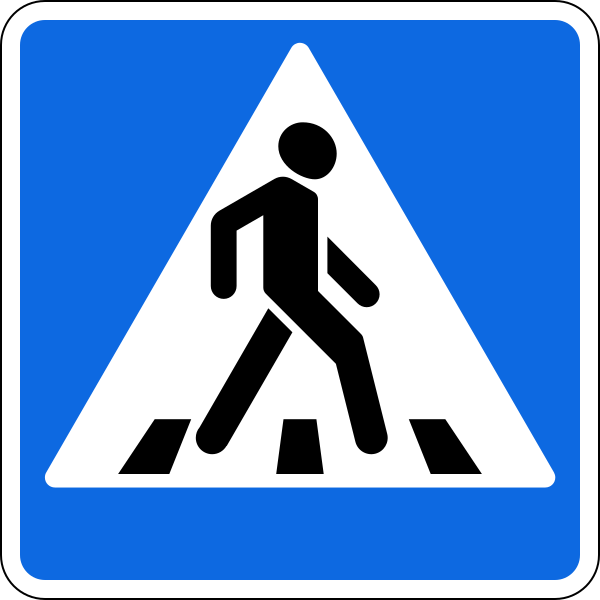
5.19.2. Pedestrian crossing

A place on the road designated as a pedestrian crossing. The sign is installed on the left side of the road. If marking 1.14 is absent at the crossing, the sign is installed at the far boundary of the crossing.
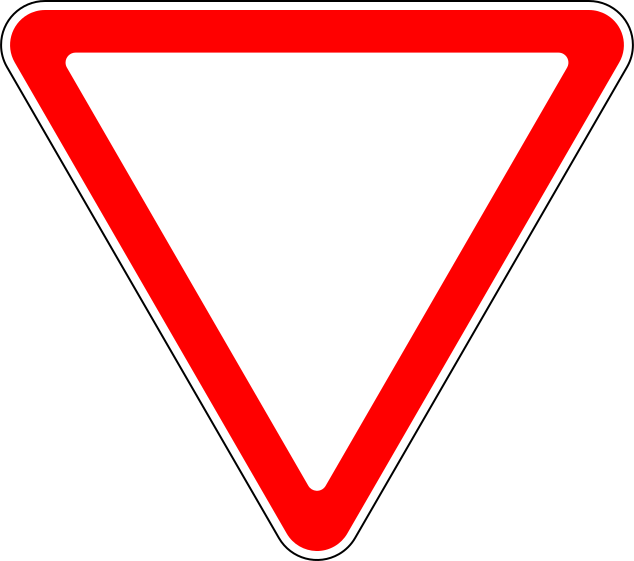
2.3. Give way

The driver on this road must give way to drivers moving on the road being crossed, and where plate 8.13 is present – to drivers on the main road. Outside built-up areas, sign 2.3 is placed in advance, 150−300 m before the intersection, with plate 8.1.1 if sign 2.3 is installed before the intersection, or with plate 8.1.2 if sign 2.4 is installed before the intersection. The sign applies to the intersection of carriageways before which the corresponding sign is installed.

8.13. Direction of the main road

Indicates the direction of the main road at an intersection. The plate is used with signs 2.1, 2.3 and 2.4 when the main road changes direction at the intersection.
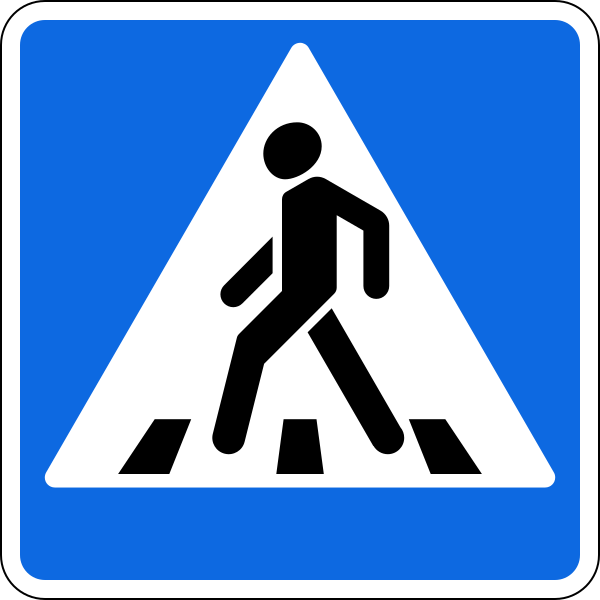
5.19.1. Pedestrian crossing

A place on the road designated as a pedestrian crossing. The sign is installed on the right side of the road. If marking 1.14 is absent at the crossing, the sign is installed at the near boundary of the crossing.

A driver holding the right to drive vehicles of category "C" is entitled to drive (except for vehicles of subcategory "D1" or category "D") a motor vehicle whose maximum permissible mass:

1 Exceeds 3,500 kg
2 does not exceed 3 500 kg
Law explanation
According to Article 54(2)(c) of the Law of Georgia "On Road Traffic", vehicles for whose driving it is mandatory to obtain the relevant driving licence are divided into the following categories: c) "C" – a motor vehicle (other than vehicles belonging to subcategory "D1" or category "D") whose maximum permissible mass exceeds 3 500 kg, and also a category "C" motor vehicle coupled with a trailer whose maximum permissible mass does not exceed 750 kg.

A driver entitled to drive vehicles of category "C" also has the right to drive a category "C" vehicle with a trailer whose maximum permissible mass:

1 Does not exceed 750 kg
2 exceeds 750 kg but does not exceed 3 500 kg
3 exceeds 750 kg
Law explanation
According to Article 54(2)(c) of the Law of Georgia "On Road Traffic", vehicles for whose driving it is mandatory to obtain the relevant driving licence are divided into the following categories: c) "C" – a motor vehicle (other than vehicles belonging to subcategory "D1" or category "D") whose maximum permissible mass exceeds 3 500 kg, and also a category "C" motor vehicle coupled with a trailer whose maximum permissible mass does not exceed 750 kg.

A driver holding the right to drive vehicles of category "CE" is entitled to drive:

1 a category "C" vehicle only with a trailer whose permissible maximum mass exceeds 750 kg but does not exceed 1200 kg
2 a category "C" motor vehicle with a trailer whose maximum permitted mass exceeds 750 kg
Law explanation
According to subparagraph “f” of paragraph 2 of Article 54 of the Law of Georgia “On Road Traffic”, vehicles for which obtaining the appropriate driving right is mandatory are divided into the following categories: f) “CE” − a category “C” motor vehicle coupled to a trailer whose maximum permissible mass exceeds 750 kg.

A driver entitled to drive vehicles of subcategory "C1" has the right to drive (except for vehicles of subcategory "D1" or category "D") a motor vehicle whose maximum permissible mass:

1 Exceeds 7,500 kg but does not exceed 12,000 kg
2 Does not exceed 3,500 kg
3 exceeds 3500 kg but does not exceed 7500 kg
Law explanation
According to Article 54(3)(c) of the Law of Georgia "On Road Traffic", vehicles within categories "A", "B", "C", "CE", "D" and "DE" for whose driving it is mandatory to obtain the relevant driving licence are divided into the following subcategories: c) "C1" − a motor vehicle (other than motor vehicles belonging to subcategory "D1" or category "D") whose maximum permissible mass exceeds 3500 kg but does not exceed 7500 kg, as well as a subcategory "C1" motor vehicle coupled to a trailer whose maximum permissible mass does not exceed 750 kg.

A driver holding a driving licence for subcategory "C1" vehicles also has the right to drive a subcategory "C1" vehicle with a trailer whose permissible maximum mass:

1 exceeds 750 kg but does not exceed 2500 kg
2 exceeds 750 kg
3 Does not exceed 750 kg
Law explanation
According to Article 54(3)(c) of the Law of Georgia "On Road Traffic", vehicles within categories "A", "B", "C", "CE", "D" and "DE" for whose driving it is mandatory to obtain the relevant driving licence are divided into the following subcategories: c) "C1" − a motor vehicle (other than motor vehicles belonging to subcategory "D1" or category "D") whose maximum permissible mass exceeds 3500 kg but does not exceed 7500 kg, as well as a subcategory "C1" motor vehicle coupled to a trailer whose maximum permissible mass does not exceed 750 kg.

Does a driver entitled to drive vehicles of subcategory "C1E" have the right to drive a vehicle of subcategory "C1" with a trailer whose maximum permissible mass exceeds 750 kg, if the total maximum permissible mass of such a combination does not exceed 12000 kg?

1 does not have the right
2 Has the right
Law explanation
According to Article 54(3)(e) of the Law of Georgia "On Road Traffic", vehicles established within categories "A", "B", "C", "CE", "D" and "DE" for which obtaining the relevant driving licence is mandatory are divided into the following subcategories: e) "C1E" – a subcategory "C1" motor car coupled to a trailer whose maximum permissible mass exceeds 750 kg but does not exceed the unladen mass of the motor car, and the total maximum permissible mass of such a combination does not exceed 12 000 kg.

A person holding a category "C" driving licence also has the right to drive vehicles of which subcategory?

1 "C1" and "C1E"
2 "C1"
3 "D1" and "C1"
4 "A1"
Law explanation
According to Article 56(1) of the Law of Georgia "On Road Traffic", a person entitled to drive vehicles of category "A", "B", "C" or "D" is also entitled to drive vehicles of subcategory "A1", "B1", "C1" or "D1" established within the granted category.

A person holding a category "CE" driving licence may also drive vehicles of which subcategory?

1 "D1E" and "C1E"
2 "D1E"
3 "C1E"
Law explanation
According to paragraph 2 of Article 56 of the Law of Georgia “On Road Traffic”, a person holding the right to drive a category “CE” or “DE” vehicle is also entitled to drive a vehicle of subcategory “C1E” or “D1E” established within the granted category.

Does a person entitled to drive vehicles of category "CE" or "DE" also have the right to drive vehicles of category "BE"?

1 does not have the right
2 Has the right
Law explanation
According to Article 56(3) of the Law of Georgia "On Road Traffic", a person entitled to drive vehicles of category "CE" or "DE", or of subcategory "C1E" or "D1E", is also entitled to drive vehicles of category "BE".
Practical part

Exam routes — exactly the way the examiner drives them

60 real exam routes across 10 cities, 793 km in total. Every turn and stop on the map, with voice guidance.

  • All routes on the map
  • GPS mode on the real road
  • Practice mode with adjustable speed
  • On the web and in the app

One-off payment, no auto-renewal — by card on the Bank of Georgia secure page.

Chat with us