imecadine.ge

Moving off, manoeuvring, positioning

78 official tickets in this topic, with the correct answer and law explanation.

Changing lanes, turning, reversing and correct positioning.

Ticket #502 — situation image

The driver of which vehicle is not prohibited from moving in the direction of the arrow?

1 the drivers of all three vehicles
2 only the truck driver
3 only to motorcycle drivers
Law explanation
According to Article 31(14) of the Law of Georgia "On Road Traffic", mopeds and/or motorcycles without a sidecar may travel in two rows in the same direction in one lane. According to paragraph 15 of the same Article, subject to the requirements established by Article 32(6) of this Law, movement is permitted on tram tracks running in the same direction that are located on the left at the same level as the carriageway, if all lanes intended for traffic in the same direction are occupied, and also when driving around an obstacle or overtaking, or when turning left or making a U-turn. At the same time, the movement of trams must not be obstructed. Driving onto tram tracks running in the opposite direction is prohibited.
Ticket #544 — situation image

The driver of which vehicle is prohibited from moving in the direction of the arrow?

1 only to the driver of the towing vehicle
2 only the truck driver
3 only to the driver of the yellow car
4 the driver of none of the vehicles
Law explanation
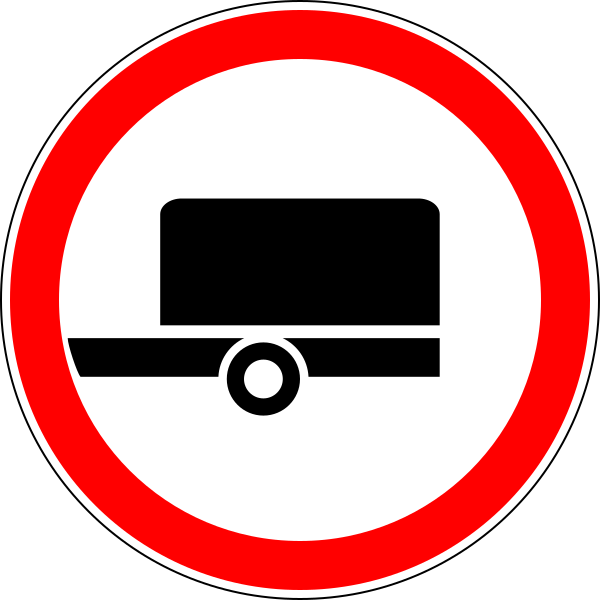
According to paragraph 7 of Article 31 of the Law of Georgia “On Road Traffic”, on a two-way road with three lanes (except road marking 1.9), the driver of a vehicle must not move into the outermost lane of the carriageway used by oncoming traffic. If on a three-lane road the middle lane is used for traffic in both directions, entering this lane is permitted only for overtaking, avoiding an obstacle, turning left or making a U-turn. According to paragraph 3.7 of Chapter 3 (Prohibitory signs) of Annex 1 to the same Law, road sign 3.7 “No vehicles with trailers” prohibits the movement of lorries and tractors with trailers of any kind, as well as the towing of power-driven vehicles.

Road sign used in this ticket

3.7. No vehicles with trailers

Prohibits the movement of all types of trucks and tractors with trailers, as well as the towing of motor vehicles. The sign indicates that traffic is prohibited in both directions. The sign does not apply to vehicles serving an enterprise located in the designated zone, or serving or belonging to persons who live or work in that zone. In such cases the vehicle must enter and leave the zone at the intersection nearest to its destination.

If the actual mass of a power-driven vehicle with an inoperative braking system exceeds half of the actual mass of the towing vehicle, its towing:

1 Is prohibited
2 Is permitted
Law explanation
According to Article 45(6)(c) of the Law of Georgia "On Road Traffic", it is prohibited to tow a power-driven vehicle with an inoperative braking system if its actual mass exceeds half of the actual mass of the towing vehicle; if the mass is smaller, towing is permitted only by a rigid coupling or by partial loading.

At any time of day, a towed power-driven vehicle must have switched on:

1 side (position) lights
2 hazard warning lights
3 Low-beam headlights
Law explanation
According to Article 45(7) of the Law of Georgia "On Road Traffic", at any time of day or night the towing motor vehicle must have its dipped headlights switched on, and the towed motor vehicle must have its hazard warning lights switched on, and if these are absent or faulty, a warning triangle must be attached to the rear of that vehicle.

A flatbed truck with sides used for carrying passengers must be equipped:

1 with seats fixed at a height of 0.3–0.5 metres from the floor and no less than 0.3 metres below the upper edge of the side, and the seats located along the rear or side panels must have rigid backrests
2 With seats fixed at a height of 0.2–0.3 metres from the floor and at least 0.5 metres from the upper edge of the side board; seats arranged along the rear or side boards must have rigid backrests
Law explanation
According to Article 46(9) of the Law of Georgia "On Road Traffic", a goods vehicle with a side-board platform used to carry passengers must be equipped with seats positioned at a height of 0.3–0.5 metres from the floor and not less than 0.3 metres below the upper edge of the side board, and when carrying a group of children the height of the side boards must not be less than 0.8 metres from the floor. Seats positioned along the rear or side boards must have rigid backrests.

A person entitled to drive vehicles of category "C" has the right to carry no more than 8 passengers in the body of a truck equipped in accordance with the established procedure:

1 one year after obtaining the driving licence of this category
2 immediately after obtaining a driving licence of this category
3 six months after obtaining the driving licence of this category
Law explanation
According to Article 46(3)(a) of the Law of Georgia "On Road Traffic", passengers may be carried in the body of a goods vehicle by a person who meets the requirements established by Article 56(7) of this Law, if the number of passengers, excluding the driver, does not exceed 8. According to Article 56(7) of the same Law, a person entitled to drive vehicles of category "C" is entitled, 1 year after obtaining a driving licence of this category, to carry passengers in the body of a goods vehicle in the manner established by the legislation of Georgia, if the number of passengers, excluding the driver, does not exceed 8.

When carrying passengers in the body of a suitably equipped truck, before the journey the driver:

1 must fulfil all the requirements listed in this ticket
2 must brief the passengers on the rules for boarding and positioning in the body, and start moving only after making sure that all conditions for the safe carriage of passengers are met
3 If the number of passengers exceeds the number of seats in the body, they must instruct the standing passengers on the rules for positioning themselves in the body
Law explanation
According to paragraph 5 of Article 46 of the Law of Georgia "On Road Traffic", the number of passengers carried in the body of a truck must not exceed the number of seats provided. Before the start of the journey, the truck driver is obliged to instruct the passengers on the rules for boarding and positioning in the body. The driver may start moving only after making sure that all conditions for the safe carriage of passengers are met.
Ticket #589 — situation image

Will the driver of the truck violate the traffic rules when moving in the direction of the arrow, if he is moving at a speed of 50 km/h?

1 will violate
2 will not violate
Law explanation
According to Article 33(7)(d.b) of the Law of Georgia "On Road Traffic", except in cases established by this Law, outside built-up areas, and also in built-up areas on a section of road where travel at more than 60 km/h is permitted by the relevant sign, vehicles of categories C and CE, as well as of subcategories C1 and C1E, when carrying passengers in the body in the established manner, are permitted to travel on all roads at a speed not exceeding 60 km/h.
Ticket #591 — situation image

In the given situation, how many traffic rules does the driver of the towing goods vehicle travelling in the direction of the arrow violate if travelling at a speed of 70 km/h?

1 three
2 two
3 none
4 one
Law explanation
According to Article 33(8)(d) of the Law of Georgia "On Road Traffic", unless otherwise established by this Law, in built-up areas and outside built-up areas a power-driven vehicle towing another power-driven vehicle is permitted to travel at a speed not exceeding 50 km/h. According to Article 45(4) of the same Law, when towing by a rigid or flexible coupling, it is prohibited to carry passengers in a towed bus, trolleybus or in the body of a goods vehicle. According to Article 45(5) of the same Law, when towing by a flexible coupling, the distance between the towing and towed vehicles must be 4–6 metres. According to paragraph 9 of the same Article, when towing a power-driven vehicle, the flexible connecting link is marked with flags, a warning device or a 200x200 mm plate on which alternating red and white stripes 50 mm wide with a retroreflective surface are drawn diagonally. At least two warning devices (flags) are attached to the flexible connecting link. The violations here are: the speed; there are no flags on the towing device; and passengers are being carried in the body of the towed goods vehicle.

Outside built-up areas, on a two-way road on which there is no dividing strip or pavement, a person pushing a bicycle or moped by hand must, in order to move, occupy:

1 the left side of the carriageway
2 any traffic lane
3 the right side of the carriageway
Law explanation
According to paragraph 5 of Article 24 of the Law of Georgia “On Road Traffic”, outside built-up areas, on a two-way road that has no dividing strip and no pavement, a pedestrian must use the shoulder located on the side facing oncoming traffic, and if there is none or it cannot be used − the left side of the carriageway, and move against the direction of traffic (except when, in the given situation, it is safer to move on the right side of the carriageway in the direction of traffic), but a person pushing a bicycle, moped or motorcycle, as well as a person with disabilities moving in a wheelchair, must use the right side of the carriageway to move.

Outside built-up areas, on a two-way road without a dividing strip and pavement, a person with disabilities moving in a wheelchair must, in order to move, occupy:

1 any traffic lane
2 the right side of the carriageway
3 the left side of the carriageway
Law explanation
According to paragraph 5 of Article 24 of the Law of Georgia “On Road Traffic”, outside built-up areas, on a two-way road that has no dividing strip and no pavement, a pedestrian must use the shoulder located on the side facing oncoming traffic, and if there is none or it cannot be used − the left side of the carriageway, and move against the direction of traffic (except when, in the given situation, it is safer to move on the right side of the carriageway in the direction of traffic), but a person pushing a bicycle, moped or motorcycle, as well as a person with disabilities moving in a wheelchair, must use the right side of the carriageway to move.

When transporting a car transporter or a container, a vehicle is considered oversized if its height from the surface of the carriageway:

1 Exceeds 2.30 metres but does not exceed 3.50 metres
2 exceeds 4.30 metres
3 exceeds 3.50 metres but does not exceed 4.30 metres
Law explanation
According to subparagraph “a” of paragraph 8 of Article 47 of the Law of Georgia “On Road Traffic”, a vehicle is considered oversized (wide load) if its parameters exceed at least one of the following values: a) height (from the surface of the carriageway) - when carrying vehicles (car transporter) or a container – 4.30 metres, in all other cases - 4 metres.

Except in the case of transporting a car transporter or a container, a vehicle is considered oversized if its height from the surface of the carriageway:

1 Exceeds 3 metres but does not exceed 3.70 metres
2 Exceeds 4 metres
3 exceeds 2 metres but does not exceed 3 metres
Law explanation
According to subparagraph “a” of paragraph 8 of Article 47 of the Law of Georgia “On Road Traffic”, a vehicle is considered oversized (wide load) if its parameters exceed at least one of the following values: a) height (from the surface of the carriageway) - when carrying vehicles (car transporter) or a container – 4.30 metres, in all other cases - 4 metres.

The direction of traffic on all roads of Georgia is established:

1 On both the left and the right side
2 on the right-hand side
3 on the left side
Law explanation
According to paragraph 1 of Article 31 of the Law of Georgia “On Road Traffic”, right-hand traffic is established as the direction of traffic on all roads of Georgia.

Unless otherwise provided by the traffic arrangements, on a road with two or three carriageways the driver of a vehicle is prohibited from:

1 changing lanes on the carriageway of the same-direction side of traffic
2 Driving onto the side of the carriageway intended for oncoming traffic
Law explanation
According to Article 31(6) of the Law of Georgia "On Road Traffic", unless otherwise provided by the traffic arrangements, on a road with two or three carriageways the driver of a vehicle is prohibited from entering the carriageway on the side intended for traffic in the opposite direction.

A driver who intends to perform any manoeuvre must start this manoeuvre only after making sure that:

1 will not create a danger to road users travelling behind, in front of or beside it, in both the same and the opposite direction, taking into account their position, direction of travel and speed
2 will not create a danger only for vehicles moving behind it or alongside it, taking into account their position, direction and speed of movement
Law explanation
According to Article 32(1) of the Law of Georgia "On Road Traffic", a driver who intends to perform any manoeuvre must begin it only after making sure that it will not endanger road users travelling behind, in front of and beside him, both in the same and in the opposite direction, taking into account their position, direction of travel and speed.

At which of the listed places is it not prohibited to make a U-turn with a vehicle:

1 At a level crossing
2 on a bridge, overpass, flyover and under them
3 At an intersection
4 In a tunnel
Law explanation
According to Article 32(15)(b), (c) and (d) of the Law of Georgia "On Road Traffic", turning a vehicle around is prohibited: b) in a tunnel; c) on a bridge, overpass, flyover and under them; d) on a level crossing.

If the driver of a truck moving ahead of your vehicle intends to turn right into a street with a narrow carriageway, you must take into account:

1 only the fact that, owing to the vehicle's large turning radius, it may shift to the left immediately before the turn
2 only the circumstance that it may stop while turning in order to give way to pedestrians
3 Only the circumstance that it will sharply reduce speed
4 that any of the circumstances listed in this ticket may arise
Law explanation
If the driver of a lorry travelling ahead of your vehicle intends to turn right into a street with a narrow carriageway, you must take into account that, because of the vehicle's large turning radius, it may move to the left immediately before the turn, may also sharply reduce speed, and may stop while making the turn in order to give way to crossing pedestrians.
Practical part

Exam routes — exactly the way the examiner drives them

60 real exam routes across 10 cities, 793 km in total. Every turn and stop on the map, with voice guidance.

  • All routes on the map
  • GPS mode on the real road
  • Practice mode with adjustable speed
  • On the web and in the app

One-off payment, no auto-renewal — by card on the Bank of Georgia secure page.

Chat with us