imecadine.ge

Full ticket list

313 official tickets — category AM, with the correct answer and law explanation.

"Insufficient visibility" is considered to be, when passing through a tunnel, at night, in fog, rain, snow and other natural phenomena, a reduction in the visibility of the road:

1 at a distance of less than 500 metres
2 At a distance of less than 300 metres
3 At a distance of less than 600 metres
Law explanation
According to Article 5(7) of the Law of Georgia "On Road Traffic", insufficient visibility is a reduction of road visibility to a distance of less than 300 metres when passing through a tunnel, during the hours of darkness, or in fog, rain, snow and other natural phenomena.

A "dividing strip" is:

1 any of the longitudinal strips, marked or unmarked by longitudinal road markings, into which the carriageway may be divided
2 a structurally separated road element dividing adjacent carriageways and not intended for the movement of trackless vehicles on it
3 the part of the road normally used for the movement of trackless vehicles
Law explanation
According to paragraph 9 of Article 5 of the Law of Georgia “On Road Traffic”, a dividing strip is a structurally separated element of the road which separates adjacent carriageways and is not intended for the movement of trackless vehicles on it.

Road sign used in this ticket
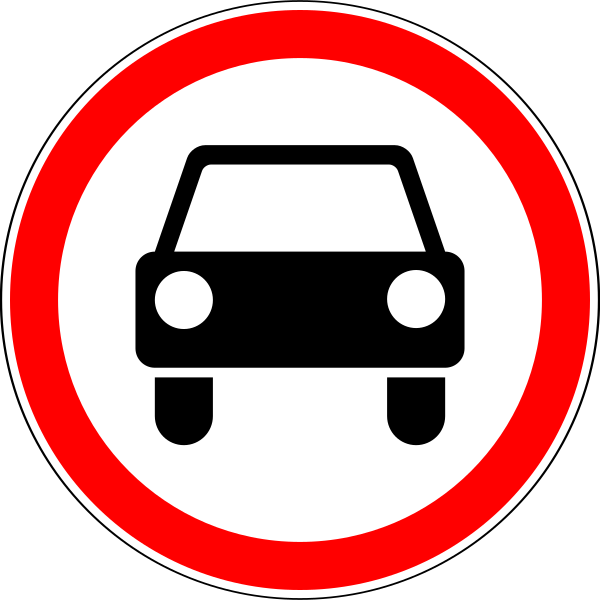
3.3. No motor vehicles

Prohibits the movement of all types of motor vehicles. The sign indicates that traffic is prohibited in both directions. The sign does not apply to route (public transport) vehicles. The sign does not apply to vehicles serving an enterprise located in the designated zone, or serving or belonging to persons who live or work in that zone. In such cases the vehicle must enter and leave the zone at the intersection nearest to its destination. The sign does not apply to vehicles driven by a person with a significant or severe disability status, or to vehicles carrying such persons.
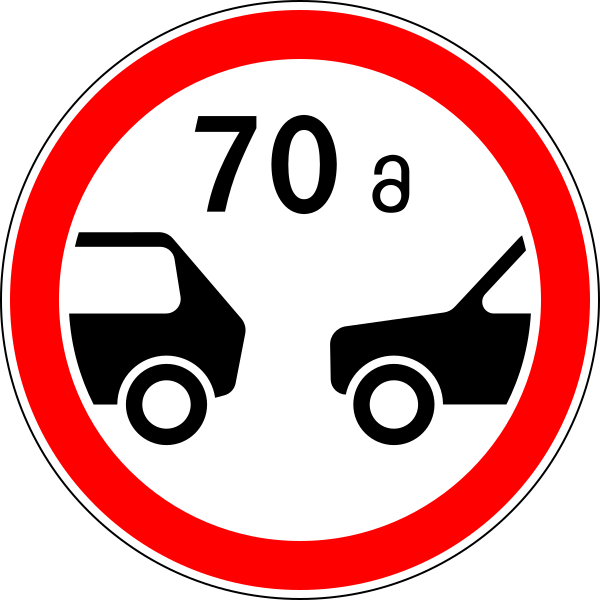
3.16. Minimum distance limit

Prohibits vehicles from travelling at a distance between them shorter than that shown on the sign. The sign applies from the place where it is installed to the nearest intersection behind it, and in a built-up area with no intersection – to the end of the built-up area. The sign's effect is also not interrupted at exits from adjacent areas or at intersections (junctions) with field, forest and other minor roads before which no corresponding sign is installed.
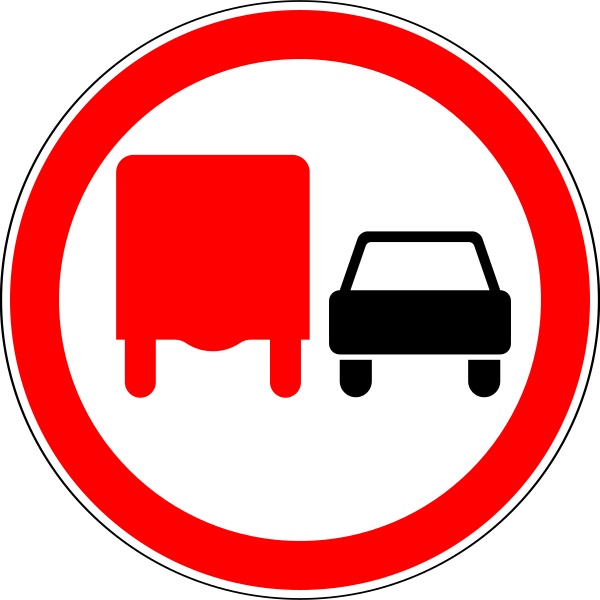
3.22. No overtaking by trucks

Prohibits trucks with a maximum permitted mass of more than 3.5 tonnes from overtaking other vehicles (except vehicles moving at less than 30 km/h), and prohibits tractors from overtaking other vehicles (except horse-drawn vehicles and bicycles). The sign applies from the place where it is installed to the nearest intersection behind it, and in a built-up area with no intersection – to the end of the built-up area. The sign's effect is also not interrupted at exits from adjacent areas or at intersections (junctions) with field, forest and other minor roads before which no corresponding sign is installed.

"Overtaking" means:

1 the movement of vehicles in lanes for traffic in the same direction faster than vehicles moving in lanes located closer to the edge of the carriageway
2 passing one or more vehicles moving ahead in the same direction in the same lane, by leaving the occupied lane
3 passing one or more vehicles moving in the opposite direction in the adjacent traffic lane
Law explanation
According to paragraph 10 of Article 5 of the Law of Georgia “On Road Traffic”, overtaking - passing one or more vehicles moving ahead in the same lane in the same direction by leaving the occupied lane.

An "intersection" is:

1 intersections of roads with exits from adjacent areas
2 an at-grade crossing, junction or fork of roads, including the areas formed by such a crossing, junction or fork
3 a crossing of carriageways located at different levels
Law explanation
According to paragraph 13 of Article 5 of the Law of Georgia “On Road Traffic”, junction - a crossing, joining or branching of roads at the same level, including the areas formed by such crossing, joining or branching. Intersections of exits from adjacent areas with roads are not considered junctions.

In the case of a fracture of the pelvis and femur of a person injured in a road traffic accident, until the "emergency medical service" arrives, he/she should:

1 Lay the casualty on their back, place a tightly rolled pad or clothing under the knees, and give a painkiller
2 lay them on the uninjured side, put a cold compress on the injured area and give a painkiller
Law explanation
In the case of a fracture of the pelvis or the femur, before the ambulance arrives the injured person should be laid on their back, a tightly rolled pad or clothing should be placed under their knees, and they should be given a painkiller.

Which of the following can cause a rear-end collision with a vehicle?

1 any of the circumstances listed in this ticket
2 Only sudden and sharp braking of the vehicle ahead
3 Only an inadequately maintained distance from the vehicle ahead
4 only the driver's inattention
Law explanation
According to paragraph 11 of Article 33 of the Law of Georgia “On Road Traffic”, the driver of a vehicle following another vehicle must keep an appropriate distance in order to avoid a collision if the vehicle in front suddenly brakes or stops. To ensure traffic safety, it is also necessary to keep a lateral clearance. According to subparagraph “m” of paragraph 10 of Article 25 of the same Law, when overtaking, an emergency situation most often arises due to failure to keep a safe distance and insufficient attention to vehicles travelling in the opposite direction.

A "traffic lane" is:

1 any of the longitudinal strips into which the carriageway may be divided, whether or not marked by longitudinal road markings, but which has sufficient width for the movement in one row of motor vehicles other than motorcycles
2 a structurally separated road element dividing adjacent carriageways
3 The entire surface of a road or street open to traffic
Law explanation
According to Article 5(45) of the Law of Georgia "On Road Traffic", a "lane" is any of the longitudinal strips, marked or unmarked by longitudinal road markings, into which the carriageway may be divided, and which is wide enough for motor vehicles other than motorcycles to move in single file.

Symptoms of injuries to the cervical vertebrae without damage to the spinal cord of a person injured in a road traffic accident are:

1 The injured person cannot move their upper limbs and has difficulty breathing
2 the injured person has pain in the neck and back area which increases when touched
Law explanation
Symptoms of injuries to the cervical vertebrae without damage to the spinal cord in a person injured in a road traffic accident are pain in the neck and back area. The pain increases when touched by hand.

If a person injured in a road traffic accident has an injury to the neck or spine, or there is a suspicion of such an injury, it is not allowed to:

1 Only setting the injured person's bone fragments and removing foreign bodies
2 only touching the injured person's wound
3 Only moving the injured person's head and neck
4 both moving the injured person's head and neck, and touching their wound, setting bone fragments and removing foreign bodies
Law explanation
In the case of a neck or spine injury of a person injured in a road traffic accident, or if such an injury is suspected, it is not permitted to: - move the victim's head and neck; - touch the wound; - set bone fragments; - remove foreign bodies.

"Limited visibility" is:

1 Driving through a tunnel, during the hours of darkness, and when road visibility is reduced to less than 300 metres due to fog, rain, snow or other natural phenomena
2 a circumstance in which a sharp bend, the end of an ascent, vegetation, a roadside structure or an obstacle on the road reduces the visibility of the road in the direction of travel to such an extent that driving at the maximum permitted speed on that road section may create a danger
Law explanation
According to paragraph 89 of Article 5 of the Law of Georgia “On Road Traffic”, “restricted visibility” - a circumstance in which a sharp bend, the end of an upward slope, greenery, a roadside structure or an obstacle on the road reduces the visibility of the road in the direction of travel to such an extent that travelling at the maximum permitted speed on that section of road may create a danger.

Giving sound and light signals to other road users during road traffic:

1 grants priority
2 does not give priority
3 does not give priority only over emergency service vehicles
4 gives priority over the specific road user in respect of whom the said sound and light signals are used
Law explanation
According to Article 48(4) of the Law of Georgia "On Road Traffic", giving sound and light signals does not give the driver priority over other road users.

Switching on the direction indicator of the corresponding direction before starting a manoeuvre:

1 does not grant priority and does not release from the obligation to take the necessary precautions
2 does not grant priority only with respect to emergency service vehicles
3 grants priority
Law explanation
According to paragraph 2 of Article 32 of the Law of Georgia “On Road Traffic”, a signal with the direction indicator or by hand must be given in good time, before the start of the manoeuvre, and must stop immediately after it is completed (a hand signal may stop immediately before the start of the manoeuvre). At the same time, the signal must not mislead other road users. Giving a signal with the direction indicator or by hand does not give the driver priority and does not release them from the obligation to take the necessary precautions.

In daylight hours in a built-up area, to warn another driver of the intention to overtake, the following may be used:

1 briefly switching the headlights on and off at intervals
2 Sound signal
3 hazard warning lights
4 repeatedly switching the headlights from dipped beam to main beam
Law explanation
According to Article 48(3) of the Law of Georgia "On Road Traffic", to warn the driver of another vehicle of the intention to overtake, a light signal may be given in a built-up area: in daylight by briefly switching the headlights on and off periodically, and during the hours of darkness by repeatedly switching from dipped beam to main beam; and outside a built-up area – instead of or together with an audible signal.

At night, in a built-up area, to warn another driver of the intention to overtake, the following may be used:

1 Sound signal
2 briefly switching the headlights on and off at intervals
3 hazard warning lights
4 repeatedly switching the headlights from dipped beam to main beam
Law explanation
According to Article 48(3) of the Law of Georgia "On Road Traffic", to warn the driver of another vehicle of the intention to overtake, a light signal may be given in a built-up area: in daylight by briefly switching the headlights on and off periodically, and during the hours of darkness by repeatedly switching from dipped beam to main beam; and outside a built-up area – instead of or together with an audible signal.

In which of the places listed below is the driver not obliged to switch on the direction indicator of the corresponding direction before starting a manoeuvre?

1 Is obliged at any of the places listed in this ticket
2 in a residential zone
3 in a courtyard area
4 in the adjacent area
Law explanation
According to Article 32(2) of the Law of Georgia "On Road Traffic", before starting a manoeuvre the driver must switch on the direction indicator for the corresponding direction, and if there is none or it is out of order, signal by hand.

Outside built-up areas, on a two-way road on which there is no dividing strip or pavement, a person pushing a motorcycle by hand must, in order to move, occupy:

1 the right side of the carriageway
2 the left side of the carriageway
3 any traffic lane
Law explanation
According to paragraph 5 of Article 24 of the Law of Georgia “On Road Traffic”, outside built-up areas, on a two-way road that has no dividing strip and no pavement, a pedestrian must use the shoulder located on the side facing oncoming traffic, and if there is none or it cannot be used − the left side of the carriageway, and move against the direction of traffic (except when, in the given situation, it is safer to move on the right side of the carriageway in the direction of traffic), but a person pushing a bicycle, moped or motorcycle, as well as a person with disabilities moving in a wheelchair, must use the right side of the carriageway to move.

Outside built-up areas, on a two-way road on which there is no dividing strip or pavement, a person pushing a bicycle or moped by hand must, in order to move, occupy:

1 the left side of the carriageway
2 any traffic lane
3 the right side of the carriageway
Law explanation
According to paragraph 5 of Article 24 of the Law of Georgia “On Road Traffic”, outside built-up areas, on a two-way road that has no dividing strip and no pavement, a pedestrian must use the shoulder located on the side facing oncoming traffic, and if there is none or it cannot be used − the left side of the carriageway, and move against the direction of traffic (except when, in the given situation, it is safer to move on the right side of the carriageway in the direction of traffic), but a person pushing a bicycle, moped or motorcycle, as well as a person with disabilities moving in a wheelchair, must use the right side of the carriageway to move.

The direction of traffic on all roads of Georgia is established:

1 On both the left and the right side
2 on the right-hand side
3 on the left side
Law explanation
According to paragraph 1 of Article 31 of the Law of Georgia “On Road Traffic”, right-hand traffic is established as the direction of traffic on all roads of Georgia.

In the absence of the corresponding road signs and markings, the number of lanes for the movement of trackless vehicles is determined:

1 By the driver themselves, taking into account the width of the carriageway, the dimensions of the vehicles and the necessary lateral interval between them
2 By the law according to which such a road is considered a one-way road
3 by the local self-government body
Law explanation
According to Article 31(3) of the Law of Georgia "On Road Traffic", the number of lanes for the movement of trackless vehicles is determined by road markings and/or road signs 5.15.1, 5.15.2, 5.15.7 and 5.15.8, and in their absence by the driver himself, taking into account the width of the carriageway, the dimensions of the vehicles and the necessary interval between them.

Unless otherwise provided by the traffic arrangements, on a road with two or three carriageways the driver of a vehicle is prohibited from:

1 changing lanes on the carriageway of the same-direction side of traffic
2 Driving onto the side of the carriageway intended for oncoming traffic
Law explanation
According to Article 31(6) of the Law of Georgia "On Road Traffic", unless otherwise provided by the traffic arrangements, on a road with two or three carriageways the driver of a vehicle is prohibited from entering the carriageway on the side intended for traffic in the opposite direction.
Practical part

Exam routes — exactly the way the examiner drives them

60 real exam routes across 10 cities, 793 km in total. Every turn and stop on the map, with voice guidance.

  • All routes on the map
  • GPS mode on the real road
  • Practice mode with adjustable speed
  • On the web and in the app

One-off payment, no auto-renewal — by card on the Bank of Georgia secure page.

Chat with us